
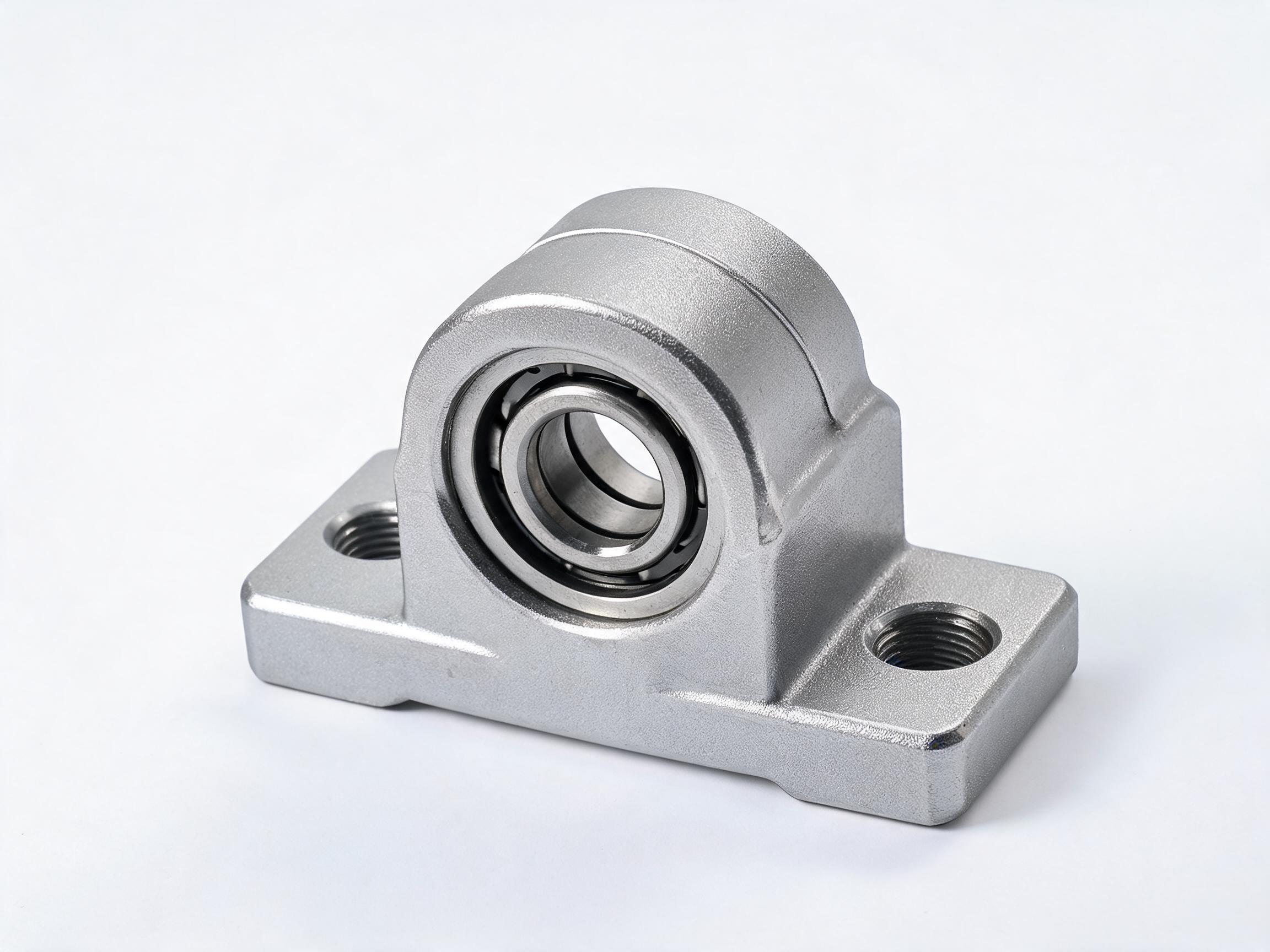
Packaging lines punish guide components in specific ways: near-continuous cycling, changeover downtime, product debris, wipe-down or wash-down routines, and slight shaft misalignment across long multi-support shafts. This article maps each of those demands to the bearing options that answer it, using the KH pillow block unit, LMUU sealed bearings and MGN stainless miniature guides as reference points.
Bearing selection guide
Packaging machines are rarely bought on their top speed. They are bought on how many shifts they run without stopping, and how quickly a line can be brought back after a changeover or a bearing failure. The linear bearing is a small part of that equation, but it sits in the places that decide both: the sealing jaw carriage, the film feed axis, the pusher, the flap folder, the label applicator. Choosing a linear bearing for a packaging machine means matching the component to those stresses rather than picking the cheapest unit that fits the shaft.
Below, the demands are set out one at a time, and each is answered with the option that actually addresses it.
- Near-continuous cycling puts service life and replacement speed ahead of peak load rating.
- A tool-free retaining cap shortens bearing swaps during changeover; the KH unit uses one.
- Dust and product debris are best answered with double-lip seals and a labyrinth groove, not with tighter clearances alone.
- Wash-down or wipe-down routines call for stainless housings and sealed bearings, not standard open types.
- Self-alignment of ±3° on the KH unit absorbs the small errors that appear on long multi-support shafts.
What this article covers
Demand 1: near-continuous cycling
A packaging line may run close to continuously through a shift, with the carriage cycling back and forth the whole time. That regime changes the selection question. A bearing that is rated generously for a static load but wears its sleeve and balls under constant reciprocation will still be the one that stops the line.
The relevant property here is the bearing's own construction margin. The LMUU sealed extended-length bearing uses an extended sleeve carrying 40% more balls than a standard LM bearing of the same bore. For the LM16UU size specifically, the listed dynamic load is 1,580 N and the static load 2,450 N. More balls sharing the load spreads contact and is the mechanism the manufacturer points to when describing the longer running life of the extended design.
These figures describe the bearing, not the machine. Whether they are sufficient for a given carriage depends on the actual load, stroke, duty cycle and support layout of that axis; confirm the numbers against the datasheet or supplier for the specific size being considered.
Demand 2: fast bearing swaps during changeover
Changeover is the window when maintenance work is cheapest to perform, because the line is already stopped for format changes. A bearing replacement that needs a press is a job that gets deferred, and a deferred job becomes an unplanned stop later.
This is the design point of the KH series pillow block linear bearing housing unit. The unit is a cast aluminum ADC12 housing, anodized, with a two-bolt base. A sealed LM..UU bearing is pre-installed, and the retaining cap allows bearing replacement without tools in under five minutes according to the manufacturer. The housing itself bolts on directly, without press-fit tooling; the manufacturer's figure for this is roughly 80% less assembly time compared with press-fit housings.
For load sizing, use the complete-unit figure, not the bearing's own rating: the KH16 unit is rated 980 N dynamic with an LM16UU bearing installed — lower than the 1,580 N rating of the LM16UU bearing on its own, because the rating that governs the assembly includes the housing and its mounting.
| KH series data (as stated by manufacturer) | Value |
|---|---|
| Housing | Cast aluminum ADC12, anodized |
| Base | 2-bolt |
| Shaft diameters | 8–50 mm (KH 8–50, ten sizes) |
| Dynamic load at KH16 (complete unit) | 980 N (LM16UU bearing installed; the bearing alone is rated 1,580 N) |
| Self-alignment | ±3° |
| Bearing replacement | Tool-free via retaining cap, under 5 minutes |
| Operating temperature | -20 to +80 °C with NBR seals (complete unit) |
| Reference standard | JIS B 1185 KH |
The service-life consequence of the swap-friendly design is illustrated in the manufacturer's own case data: 8,000 KH20 units were supplied to a Japanese packaging machinery OEM, and the average bearing replacement interval on those machines was 2.5 years, against 8 months with the press-fit design they had used previously. That is a record from one OEM's machines, not a general expectation — the interval on another line will follow its own duty cycle.
Demand 3: dust and product debris
Whether the product is flour, sugar, powder sachets, carton dust from board creasing, or film fragments from a sealing station, airborne particles settle on guide shafts. Once a particle is drawn into the ball track, the raceway degrades and the bearing gets noisy, then tight, then replaced.
Sealing construction decides how much gets in. The LMUU bearing uses double-lip NBR seals together with a labyrinth groove; the manufacturer states this reduces dust ingress by about 95% compared with open-type LM bearings. The two mechanisms are complementary: the labyrinth changes the path that particles must follow, and the double lip provides a contact barrier close to the ball track.
Seals are a wear item in their own right. The LMUU's NBR seals are rated -30 to +110 °C, while the KH unit as a complete assembly is rated -20 to +80 °C with NBR seals; where a nearby sealing jaw or heat tunnel raises the local temperature beyond the relevant figure, an FKM seal option is available on the LMUU. Confirm the seal material against the actual measured temperature at the bearing position, not just the line setpoint.
Demand 4: wash-down and wipe-down hygiene
Food, beverage and pharmaceutical packaging lines differ in how aggressive their cleaning is. Some are wiped down with damp cloths at each shift; others see low-pressure wash-down with cleaning agents. In both cases the enemy of an aluminum housing is corrosion at the mounting surfaces and around the retaining cap, and the enemy of the bearing is water carried past the seal.
Two product routes answer this:
- Stainless 304 housing variant of the KH unit, offered for food-grade and wash-down applications. The bearing inside remains a sealed LM..UU, so the sealing logic discussed above still applies.
- MGN stainless miniature guide in 9Cr18Mo stainless as standard, for compact wipe-down axes where space does not allow a pillow block. Typical positions are small pushers, diverter fingers and light-duty adjustments.
Neither route is a claim that the machine is hygienically certified. Housing material and seal grade must be checked against the cleaning chemicals, concentration and temperature that the site actually uses, and against the machine builder's own sanitary design requirements; confirm with the datasheet or supplier.
Demand 5: shaft misalignment on long multi-support shafts
A shaft spanning several supports along the length of a packaging machine is rarely perfectly straight in service. Support heights vary slightly, frames deflect, and long shafts sag between supports. A rigid housing forces that error into the bearing, loading the ball track at the ends of the stroke.
The KH pillow block unit is self-aligning to ±3°. That range is intended to absorb the small support-height and parallelism errors that accumulate across a long shaft run, so the bearing does not carry a bending moment it was not designed for. It is not a substitute for correct shaft alignment at installation, and the alignment tolerance of the machine's own frame drawing still governs.
Where a compact rail axis sits between supports over a short distance, the MGN stainless miniature guide is the alternative — the rail itself carries the straightness rather than a shaft.
Summary: demand-to-option mapping
| Line demand | Design property that answers it | Option |
|---|---|---|
| Near-continuous cycling | Extended sleeve, 40% more balls; LM16UU bearing 1,580 N dynamic / 2,450 N static | LMUU sealed extended-length bearing |
| Fast swaps at changeover | Retaining cap, tool-free replacement under 5 minutes; bolt-on, no press-fit; complete-unit rating 980 N at KH16 | KH series pillow block unit |
| Dust and product debris | Double-lip NBR seals plus labyrinth groove, about 95% less ingress vs open type | LMUU sealed bearing (fits standard LM housings) |
| Wash-down / wipe-down | Stainless 304 housing; 9Cr18Mo stainless rail | KH stainless variant / MGN miniature guide |
| Shaft misalignment | Self-alignment ±3° | KH series pillow block unit |
On many lines the sensible specification combines two of these. A KH pillow block handles the alignment and the swap time on a long sealing-jaw shaft, while the bearing inside it — or the LMUU unit fitted to an existing housing — carries the sealing and the cyclic life. Because the LMUU drops into standard LM housings, a builder can upgrade sealing and ball count on an existing carriage design without changing the mounting drawing.
What to put in a specification request
To get a comparable answer from a supplier, state the following per axis: shaft diameter and total supported length; the number and spacing of supports; the carriage load and its direction; the stroke; the cycle pattern (continuous reciprocation or intermittent indexing); the ambient and local temperature at the bearing; the cleaning regime and any chemicals used; and, for food-facing axes, whether a stainless housing is required. A supplier can then answer against a real condition rather than a general description.
Load ratings, temperature ranges and replacement intervals quoted here are the manufacturer's own published or case figures for the named products. They must be checked against the datasheet or supplier for the specific size, seal option and duty cycle of your application.
Buyer questions
Can a sealed LMUU bearing replace an open LM bearing in an existing housing?
Yes — the LMUU is built to the standard LM envelope and drops into standard LM housings. The external dimensions and the housing bore are unchanged; what changes is the seal construction and the extended sleeve with 40% more balls. Check the load rating of the specific size against your existing duty cycle before swapping, since the dynamic rating for a given bore is a fixed published figure.
Is the KH unit's 5-minute bearing replacement realistic on a production line?
The under-5-minute figure is the manufacturer's stated time for releasing the retaining cap and replacing the bearing without tools. The realistic line figure adds the access time, the guarding removal and any realignment that the carriage design requires. The design advantage is that no press is needed on the shop floor, so the work can be done by line maintenance rather than in a machine shop.
Which seal should be used for a heat-sealing station?
NBR seals on the LMUU are rated -30 to +110 °C; the KH pillow block unit with NBR seals is rated -20 to +80 °C as a complete unit. Where the bearing position sits close enough to the sealing jaw or heat tunnel that the local temperature exceeds the relevant figure, the FKM option on the LMUU is the appropriate route. The temperature to compare is the one measured at the bearing, not the jaw setpoint.
Does a stainless housing make a machine wash-down rated?
No. The 304 stainless housing variant removes the corrosion concern on the housing itself, and the sealed bearing limits water ingress at the ball track, but the rating of a machine for wash-down depends on the whole design — drain paths, motor and sensor protection, frame material and cleaning agents. Treat the stainless KH housing as one correct component choice within that wider design, and confirm the chemical and temperature compatibility with the supplier.