
Cold rooms and freezer warehouses change what linear motion components have to survive: thicker grease, stiffer seals, condensation on carbon steel, and fits that tighten as the shaft cools. This guide explains those effects and compares two bearing types — sealed LMUU bushings and stainless MGN miniature guides — with a pre-order checklist for automation builders.
Cold room and freezer automation
A cold storage warehouse is a building where a defined temperature band is held for stored goods — chilled rooms, typically, or freezer rooms held well below zero. For anyone building the conveyors, shuttle units, and pick-and-place axes that work inside those rooms, the practical question is narrower: which linear motion components still move correctly after weeks at low ambient, and which ones stiffen, seize, or rust first.
Low temperature changes four things at once — lubricant viscosity, seal flexibility, condensation behavior, and the fit between a steel shaft and a steel housing. The component choice follows from those four, not from a general preference for "cold-rated" parts.
What this guide covers
- How cold changes lubrication and regrease intervals
- Oil seals and the temperature limit that matters
- Condensation and corrosion on carbon steel raceways
- Thermal contraction and fit
- Two relevant bearing types, compared
- Pre-order checklist
What low temperature changes for linear motion
Grease viscosity and regrease intervals
Grease behaves like a temperature-dependent fluid. As ambient drops, base oil viscosity rises and the grease stiffens, so the film that separates rolling elements from raceway becomes harder to establish. The effect is not a step change at one temperature; it builds as the room gets colder, and it shows up first as higher breakaway force on an axis that was easy to move at room temperature.
The practical consequences are an increase in drive torque, a change in how the bearing feels at low speed, and shorter effective lubrication life. Cold storage rooms that cycle — defrost cycles, door openings, loading shifts — add a second problem: repeated warm-up and cool-down pushes grease to migrate and eventually to channel away from the ball path. Regrease intervals in a freezer room are therefore shorter than the same axis would need in a dry, room-temperature cell, and the interval has to be set for the coldest condition the bearing actually sees, not the average.
Which grease is right for a given room temperature is a supplier question. Bearing makers publish grease grades against temperature bands, and the correct choice depends on the real minimum ambient, the duty cycle, and whether washdown chemicals are present. Confirm it with the bearing supplier rather than assuming any one grade covers every freezer installation.
Oil seals and their temperature limits
Seals are the second constraint. A seal has to stay flexible enough to follow the shaft or rail and still exclude moisture and dust. Elastomers stiffen at low temperature, and at some point a seal loses contact or takes a permanent set. That is why the seal material's rated band — not the bearing body's — often sets the cold limit of the whole assembly.
NBR (nitrile) is the common choice for general industrial seals and is rated from roughly −30 °C to +110 °C. That range covers many chilled and freezer applications. Where a room runs below the rated cold end of the seal, the seal is the part to reconsider first, and material selection moves to the supplier discussion.
Condensation, humidity swings, and carbon steel
Cold storage is not only cold; it is cold and often humid, and humidity swings hard between rooms. Air moving from a warm packing area into a cold room carries moisture that condenses on any surface below the dew point. In a freezer, that film freezes. Over many cycles, condensation on unprotected carbon steel — including GCr15 chrome steel raceways and shafts — is a corrosion path, and corrosion pits in a raceway degrade rolling contact long before the bearing wears out from load.
Two design responses follow. The first is sealing: keep the moisture out of the ball path rather than drying it afterwards. The second is material: for the parts most exposed to condensation — small guides, rails in washdown or high-humidity zones — a martensitic stainless steel such as 9Cr18Mo avoids the rust question at the source.
Thermal contraction and fit
Steel contracts as it cools. A shaft that slides into a housing with a comfortable clearance at 20 °C can end up tighter in a −30 °C room, and the reverse is true for parts that were an interference fit when warm. The direction and size of that change depend on the materials and the dimensions, but the reasoning is standard: a fit is only defined at a temperature, and a cold room moves the assembly away from that reference.
For linear motion the practical points are shaft-to-housing fit, rail mounting flatness across a long rail in a cold room, and whether preload set at assembly is still acceptable at the cold end. Where a design is sensitive to a few tens of microns, run the numbers for the cold condition rather than assuming the room-temperature fit is representative.
Component guidance for cold rooms
Sealed bushings with NBR seals and stainless guides
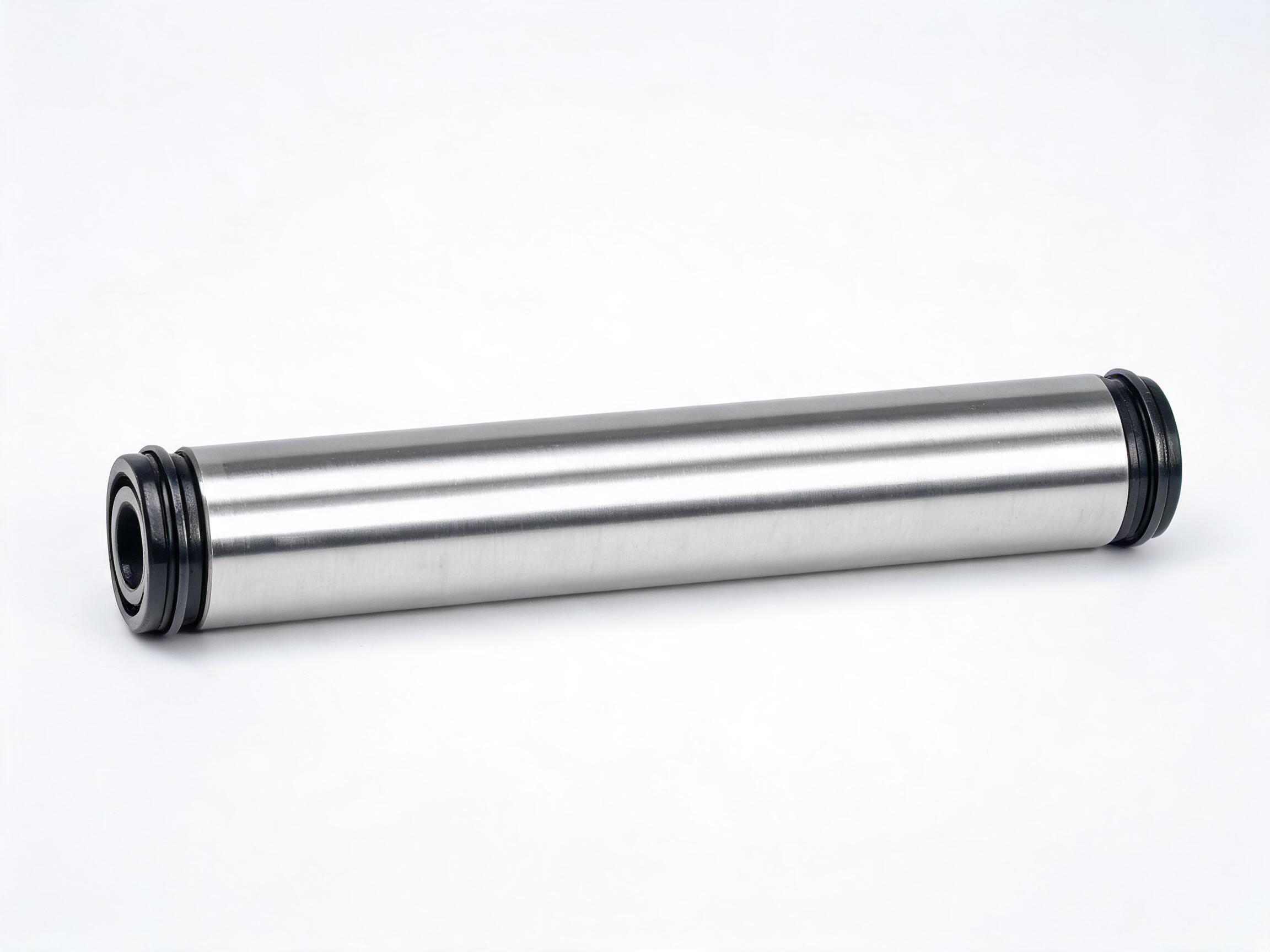
For long-stroke, high-load axes in chilled and freezer rooms, a sealed extended-length bushing is a workable starting point. The LMUU series sealed extended-length linear bearing combines double-lip NBR rubber seals with a labyrinth groove. The NBR seals are rated −30 °C to +110 °C, which is a useful reference point when matching the seal to the room's minimum ambient. The body is GCr15 chrome steel, so the raceway is carbon steel and the seal is doing the corrosion work; the extended sleeve carries 40% more balls than a standard-length bushing, which spreads load over more rolling elements.
For an LM16UU size, dynamic load rating is 1,580 N and static load rating is 2,450 N. Those are catalog ratings under standard conditions — a cold room with stiffened grease does not raise them, and the drive sizing should account for higher breakaway torque at the cold end.
Stainless miniature guides for exposed axes
Where the axis is small, exposed, or sits in a high-humidity zone that swings between rooms, a stainless guide removes the condensation problem from the rail and block. The MGN series stainless steel miniature linear guide uses 9Cr18Mo martensitic stainless steel as standard, with stainless balls and retainer, at HRC 54–58 hardness. Sizes cover MGN 9, 12, and 15, with C and H carriage options.
For MGN12C, dynamic load rating is 3.7 kN and static load rating is 5.4 kN, with a friction coefficient of 0.002–0.004. That low friction coefficient is measured under standard conditions; in a cold room the effective friction depends on the grease state, which is why lubricant selection and regrease planning matter as much as the rail material.
Comparing the two for a cold application
| Attribute | LMUU sealed bushing | MGN stainless guide |
|---|---|---|
| Seal / protection | Double-lip NBR rubber seals + labyrinth groove | Stainless construction; sealing depends on configured options |
| Seal temperature range | NBR: −30 °C to +110 °C | Not specified in the same terms |
| Body material | GCr15 chrome steel | 9Cr18Mo martensitic stainless steel, HRC 54–58 |
| Rolling elements | Extended sleeve with 40% more balls | Stainless balls and retainer |
| Load rating (reference size) | LM16UU: 1,580 N dynamic / 2,450 N static | MGN12C: 3.7 kN dynamic / 5.4 kN static |
| Friction coefficient | Not specified | 0.002–0.004 |
| Sizes covered | Shaft diameter sizes including LM16UU | MGN 9 / 12 / 15, C and H carriages |
| Best fit in a cold room | Long-stroke, higher-load axes where the seal does the moisture work | Small, exposed axes where condensation on carbon steel is the main risk |
Pre-order checklist
Before specifying bearings for a cold room or freezer warehouse, collect these four inputs. They decide more than the load rating does.
- Minimum ambient temperature. The coldest temperature the bearing will see, including defrost and door-open events — not the setpoint. Compare it against the seal's rated cold end (−30 °C for NBR) and against the grease's rated band.
- Humidity swings between rooms. Whether the axis crosses between a warm packing area and a cold room, and how often. This sets the condensation risk and favors sealing or stainless construction.
- Washdown frequency. Whether the equipment is cleaned with water or chemicals, and how often. Washdown raises both moisture exposure and the demand on seal material.
- Duty cycle. Continuous operation at cold ambient and repeated warm/cool cycling both shorten regrease intervals, so plan the interval from the coldest condition, not the average.
The one item that needs supplier confirmation: exact grease selection. Grease performance at low temperature is specific to the grade and the real operating condition. Give the bearing supplier your minimum ambient, duty cycle, and washdown details, and let them confirm the grade — then set the regrease interval from that answer.
Frequently asked questions
Can standard linear bearings be used in a freezer?
They can be, if the seal material and grease are matched to the real minimum ambient. The failure mode to watch is not sudden seizure but progressive: stiffened grease raises breakaway torque, and moisture that reaches the raceway causes corrosion. Sealed construction and correct lubrication address both.
Is stainless always necessary in cold storage?
No. Stainless is the direct answer where condensation on carbon steel is the dominant risk — small exposed guides, or axes in high-humidity zones. In a sealed, low-humidity chilled room, a sealed GCr15 bushing with a suitable grease can be appropriate. Match the material to the moisture exposure, not to the temperature alone.
What does thermal contraction change?
Housing and shaft fits, rail mounting flatness over long runs, and the preload that was set at assembly temperature. Where the design is sensitive to small dimensional changes, check the fit at the cold condition rather than at 20 °C.
Choosing for the room, not the catalog
Linear bearings for cold storage are selected by four conditions: minimum ambient, humidity swing, washdown, and duty cycle. Seal material sets the cold limit, grease sets the running behavior, and material choice answers the condensation question. Work through the checklist, confirm the grease with the supplier for the actual room temperature, and then size the drive for the cold-end torque rather than the catalog value.