
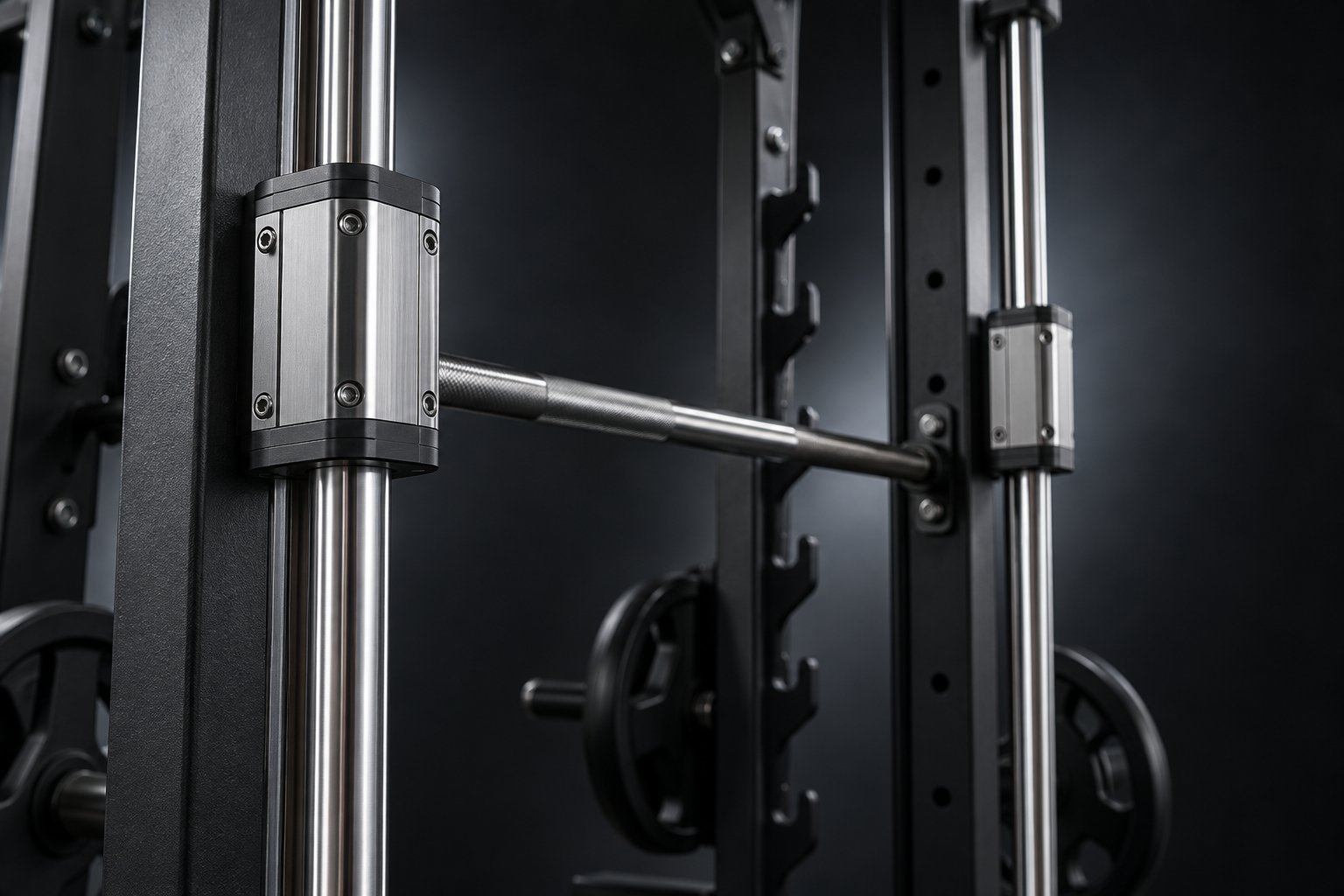
A sourcing guide for fitness-equipment buyers and manufacturers on how linear bearings work in Smith machines, why they fail in gym environments, and which specifications to verify with a supplier before ordering.
A Smith machine's bar path is only as smooth as the bearings carrying it. For buyers and equipment manufacturers, this guide explains why the category relies on linear bearings running on hardened rails, how those bearings fail in real gym conditions, and which points to verify with a supplier before placing an order.
- Smith machines use linear bearings on hardened shafts or guideways because the bar must travel on a fixed vertical path under load, with low friction and a light push-off force.
- Most field failures are contamination failures: dust, chalk, and sweat reach the rolling elements long before a bearing reaches its nominal life.
- Rail hardness, bore-to-shaft clearance, seal type, and batch consistency matter more than bearing catalog load ratings in this application.
- Sealed, extended-length bearings handle gym contamination better than open types; NBR double-lip seals are commonly rated for roughly -30 to +110 °C working temperatures.
- Ask suppliers for hardness and material verification, seal material, and a consistent batch across every station on the machine.
Why Smith Machines Use Linear Bearings Instead of Bushings
A Smith machine constrains the barbell to a fixed track: the user pushes the bar up and down, and the frame absorbs horizontal loads and torque. The bearing must let the carriage glide along a vertical steel shaft or guideway with very little input force, then hold that line when the bar is loaded unevenly — one plate heavier, one hand higher, one hook catching at an angle.
Linear bearings are chosen for a specific combination of properties:
- Low breakaway force. Recirculating ball bearings convert sliding friction into rolling friction, so the bar starts moving with light pressure even under load. That keeps the movement feeling close to free-weight training.
- Rigid line under side load. A bearing supported along its full length resists tilting better than a short bushing, keeping the bar path straight when the load is offset.
- Wear behavior on hardened steel. When the shaft is hardened and ground, rolling contact wears slowly and predictably compared with plain bearing surfaces.
The consequence for sourcing is that the bearing is only half the system. The shaft or guideway it runs on, and the housing that holds it, decide whether the assembly actually feels smooth in the gym.
Hardened Rails: Why Shaft Matching Decides Bearing Life
Linear bearings are designed to run on shafts in a defined hardness and tolerance band. If the rail is soft, it deforms under the ball contacts and the raceway develops indentations; the bar then moves in steps rather than gliding. If the rail diameter or roundness drifts, clearance changes and either the carriage rocks or the bearing preloads and drags.
Typical specifications buyers should confirm for the shaft or guideway:
| Property | What to verify | Why it matters in a Smith machine |
|---|---|---|
| Surface hardness | Hardened and ground shaft, commonly specified in the 58–62 HRC range, with material verification such as SGS documentation where the supplier offers it | Soft rails indent under ball contact and produce a notchy, uneven glide |
| Diameter and tolerance | Matched nominal bore-to-shaft fit; ask for the tolerance class rather than assuming h6 or g6 | Too loose causes rocking and noise; too tight raises push force and heat |
| Straightness and roundness | Measured straightness over the full rail length, not a sample section | Bent or oval rail makes the carriage bind at one end of the travel |
| Mounting and support | Support spacing along the rail; how the bearing housing is aligned to the frame | Unsupported spans flex under load and change alignment during the rep |
A supplier who only quotes a bearing part number without asking about the shaft is quoting half a solution. For fitness equipment, the shaft and the bearing should be specified as a pair.
Failure Modes Buyers Actually See in the Field
Noise and roughness
The most common complaint is a grinding or rattling sound that develops after weeks or months of use. It usually traces to contaminant particles in the ball track, or to a rail that has picked up surface damage from a seized or misaligned bearing. By the time noise appears, the damage is often already in the rail as well as the bearing.
Jamming and uneven glide
Jamming shows up as a bar that sticks at a particular height, or that needs noticeably more force in one direction. Causes include inadequate clearance, a bent or misaligned rail, or a bearing housing that is not parallel to its partner on the same carriage. In a two-rail design, one binding bearing is enough to make the whole carriage feel stiff.
Dust, chalk, and sweat contamination
Gyms are an abrasive environment. Magnesium chalk, floor dust, and sweat aerosol settle on exposed rails. Open linear bearings have no barrier, so these particles enter the ball circuit and act as lapping compound, accelerating wear. This is the single most predictable failure mode in fitness equipment, and it is addressed by bearing selection rather than by maintenance alone.
Corrosion on rails and housings
Sweat and cleaning agents leave salts on steel surfaces. Where the application calls for it, food-grade stainless variants and documented FDA compliance for the bearing components are one route suppliers use for higher corrosion resistance; buyers should confirm which specific parts carry that compliance for their model rather than assuming it applies to the whole assembly.
Sealing: The Specification That Decides Gym Life
For Smith machines, the choice between sealed and open bearings is more consequential than small differences in dynamic load rating. Sealed bearings use lip seals at each end to wipe the shaft as the carriage moves, keeping contaminants out of the ball circuit and retaining lubricant.
- Open bearings suit clean, enclosed automation environments with separate rail covers or bellows.
- Sealed bearings are the appropriate default where the rail is exposed to users and air, which describes most Smith machines.
- Extended-length sealed types with double-lip NBR seals provide a longer sealing path and two contact lips; NBR is commonly rated for working temperatures of about -30 to +110 °C. The extra length also increases the bearing's resistance to tilting under offset load.
Two practical questions follow. First, does the seal actually contact the shaft along its full travel, including at the ends of the stroke where the carriage parks? Second, is the seal material compatible with the cleaning chemicals the end user will apply? NBR covers a wide temperature band, but aggressive solvents still degrade it over time.
Load, Consistency, and Multi-Station Machines
Buyers often ask for a load figure and stop there. In a Smith machine the more useful questions are about consistency and margin.
- Static versus dynamic rating. Equipment frames see impact when a lifter racks the bar hard. The bearing's static capacity, and the housing that supports it, determine whether that impact dents the raceway.
- Four bearings on two rails. A typical Smith carriage has multiple bearings; they must share load evenly. If one bearing carries more because of alignment error, it fails first and the glide degrades across the whole machine.
- Batch consistency. A gym order may need dozens of identical bearings across a production run. Bore, outer diameter, and preload must stay within a narrow band from unit to unit, or assembly alignment becomes a manual correction step on the line. Ask how the supplier controls batch-to-batch variation and whether they will hold dimensions across a repeat order.
- Warranty terms. A stated warranty period — for example, 24 months on the bearing — is only meaningful alongside the conditions it covers. Ask what the supplier defines as a defect versus wear under contaminated service.
Sourcing Checklist for Fitness-Equipment Buyers
Use these points in an RFQ or during supplier qualification:
- Rail hardness range and the verification document the supplier can provide — for example, SGS material verification stating 58–62 HRC.
- Nominal bore-to-shaft fit and the tolerance class of both bearing and rail, stated numerically.
- Bearing type: open, sealed, or sealed extended-length, with seal material and its temperature range.
- Whether the sealing arrangement wipes the full stroke length of the rail.
- Static and dynamic load ratings for the exact bearing offered, not the series maximum.
- Batch consistency data: how bore, outer diameter, and running clearance are controlled across a production run.
- Corrosion protection for rails and housings, and which specific components carry any food-grade or stainless rating the supplier cites.
- Quality system documentation — for example, ISO 9001:2015 — and product-level compliance such as CE where applicable to the destination market.
- Warranty length and its scope, plus spare-part availability for the expected service life of the machine.
- OEM/ODM capability if the bearing must fit an existing housing or carry a private label.
Suppliers who serve both fitness-equipment and automation buyers generally understand this split well: automation customers ask about precision classes and lubrication intervals, while gym-equipment customers ask about contamination, push force, and repeatability across a large order. A supplier who can answer both sets of questions is easier to work with when a machine design changes.
Frequently Asked Questions
What is a linear bearing in a Smith machine?
It is a recirculating rolling-element bearing that lets the barbell carriage travel along a fixed, hardened steel shaft or guideway. The rolling elements reduce friction so the bar moves with light push force while staying on a straight vertical path.
Are sealed bearings necessary for gym equipment?
Where the rail is exposed to users, chalk, dust, and sweat, sealed bearings are the practical choice. They keep contaminants out of the ball circuit and retain lubricant. Open bearings suit enclosed, clean automation applications with separate rail protection.
How hard should the rail be?
Rails are typically hardened and ground. A commonly specified band is 58–62 HRC, with material verification available from the supplier. The specific requirement should be confirmed against the bearing's design and the loads of the machine.
Why does a Smith machine bar feel notchy after a few months?
Notchiness usually indicates rail surface damage or contamination in the ball track rather than a sudden bearing defect. Inspect the rail for indentations and the seal for wear, and check that both bearings on the carriage are aligned and sharing load.
What should be specified alongside the bearing part number?
The rail diameter and tolerance class, rail hardness, support spacing, seal type and material, static and dynamic load ratings, and the acceptable batch variation. Specifying the bearing alone leaves the most common failure modes unaddressed.
When requesting a quote for linear bearings for gym equipment, include the rail diameter and material, stroke length, expected maximum load, whether the rail is exposed, the number of bearings per machine, and your annual or per-order quantity. These details let a supplier recommend a sealed or open configuration and confirm whether a sealed extended-length bearing suits the application.