
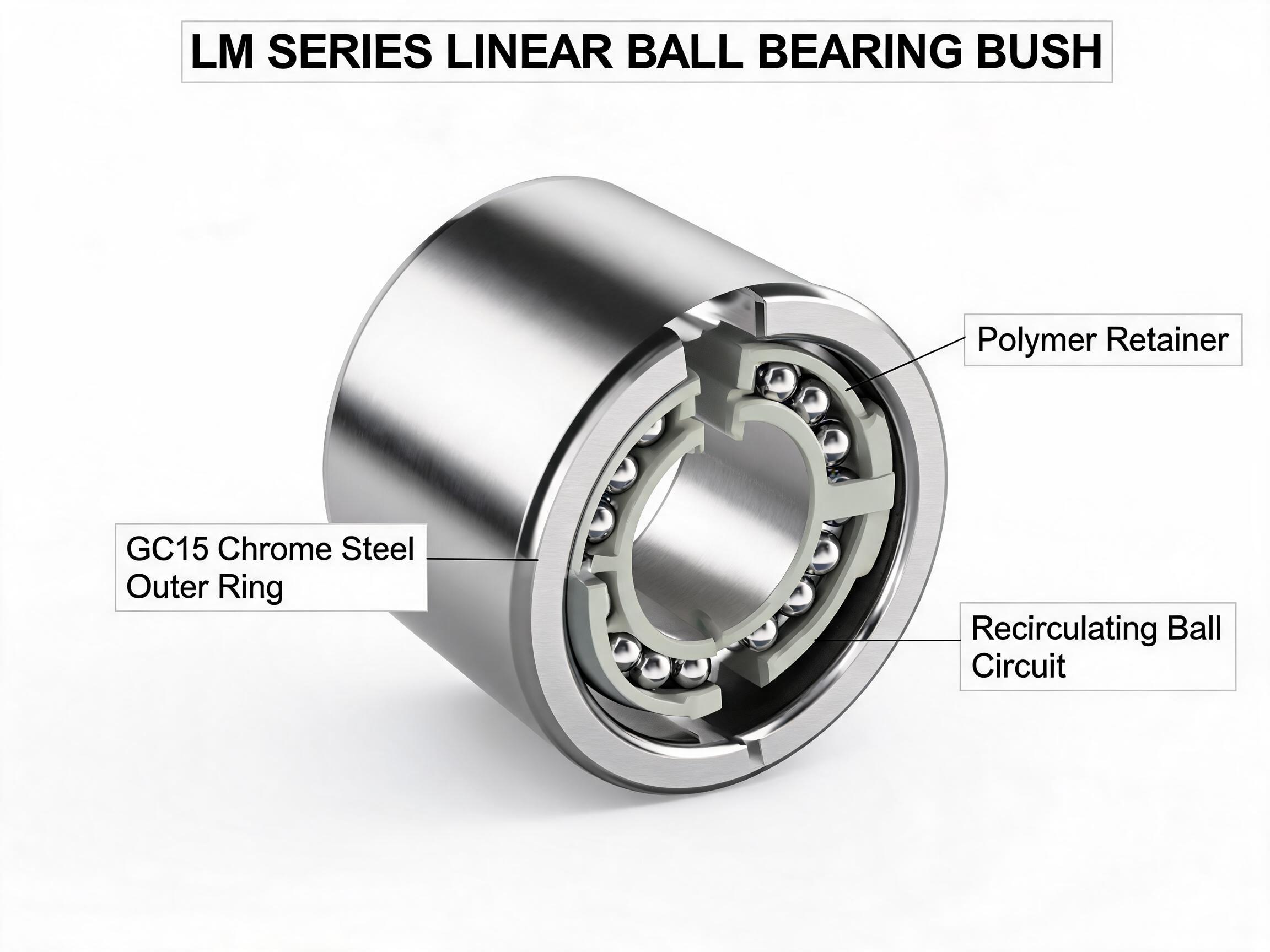
Wood dust destroys ball bushings fast. This article explains why recirculating ball bearings clog in CNC woodworking, how self-lubricating plain bushings tolerate dust, and what to check before specifying a linear motion system for a dusty shop.
If you run a CNC router, a panel saw, or any woodworking machine with linear guides, you have probably seen it: a ball bushing that moved smoothly for weeks starts to drag, then chatters, then locks up. The dust you are cutting is the cause, and the failure often has less to do with bearing quality than with how the bearing handles contamination.
This article explains why recirculating ball bushings clog in wood dust, how self-lubricating plain bushings tolerate the same environment, and what to check before specifying a linear motion system for a dusty shop floor.
Key Takeaways
- Wood dust is abrasive and tends to pack, not drain — a ball bushing's recirculation path is the first thing to suffer.
- Seals help, but standard wiper seals are not a substitute for dust-tolerant bearing design.
- Self-lubricating plain bushings use a sliding contact, no rolling elements to jam, and often survive where ball bushings fail.
- The right choice depends on load, speed, rigidity requirements, and how much dust your process actually produces.
- Lubrication and maintenance intervals are the real differentiators in wood dust, not just bearing type.
Why Wood Dust Is a Different Kind of Contaminant
Wood dust is not just dirt. It has properties that make it especially hard on linear bearings:
- Abrasive. Silica and other minerals in wood, plus the cutting edge debris from tooling, create hard particles that wear steel surfaces.
- Moisture-absorbing. Dust absorbs humidity and can become sticky, forming a paste that clings to shafts and seals.
- Variable in size. Fine sanding dust penetrates small gaps; chips from routing can be large enough to block return channels.
- Resinous. Some species leave resin on surfaces, which traps dust and increases friction.
In a typical woodworking CNC, the linear bearing is exposed to this mix continuously. Unlike metal machining, where chips are often heavier and fall away, wood dust tends to float and settle on every surface, including the bearing raceways.
How Ball Bushings Work — and Why They Clog
A recirculating ball bushing uses rows of steel balls that roll between the shaft and the bearing housing. The balls circulate through return channels inside the bearing. This design gives low friction and high rigidity, but it depends on those channels staying clear. Our LM series linear ball bearing bush is a typical example of this recirculating design, with hardened GCr15 (HRC 60–64) outer rings interchangeable under JIS B 1185 / ISO 10285.
When wood dust reaches the ball circuit, several things happen:
- Dust enters the bearing past the seals or through the gap between shaft and housing.
- Particles mix with lubricant and form a paste that accumulates in the return channels.
- The balls can no longer circulate freely; they skid instead of roll.
- Friction and heat rise; the bearing may seize or damage the shaft.
Once a ball bushing is contaminated, cleaning is rarely a permanent fix. The internal clearances and ball tracks are designed for clean operation; abrasive particles that have already embedded in the lubricant will continue to wear the surfaces. In practice, a badly clogged ball bushing is usually replaced, not repaired.
What Sealed Linear Bearings Can and Cannot Do
Sealed linear bearings add wiper seals or lip seals to keep dust out. These help, and in light-dust applications they can extend service life significantly. But a seal is a wear item: it degrades, and once it loses contact with the shaft, dust bypasses it. Seals also cannot remove particles that are already inside the bearing. For heavy dust, a sealed ball bushing buys time, not immunity.
How Self-Lubricating Plain Bushings Handle Dust
Self-lubricating plain bushings use a sliding contact between the shaft and a liner or bushing material. There are no rolling elements, no recirculation channels, and no ball return path to clog. The bearing surface is typically a composite or polymer that transfers a thin film of lubricant to the shaft as it moves. For dusty woodworking axes, a PTFE-impregnated bronze bushing such as our SC series self-lubricating plain bearing bush is a representative choice: it tolerates dust and shock loads and runs across −50 to +200 °C without external lubrication.
In wood dust, this design has several practical advantages:
- No recirculation path. There is no internal circuit for dust to block.
- Scraping action. The sliding contact tends to push debris aside rather than trap it.
- No grease to trap dust. Many self-lubricating bushings run dry or with minimal lubrication, so there is less sticky media to hold particles.
- Tolerant of edge loading. Plain bushings handle some misalignment better than ball bushings, which can bind if the shaft is not perfectly parallel.
The trade-off is friction and stiffness. Plain bushings generally have higher friction than ball bushings and lower load capacity for the same envelope. For many woodworking axes — especially those that move at moderate speed and do not require extreme rigidity — this is an acceptable compromise.
Ball Bushing vs Plain Bushing: A Side-by-Side Comparison
| Factor | Recirculating Ball Bushing | Self-Lubricating Plain Bushing |
|---|---|---|
| Contamination tolerance | Low — dust clogs ball return channels | High — no internal circuit to block |
| Friction | Very low | Higher, but predictable |
| Load capacity | High for size | Moderate |
| Rigidity | High | Lower; some compliance |
| Lubrication | Requires grease or oil; attracts dust | Often self-lubricating or minimal |
| Maintenance in dust | Frequent cleaning; early replacement | Low; wipe shaft as needed |
| Typical failure mode | Seizure, clogging, shaft wear | Gradual wear of liner |
| Best for | Clean, high-precision, high-load axes | Dusty, moderate-load, moderate-speed axes |
When Ball Bushings Still Make Sense in Woodworking
Ball bushings are not obsolete in woodworking. They remain a good choice when:
- The axis runs in a protected area, with bellows or covers that keep most dust away.
- High rigidity is required, such as on a heavy gantry or a precision positioning axis.
- Speeds are high and friction must be minimized.
- The machine is maintained on a strict schedule, with regular cleaning and re-lubrication.
If any of these conditions is missing — especially if the bearing is exposed and maintenance is irregular — a plain bushing is often the more reliable choice, even if it costs a little friction.
What to Check Before Specifying Linear Bearings for Wood Dust
When selecting a linear motion system for a dusty woodworking application, work through these questions:
- What is the actual dust exposure? Is the bearing inside an enclosure, behind bellows, or open to the cutting area? The answer changes the specification.
- What is the load and duty cycle? Heavy, continuous loads favor ball bushings if they can be protected. Intermittent, moderate loads are fine for plain bushings.
- What speed and acceleration are required? Plain bushings have speed limits; check the manufacturer's PV (pressure-velocity) rating.
- How rigid must the axis be? If deflection affects cut quality, ball bushings or a profiled rail system may be necessary.
- What maintenance is realistic? A design that needs daily greasing will not get it in a busy shop. Match the bearing to the maintenance culture.
- What shaft material and finish? Plain bushings are sensitive to shaft hardness and surface roughness; hardened, ground shafts are typical.
- Are seals or wipers available? Even plain bushings benefit from a wiper to keep large chips off the shaft.
Note: The right answer is application-specific. A bearing that works well on a nested-based router may fail on a tenoner, and vice versa. Confirm load, speed, and environment with the machine builder or bearing supplier before committing.
Maintenance Practices That Extend Bearing Life in Wood Dust
Regardless of bearing type, these practices reduce dust-related failures:
- Wipe shafts daily. A clean shaft is the single most effective way to keep dust out of any bearing.
- Check seals and wipers. Replace them at the first sign of wear; a worn seal is an open door.
- Use the right lubricant. For ball bushings, a grease that resists dust pickup is better than a light oil. For plain bushings, follow the manufacturer's recommendation — often no lubricant at all.
- Inspect for smooth motion. Any roughness or binding is an early warning; address it before the bearing seizes.
- Keep the area under the machine clean. Dust that accumulates on the floor becomes airborne again with every axis move.
FAQ
Can I use a sealed ball bushing in a woodworking CNC?
Yes, if the dust level is moderate and the seals are maintained. In heavy dust, seals delay contamination but do not prevent it. A plain bushing is often more reliable in those conditions.
Do self-lubricating bushings need any lubrication?
Most are designed to run dry or with a thin initial lubricant film. Adding grease can attract dust and defeat the purpose. Check the specific bushing's instructions.
Will a plain bushing wear out my shaft?
A plain bushing with a proper liner is designed to wear preferentially, protecting the shaft. However, if dust embeds in the liner, it can act as an abrasive. Keeping the shaft clean is critical.
How do I know if my ball bushing is clogged?
Symptoms include increased resistance, chattering, a grinding feel, and visible dust around the seals. If the bearing does not move smoothly by hand, it is likely contaminated.
Can I replace a ball bushing with a plain bushing on the same shaft?
Sometimes, but check the shaft hardness, tolerance, and surface finish. Plain bushings often require a different shaft specification than ball bushings. Also verify load and speed ratings.
Next Steps
If you are specifying linear motion for a woodworking machine, start by mapping the dust exposure and maintenance reality of each axis. Then compare bearing types against load, speed, and rigidity requirements. For dusty, moderately loaded axes, a self-lubricating plain bushing is often the more durable choice. For protected, high-precision axes, a sealed ball bushing can still perform well.
To discuss a specific application, contact our engineering team with your axis details: load, speed, stroke, environment, and maintenance schedule. We can help you select a bearing that matches the real conditions of your shop.