
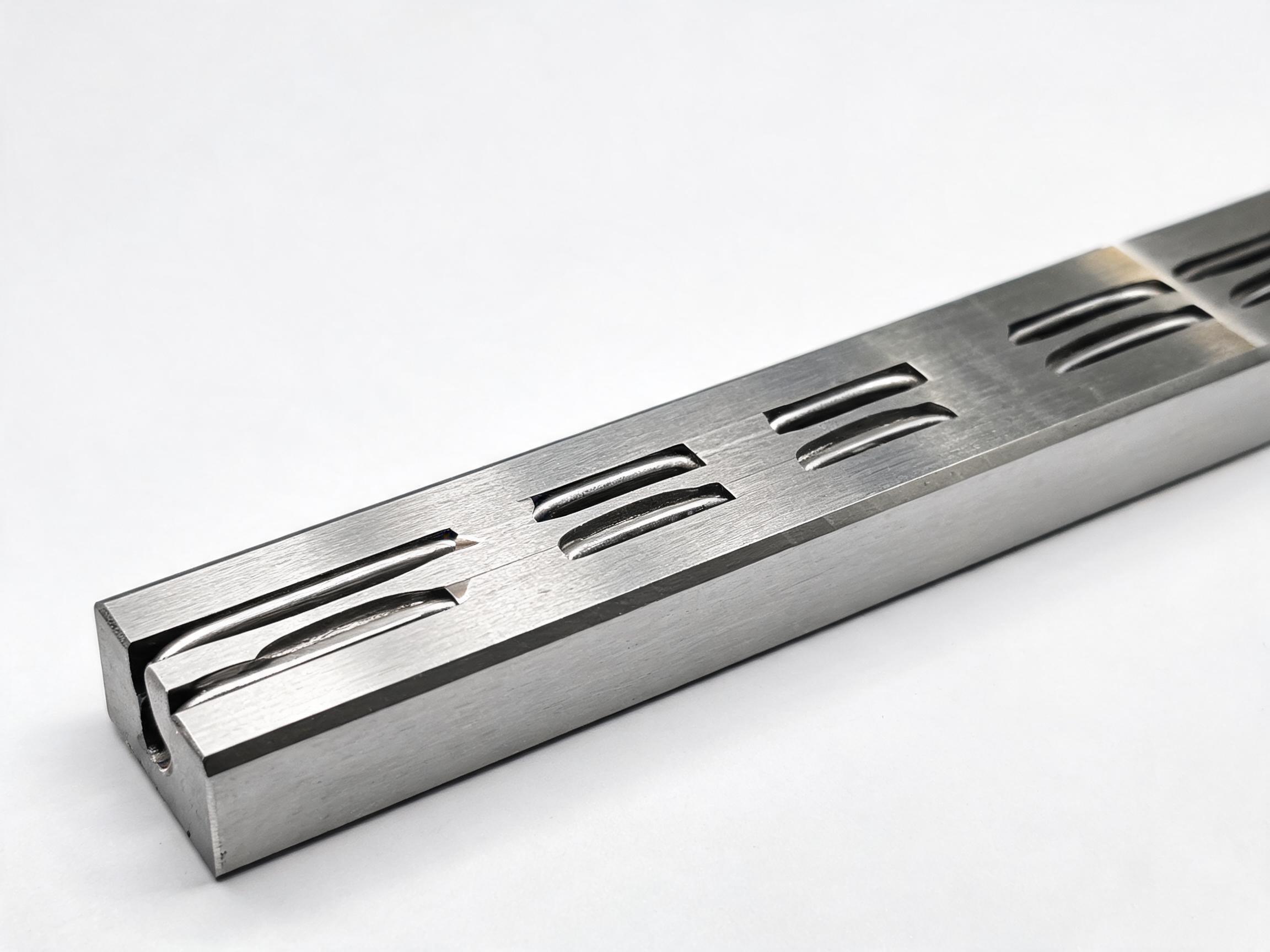
A complete linear guide assembly is more than a rail and a carriage. This article breaks down every part that ships with an HGR/HGH or SBS16 assembly, explains which dimensions and grades must match before installation, compares pre-assembled slide units against component kits, and gives a readiness checklist you can run before the first bolt goes in.
Linear Guide Assembly: What Ships Together and What Fits
A linear guide assembly is not a rail plus a carriage. It is a set of parts whose size, height, preload and mounting pattern only work together when they match. This article explains what is inside a complete assembly and which dimensions you must verify before the first bolt is tightened.
Key points before you read further
- A complete assembly normally includes the rail section(s), the carriage(s), two sealing elements, the lubrication interface, and the mounting hardware.
- The size number is shared between rail and carriage; a mismatch here is a hard stop, not an adjustment.
- If a rail is longer than the standard 4000 mm maximum, check that the precision splice joint is held to the same grade across the joint.
- Pre-assembled slide units and component kits are two different supply forms; each has its own verification step on receipt.
What a complete assembly actually contains
The word “assembly” hides a list. Before you compare quotations from two suppliers, itemise the list, because a quotation for a rail alone is not comparable with one for a rail with two carriages, seals and a lubrication connector.
Rail sections and precision grade
HGR series rails are supplied in two standard grades: ground H (P5) and rolled N (P7). The grade describes the rail and the carriage that mounts on it. Maximum standard length is 4000 mm. Longer rails are supplied as precision splice joints, with straightness held to the same grade across the splice. That detail matters because a splice that meets a lower tolerance quietly downgrades the whole run.
See the rail specification on the HGR series rail page.
Carriages: size, height code and preload
HGH carriages carry a height code of CA (standard) or HA (high), and a preload grade of C0 (clearance), C1 (light) or C2 (medium). HGW carriages offer dual lubrication ports: a top M6 grease nipple and a side oil port, plus four top-face bolts and two side bolts. The height code and preload grade belong on the purchase order, not on the packing list only.
Specifications for the flange-style carriage are on the HGH series carriage page.
End seals, side seals and lubrication interface
HGH carriages ship with an end seal and a side seal strip, rated IP40 equivalent. The carriage top face has a lubrication port that accepts either a standard grease nipple or a central lube line connector. If you plan a centralised lubrication system, the connector spec needs to be in the order; buying a generic nipple later rarely matches the port thread.
Mounting hardware
For an HGR45 rail, the mounting hardware is M12 bolts at 60 mm pitch. Hardware is sometimes quoted separately, sometimes bundled. Either way, verify the bolt size and pitch against the rail datasheet, because the pitch determines how you drill your base plate.
What must match before installation
Three matches are decisive. Everything else can be corrected on site from the data sheet; these cannot.
1. Rail and carriage size number
HGR is the rail family and HGH or HGW is the carriage family, but the number after the letters is the size. An HGR45 rail takes a 45-size carriage. The parts are not interchangeable across size numbers, and a wrong carriage cannot be made to work by adjusting preload or bolting pattern.
2. Preload grade consistency
If two carriages share a rail, both should be the same preload grade unless the machine has a specific reason for differing loads. Mixed C1 and C2 on the same rail means two different running characteristics from one drive, which complicates commissioning and receipts acceptance. State the preload grade for every carriage line item.
3. Grade consistency across spliced rails
For runs beyond the 4000 mm standard length, the splice joint must be held to the same grade across the joint. If you order a ground H rail in segments, confirm in writing that the joint does not drop to a rolled N tolerance. This is a packing and production line question, not a price line.
| Match | What must be equal | Where it goes wrong |
|---|---|---|
| Size number | Rail size number = carriage size number | Carriage ordered from a different series; bolts will not line up |
| Preload grade | Every carriage on one rail at the same C grade | Mixed C1/C2 lines on a multi-carriage axis |
| Splice grade | Same grade before and after the joint | Long rail supplied in segments without grade confirmation |
| Height code | CA or HA as specified, consistent across carriages | Height code changed to fit a base plate |
| Bolt pattern | M12 at 60 mm pitch (HGR45 example) | Base plate drilled to a different pitch |
Two supply forms: pre-assembled unit vs component kit
The same linear guide assembly can reach you in two very different states. The choice changes what you inspect on receipt and where assembly risk sits.
Pre-assembled slide units
SBS16 is a single-axis linear motion slide unit that ships pre-assembled: shaft, aluminium support rail and a low-profile carriage, already aligned. The system height is 18 mm and the mounting holes run every 25 mm. Because it arrives aligned, the buyer's first task is to check that the delivered length and hole spacing match the drawing, not to re-align the carriage. Details are on the SBS16 slide unit page.
Component kits assembled on site
An HGR rail with separate HGH carriages is a kit. You or your machine builder join the parts. Here the interface work is yours: you must confirm carriage preload, fit the seals, connect the lubrication port and align the carriage to the rail. The advantage is flexibility in carriage count and rail length; the cost is that the matching checks above become your responsibility, not the supplier's.
| Aspect | Pre-assembled unit (e.g. SBS16) | Component kit (rail + carriages) |
|---|---|---|
| Alignment | Supplied aligned | Aligned by the buyer |
| Matching checks | Confirm length and hole spacing | Confirm size, preload, height code, pitch |
| Lubrication | Fitted as supplied | Buyer connects nipple or lube line |
| Flexibility | Fixed configuration | Carriage count and rail length adjustable |
Completeness check before install
Run this list with the packing list in one hand and the datasheet in the other. Each item is a yes/no; a no is a phone call before the base plate is drilled.
- Rail length and segment count match the purchase order; for long runs, splice joints confirmed at the same grade.
- Every carriage has the correct size number (e.g. 45 rail, 45 carriage).
- Height code (CA or HA) recorded and consistent across all carriages.
- Preload grade (C0/C1/C2) recorded and consistent across all carriages.
- End seal and side seal strip present on every carriage.
- Lubrication port type matches your plan: standard grease nipple or central lube line connector.
- Mounting bolts match the rail pattern, e.g. M12 at 60 mm pitch for HGR45.
- For pre-assembled units, system height and mounting hole spacing match the drawing (18 mm and 25 mm for SBS16).
FAQ
Can I buy the rail and carriage separately and still get a matched assembly?
Yes, provided you order the rail and carriage with the same size number, height code and preload grade. The matching does not happen in the factory if the parts are bought as two line items; it happens on your purchase order. Confirm each field on the order before release.
If a rail is longer than 4000 mm, is it a single piece?
HGR rails have a standard maximum length of 4000 mm. Longer runs are supplied as precision splice joints. The straightness must be held to the same grade across the splice; ask the supplier to confirm that on the delivery documents.
Do I need to specify preload grade per carriage or per rail?
Specify per carriage line item, even if all carriages share a grade. If preload is omitted, the supplied grade is not the one you planned for. Mixed grades on one rail should be a deliberate engineering decision, not a default.
What is the difference between a pre-assembled slide unit and a component kit in terms of what I check?
With a pre-assembled unit such as SBS16, check length, system height, hole spacing and that the carriage is aligned as shipped. With a kit, check that every part matches the others and that you have the seals, lubrication connector and bolts before you begin assembly.
Specifications in this article are as listed for the Dongfeng Bearing HGR, HGH and SBS16 ranges. Custom configurations, preload options outside the listed grades, and lubrication connector threads should be confirmed against the datasheet for the exact model you order.