
A selection guide for CNC machine builders and retrofitters comparing C0 clearance, C1 light preload and C2 medium preload on HGH series linear guide carriages. Covers rigidity, running resistance, heat, seal drag, self-alignment, and order-time specification.
On a CNC machine, preload is one of the few linear guide specifications a buyer sets at order time and then lives with for the life of the axis. It is also one of the easiest to get wrong: too little preload and a heavy-cutting spindle head deflects under load; too much and the carriage drags, runs hot, consumes torque, and wears the ball circuit faster than the application requires. This article explains what carriage preload actually changes on an HGH profile rail system, how the C0, C1 and C2 grades differ, and how to match a grade to high-speed transfer, general machining, or heavy-cutting applications.
- Preload removes internal clearance and adds rigidity, but it also raises running resistance and heat.
- HGH carriages are available in three preload grades: C0 (clearance), C1 (light preload) and C2 (medium preload).
- The four-row ball circuit carries radial, reverse-radial and both lateral load directions, so preload acts in all of them.
- Self-aligning tolerance of ±0.5° absorbs minor rail misalignment without losing preload.
- Preload must be stated on the order; it is not something the machine builder can adjust after assembly.
In this article
What "linear guide preload" actually means
A linear guide carriage is assembled with a defined gap between the balls and the raceways. That gap is clearance. Preload is the amount of interference built in when the carriage is assembled: the balls are slightly larger than the nominal space between the rail and carriage raceways, so they are always in contact under a small elastic force.
The practical effect is that the carriage never has a moment where it is loose inside its own bearing. When you push a preloaded carriage, it behaves like a spring that is already partly compressed. External loads first have to overcome the preload before the carriage can deflect further. That is why preload is described as a rigidity setting, not just a fit setting.
Preload on an HGH carriage is factory-set during carriage assembly. It is not adjusted by the machine builder on site, and it is not the same thing as the mounting clearance between the carriage and the rail datum surfaces. If a machine builder needs a different grade, it has to be specified when the order is placed.
What preload changes at the carriage
Four effects move together. Buying more preload never buys only rigidity.
| Effect | Direction as preload increases | Why it matters on a machine |
|---|---|---|
| Internal clearance | Reduced to zero, then interference | A clearance-free carriage holds position without a dead band when the axis reverses. |
| Rigidity | Increases | Less deflection of the carriage under cutting or inertial load. |
| Running resistance | Increases | Higher drag torque, more motor current, more heat in the ball circuit. |
| Heat and seal drag | Both rise with speed and preload | Thermal growth changes axis geometry; seal drag adds to total resistance. |
On an HGH carriage the load is carried by a four-row ball circuit. That arrangement accepts radial, reverse-radial and both lateral directions. Because preload is applied across all four rows, it raises stiffness in every direction the carriage can be loaded, not only vertically. For a spindle head that sees side cutting forces, for example, lateral stiffness is often the limiting factor, and it is governed by the same preload setting as the vertical stiffness.
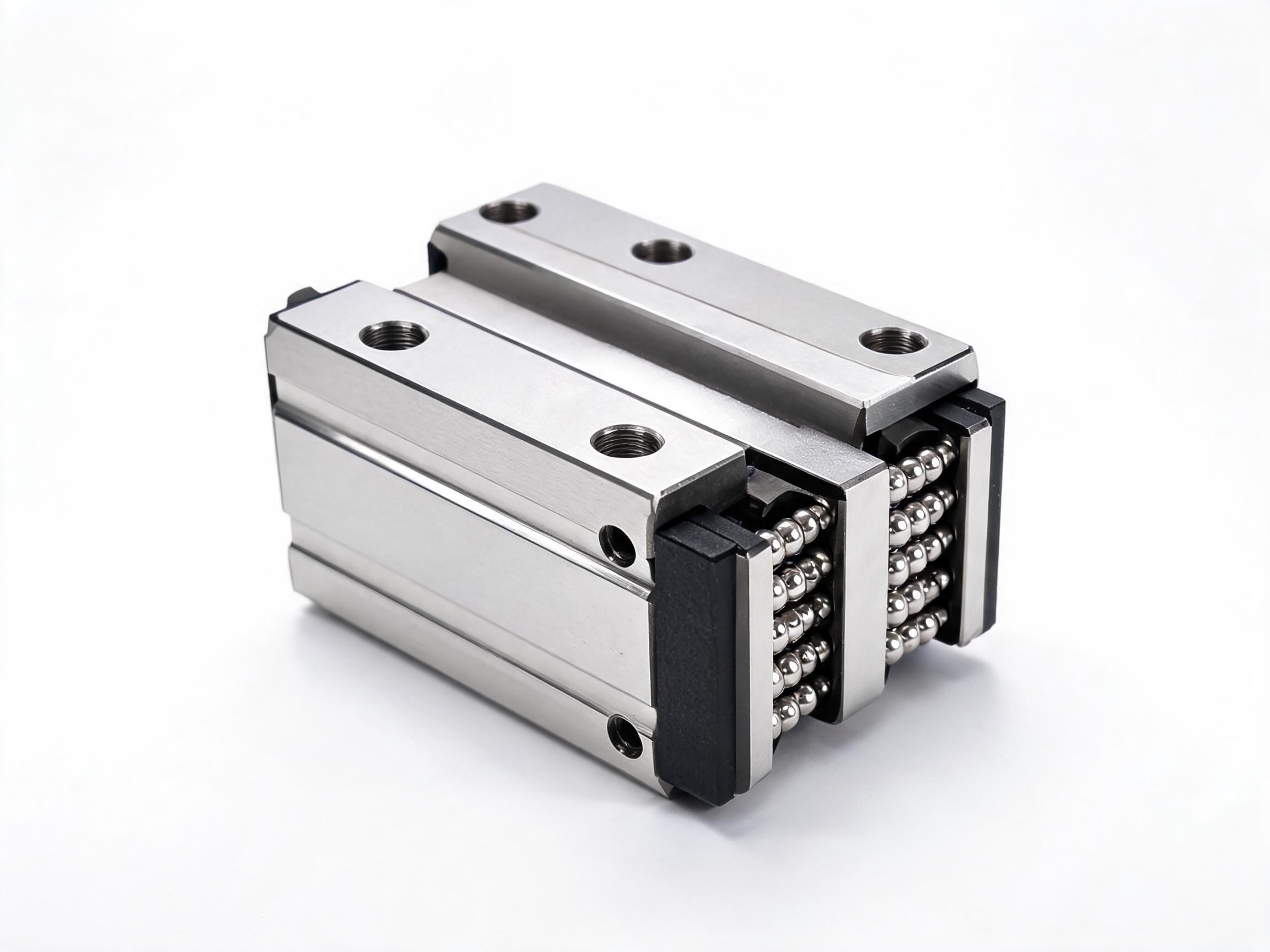
C0, C1 and C2 defined
The HGH product record defines three preload grades:
| Grade | Preload class | Condition inside the carriage |
|---|---|---|
| C0 | Clearance | No preload. A small internal clearance remains. |
| C1 | Light preload | Clearance removed; a light elastic interference holds the balls in contact. |
| C2 | Medium preload | Higher interference for greater rigidity under heavier load. |
Those are the only grades in the HGH range, and they are named exactly this way on the product record. When you write a purchase specification, use the same three designations so the order is unambiguous.
Matching preload grade to the axis
The right grade follows from what the axis has to do, not from the machine category as a whole. A gantry router can have a fast transfer axis and a very different Z-axis under the spindle. Grade the axis, not the machine.
High-speed transfer and light-load axes
Axes that move quickly with little cutting force — pick-and-place transfer, light gantry travel, measurement positioning — benefit from low running resistance. C0 clearance keeps drag and heat down and keeps motor sizing modest. On long, fast axes the trade-off is usually the right one, because there is little cutting load to deflect the carriage.
General CNC axes
For typical milling, drilling and general machining axes, C1 light preload is the common starting point. It removes the clearance that would otherwise show up as a small dead band during axis reversal, and it raises stiffness enough for normal cutting loads. It is the grade most general-purpose CNC builds sit on, and it is a reasonable default when an axis has mixed requirements.
Heavy-cutting spindle heads and high-rigidity axes
Where the carriage sits directly under a heavy-cutting spindle and deflection translates into surface error or chatter, C2 medium preload is the grade to consider. It gives the highest rigidity of the three grades in all four load directions, at the cost of higher running resistance and more heat. That cost is usually acceptable on an axis that spends its time cutting rather than rapid-traversing.
| Axis role | Typical choice | Main reason |
|---|---|---|
| High-speed transfer / positioning, light load | C0 clearance | Lowest running resistance and heat |
| General CNC cutting axis | C1 light preload | Clearance-free reversal plus moderate rigidity |
| Heavy-cutting spindle head, high-rigidity axis | C2 medium preload | Maximum rigidity under cutting load |
One size reference: the HGH20CA carriage block is rated 18.0 kN dynamic and 29.5 kN static in the HGH product record. Its preload grade is a separate specification from those ratings and has to be ordered separately. The full HGH range covers sizes HGH15 through HGH45, so a builder can match carriage size and preload independently across the machine.
Preload loss, rail misalignment and self-alignment
Preload is set at the carriage, but it can be undermined by the installation. If a rail is not aligned to its neighbor within tolerance, the carriage is forced to twist as it travels. That twist is an additional load, and it can use up part of the preload. The symptom is not always obvious: an axis that measured as tight at assembly can behave loosely after a period of running, or develop uneven drag along the travel.
Mounting base and rail straightness are therefore part of the preload decision, not a separate topic. The HGH carriage has a self-aligning tolerance of ±0.5°. Within that range it absorbs minor rail misalignment without a loss of preload. This does not replace careful rail mounting — it means minor, normal assembly variation is tolerated rather than transferred directly into the ball contact.
For heavy-duty rail applications, the HGR series heavy-duty linear guideway rail is the matching rail family for HGH carriages. Rail and carriage work as one system; preload is specified on the carriage, and the rail supplies the datum that the preload acts against.
Specifying preload at order time
Because preload is built into the carriage, it cannot be changed once the carriage is delivered. Four things are worth fixing in the purchase description:
- Grade: state C0, C1 or C2 explicitly. Do not leave it to "standard" if the axis requirement is known.
- Carriage model: the preload grade accompanies a specific block, such as the HGH20CA, and the two travel together on the order line.
- Rail family: confirm the rail that the carriage will run on, since preload acts against the rail raceway.
- Environment and speed: if the axis runs fast or in a dusty environment, note it. The HGH carriage uses an end seal plus a side seal strip for an IP40-equivalent sealing arrangement, and lubrication is NLGI 2 lithium grease with a re-grease reference every 100 km of travel or 3 months. High speed and higher preload both add heat, so the lubrication reference is relevant to the preload choice.
For retrofits, the existing carriage grade is not always visible from the outside. Where the original specification is unknown, the safer path is to identify the axis requirement first and select the grade accordingly, rather than copying an unverified number from a worn part.
FAQ
Can I use C2 preload on a high-speed transfer axis?
It is possible, but C2 raises running resistance and heat, and a fast axis with little cutting load gains little from the extra rigidity. C0 or C1 is usually the better match when speed and low drag are the main requirements.
Does self-alignment replace the need to align the rails carefully?
No. The ±0.5° self-aligning tolerance absorbs minor misalignment. It is not a substitute for mounting the rail within its specified straightness and base flatness.
Can preload be changed after the machine is assembled?
No. Preload is set when the carriage is built. A different grade requires a different carriage on the order.
Does preload affect lubrication intervals?
The product record gives a re-grease reference of every 100 km of travel or 3 months, using NLGI 2 lithium grease. Preload and speed both influence running heat, so keep to the reference interval and check the axis if drag or temperature changes.
Next step
If you are building or retrofitting a CNC axis, list each axis with its load type, speed and rigidity requirement, then assign C0, C1 or C2 per axis before the order is placed. HGH carriages are available from HGH15 to HGH45, with C0, C1 and C2 preload grades, and can be quoted together with matching HGR rails. Send the axis list and the carriage models you need, and confirm the preload grade for each line.