A warranty on linear guide rails and carriage blocks is a procurement risk tool, not a marketing line. This checklist covers the six clauses to get in writing before you place an order, how inspection documents support a claim, and why coverage duration varies by product line rather than being one fixed number.
Procurement Risk Management
Most buyers compare carriage block preload grades and rail hardness before ordering. Far fewer ask what happens if a shipment does not perform. Warranty terms on linear guide rails and bearings are part of the price you are actually paying, and they are usually negotiable only before the PO is issued.
Why Warranty Terms Matter More Than the Warranty Sentence
A supplier page that says "long warranty" tells you almost nothing. What matters is the structure behind that sentence: how long coverage runs, when the clock starts, what counts as a defect, who pays freight, and what evidence you must produce. Those five questions decide whether a warranty claim is a routine correction or a month of email.
One caution before you shop: warranty duration is not uniform across a product catalog. A supplier may state one period on a service page and a different period on individual product pages. That is not necessarily an error — different product lines can carry different coverage — but it means you cannot assume a single number applies to your order. The duration that governs your purchase is the one written into your quotation or contract, not the one on a landing page.
Rule one for buyers: treat warranty duration as a line item to be confirmed in writing per part number, not as a specification you read off a website.
Six Clauses to Confirm in Writing
These are the clauses that decide the outcome of a claim. Ask for each one in the quotation, and keep the answer with the order documents.
Duration and Start Date
Ask two separate questions: how many months, and counting from what event. Common start points are invoice date, shipment date, or date of receipt at your warehouse. The gap between these can be several weeks, which matters on a 12- or 18-month window. Also ask whether the period restarts on a replacement part or continues from the original purchase. On long projects with staged deliveries, confirm whether each delivery carries its own start date.
Defect Definition: Manufacturing Versus Everything Else
This is the clause most likely to be vague. Ask the supplier to state explicitly which conditions are covered. Manufacturing defects typically include dimensional non-conformance, incorrect hardness, wrong preload grade against the order, or raceway geometry outside the stated tolerance. Ask whether the definition is tied to a measurable criterion — for example, whether a rail that measures outside the specified 58–62 HRC band is covered, or whether preload that does not match the ordered C0/C1/C2 grade is treated as a defect.
Then ask the reverse question: which field conditions are excluded. Wear under normal service, improper installation, contamination from inadequate sealing, and overload are commonly outside coverage. If your application runs a self-aligning carriage at up to 0.5 degrees of misalignment compensation, confirm whether operation beyond that angle is treated as improper installation or as a defect. Get the answer before you mount the first block.
Claim Process and Response Time
Ask how a claim is submitted, who reviews it, and what response time the supplier commits to. Distinguish between the acknowledgment window ("we confirm receipt within X days") and the technical determination window ("we issue a finding within Y days"). Ask whether a failed part must be returned before a determination is made, and whether the supplier may request installation photos, operating parameters, or a sample of the failed unit. A supplier that answers these in specific terms is easier to work with than one that answers generally.
Replacement Logistics and Freight Responsibility
Establish who pays what. Ask whether a confirmed defect results in replacement parts, repair, or credit, and who covers outbound and return freight in each case. Ask how a replacement is prioritized against new orders — this is the difference between a claim that costs you a week and one that costs you a production line. For air or expedited shipment requests, confirm in advance whether the supplier absorbs the cost or invoices it.
Documentation Requirements
Ask what you must provide with a claim: order number, part number, batch or lot marking, quantity affected, installation date, operating conditions, and photographs. For machined parts, having the original inspection data on hand shortens the argument considerably. Request that the supplier confirm the lot identification method on the parts and packaging, so a claim can be tied to a specific production run.
Exclusions
Request the exclusion list in writing rather than inferring it. Typical exclusions include unauthorized disassembly, modification of the block or rail, use beyond rated load or speed, inadequate lubrication, and damage in transit where the carrier is responsible. Ask specifically about contamination: a standard LMUU double-lip NBR seal is rated for roughly -30 to +110 C, and coverage questions often turn on whether the operating environment stayed inside the seal's intended range and cleanliness level. If your application runs abrasive dust or metal chips, raise it at the quotation stage rather than at claim time.
| Clause | Question to put in writing |
|---|---|
| Duration and start | Months of coverage; start event; restart on replacement; per-delivery start on staged orders |
| Defect definition | Which non-conformances are covered; measurable criteria; treatment of misalignment and preload mismatch |
| Claim process | Submission route; acknowledgment window; technical determination window; return-before-determination rule |
| Replacement logistics | Replace, repair, or credit; outbound and return freight; priority against new orders |
| Documentation | Required evidence; lot marking method; installation and operating records |
| Exclusions | Wear, installation, contamination, overload, unauthorized modification; seal temperature and cleanliness limits |
How Inspection Documents Support a Claim
A warranty discussion is easier when both sides already hold the same measurements. Ask what inspection documentation accompanies the shipment. At Xiamen Dongfeng Bearing, each shipment includes CMM inspection reports, hardness test data, lead accuracy measurements, and material certificates. For a claim, these records establish what the part measured when it left the factory, which separates a manufacturing issue from a field condition.
This is where part-level documentation connects to the clauses above. If a rail is specified at 58–62 HRC and the accompanying hardness data shows a value inside that band, a claim based on wear is unlikely to be treated as a manufacturing defect. If the CMM report shows a dimension outside the drawing tolerance, that is a documented non-conformance and a much stronger basis. Either way, the buyer is not arguing from memory.
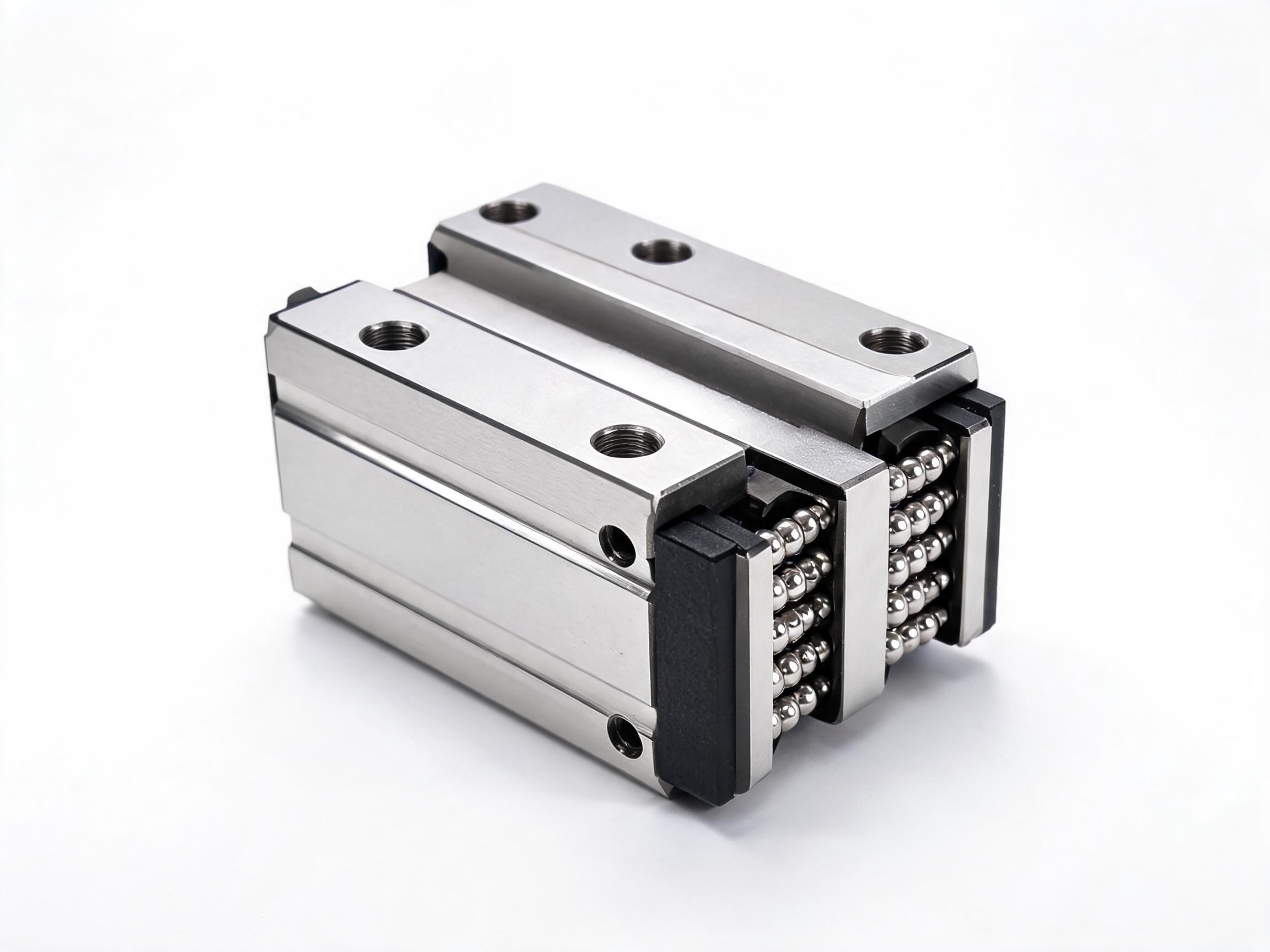
Ask for the documents in a usable format and confirm the lot or batch identifier that links them to the physical parts. Related components in a typical assembly include the HGH series flange-type carriage block, the HGR series heavy-duty guideway rail, and the LMUU series sealed extended-length linear bearing. When ordering a mixed assembly, confirm whether each part carries its own documentation and whether the warranty applies per component or per assembled set.
ISO 9001:2015 certification at the company level covers design, production, inspection, and after-sales. That tells you a documented quality system exists and is auditable. It does not, by itself, set the warranty terms of a specific order — those still come from your quotation and contract.
Questions Buyers Ask Most Often
What does a linear guide warranty cover?
Coverage varies by supplier and product line, but the usual dividing line is manufacturing defect versus field condition. Dimensional non-conformance, incorrect hardness, or a preload grade that does not match the order are commonly treated as defects. Wear under normal service, contamination, improper installation, and overload usually are not. Because the boundary is set per supplier, ask for the covered and excluded lists in writing and tie them to the specific part numbers you are ordering.
How long do guideways last?
Service life depends on load, speed, lubrication, sealing, and contamination rather than on a single figure that applies to every installation. The practical approach is to state your operating conditions — load per block, stroke, cycle rate, environment, and lubrication interval — and ask the supplier what maintenance interval and expected service range apply to that configuration. This is also the information you will need if a claim arises, so record it at commissioning.
Before You Place the Order
Put the six clauses into the quotation as written terms, per part number, and attach the inspection documentation requirement. Confirm the lot identification method so claims can be traced. Then file the warranty terms, inspection reports, and your own installation and operating records together — that file is what turns a claim from a negotiation into a verification.
If your project involves mixed rail and block assemblies, send the part numbers, quantities, and operating conditions and ask for warranty terms to be confirmed alongside the technical quotation.