An engineering explainer for buyers sizing fast or vertical axes: how carriage weight becomes part of the moving mass your motor must accelerate, why lighter miniature carriages matter on rapid moves, and how to read weight and load ratings together without trading away stiffness.
Technical explainer · Motion sizing
On a fast or vertically oriented axis, the carriage is not just a bearing sitting on a rail — it is mass that changes direction with every stroke. The motor has to accelerate it, decelerate it, and bring it to rest with enough stability that the end effector lands where the program says. When engineers ask about linear guide rail carriage weight, they are usually trying to close a gap in the sizing sheet: the rail is chosen, the load is known, but the block’s own weight has not yet been counted as part of the moving mass.
That gap matters because force scales with mass and acceleration. The physics is simple: F = m × a. A heavier carriage demands more drive force for the same motion profile — or an existing drive delivers less acceleration and settles more slowly. This article explains where carriage weight enters the calculation, why lighter miniature carriages suit fast axes, and how to read weight alongside dynamic and static load ratings instead of treating them as separate catalog columns.
Key takeaways
- Carriage weight is part of the moving mass; the acceleration force your drive must supply scales with it (F = m × a).
- Lighter miniature carriages change the balance on fast, low-payload axes, but they also carry lower load ratings — read both together.
- On vertical axes, the carriage weight also enters the gravity and holding-force picture, so it is not only an inertia question.
- Confirm weight and loads per size from the datasheet; only a few reference values are shown here to illustrate how to read them.
On this page
- Where carriage weight sits in the motion system
- Why lighter carriages matter on fast axes
- Vertical axes: weight is also a gravity term
- Reading weight and load data together
- What to confirm per size
Where carriage weight sits in the motion system
The moving mass of a linear axis includes the carriage or block, the fixture or bracket bolted to it, the workpiece or tool at the end, and whatever cabling and hardware travels with the slide. The carriage is one term in that sum. It is the term the bearing manufacturer specifies directly, which is why it is easy to isolate and easy to overlook.
When the drive and servo are selected, the moving-mass figure determines the force required for a commanded acceleration. If the carriage’s weight is left out, the drive is sized for a lighter assembly than what will actually run. Depending on how close the sizing is to the motor’s limit, the consequences show up differently: a drive that cannot hold the programmed acceleration, a tuning exercise that never quite settles, or an axis run with reduced acceleration to compensate. None of these is visible from the catalog page alone — they emerge when the full moving mass is used in the calculation.
This is also why a carriage should be judged by its own inertia contribution, not only by whether it “fits” the load. Two blocks with the same dynamic load rating can have different weights; the heavier one costs more drive force every time the axis changes direction.
Why lighter carriages matter on fast axes
On a rapid traverse or a high-cycle pick-and-place axis, the motion profile is dominated by acceleration and deceleration rather than by the static load. The carriage reverses direction many times per cycle, and each reversal is an acceleration event. Lower carriage mass reduces the force needed for each event, which leaves more of the drive’s capacity for the payload or for a more aggressive profile.
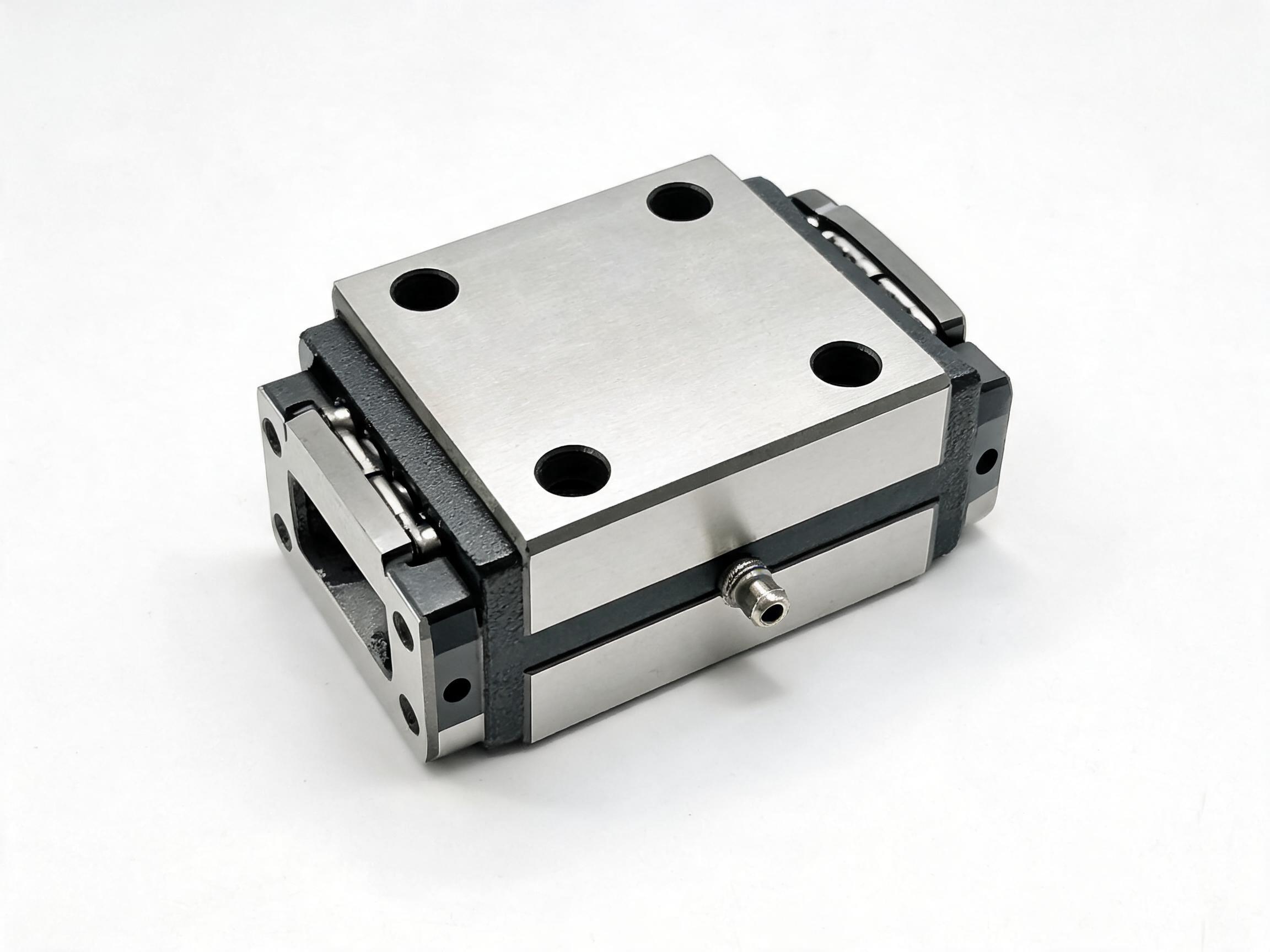
EGH miniature rail carriages illustrate the trade-off in concrete terms. The EGH15CA weighs 0.038 kg, which is light enough that it does not dominate the moving mass on a small, fast axis. Its ratings are dynamic 5.5 kN and static 9.2 kN — lower than a full-size flange block, as expected for a block this size. The block uses dual Gothic-arc ball grooves, a point-contact arrangement, and ground H (P5) accuracy is standard. Rails are available from 9 mm width (EGS9), and lubrication is handled through the end seals.
For contrast, an HGH flange carriage such as the HGH20CA carries dynamic 18.0 kN and static 29.5 kN, with four ball rows and preload classes C0/C1/C2. It supports far more load, and it is a larger, heavier part. Neither block is “better” in isolation: the miniature block suits a fast, lightly loaded axis where inertia dominates; the flange block suits an axis where the load and stiffness requirement dominate. The mistake is to select by load rating alone on a fast axis, or by weight alone on a heavily loaded one.
There is a second, subtler reason weight matters on fast axes. When an axis decelerates, the carriage mass contributes to the settling behavior at the end of the move. A drive fighting a larger moving mass has to work harder to bring the assembly to rest without residual oscillation. Settling time is not published for a block, and it is not something the catalog can promise — but the mass term is one of the inputs an engineer can control at the selection stage.
Vertical axes: weight is also a gravity term
On a vertical axis, the carriage and the fixture it carries are not only accelerated; they are held against gravity when the axis is idle or moving upward, and gravity assists on the downward stroke. That makes the carriage weight part of the holding-force and braking picture as well as the inertia picture. A light carriage reduces the steady holding burden on the drive or brake, and it changes the asymmetry between up and down strokes.
On small vertical slides, a complete module is sometimes a more useful reference than a bare block. The SKF20 aluminum profile linear motion slide module is listed at 2.8 kg total weight at 500 mm stroke — a complete assembled unit rather than just the carriage. That total matters because on a vertical module, the whole moving assembly is what the drive holds, not just the block. When sizing, use the moving portion of the module, and confirm which parts of the listed total actually travel.
Reading weight and load data together
Catalog pages list weight and load ratings in separate columns, but the selection decision uses them together. The practical reading order is:
- Start from the load case. Determine the applied load, its direction (radial, lateral, or moment), and whether the axis is horizontal, vertical, or inclined. This sets the minimum load rating the block must carry.
- Then look at the mass budget. Once the block can carry the load, ask whether its weight leaves enough drive capacity for the required acceleration profile. This is where a lighter block can earn its place.
- Check the accuracy and preload fit. EGH blocks are listed with ground H (P5) accuracy as standard. HGH blocks offer preload classes C0/C1/C2, which affect stiffness and running behavior. Weight and load alone do not describe how the axis will perform.
- Confirm the per-size values. Ratings and weights vary by size and by configuration. Do not scale from one size to another; confirm the weight in the datasheet for the exact size under consideration.
A compact comparison of the reference values available here shows the pattern:
| Item | Weight | Dynamic load | Static load | Notable configuration |
|---|---|---|---|---|
| EGH15CA miniature carriage | 0.038 kg | 5.5 kN | 9.2 kN | Dual Gothic-arc ball grooves (point contact); ground H (P5) accuracy standard |
| HGH20CA flange carriage | Confirm in datasheet | 18.0 kN | 29.5 kN | Four ball rows; preload classes C0/C1/C2 |
| SKF20 slide module | 2.8 kg total at 500 mm stroke | — | — | Complete aluminum profile module; total includes more than the carriage |
The EGH row is the clearest illustration of the miniature case: 0.038 kg is small relative to the load ratings it carries, which is what makes it a candidate for a fast, lightly loaded axis. The HGH row carries roughly three times the dynamic load of the EGH15CA in the sizes listed, which is consistent with a larger, heavier flange block. The SKF20 row is a different kind of number entirely — a module total, not a carriage weight — and should not be compared directly to the block figures.
What to confirm per size
The reference values above cover only a few sizes. Before finalizing a selection, the following should be confirmed from the datasheet for the exact item:
- Carriage weight for the specific size and configuration. Weight changes with size, and a flange or extended block can differ from a square block of the same rail width.
- Dynamic and static load ratings for that size. These are per-size values; do not interpolate from the examples here.
- Accuracy grade as supplied. For EGH, ground H (P5) is listed as standard, but confirm the supply configuration for the ordered part.
- Preload class where offered. HGH blocks list C0/C1/C2; the choice affects stiffness and running behavior, not weight.
- What the weight figure includes. For modules such as the SKF20, confirm whether the listed total covers the moving portion, the rail, or the complete assembly.
- Lubrication arrangement. EGH blocks use end-seal lubrication; confirm the maintenance arrangement for the intended duty cycle.
Commercial terms: EGH miniature carriages carry a minimum order quantity of 100. The company operates under ISO 9001:2015 certification, and CE and SGS factory audit documentation is held at company level.
The practical rule
Carriage weight is not a headline specification, but it enters every motion calculation. On a slowly moving, heavily loaded axis it is a minor term; on a fast or vertical axis it is one of the inputs that determines whether the drive can deliver the profile the process requires. The right order is to satisfy the load case first, then use the mass budget to choose between blocks that both qualify — and to take the weight figure from the datasheet for the exact size, not from a neighboring size or a general rule.