
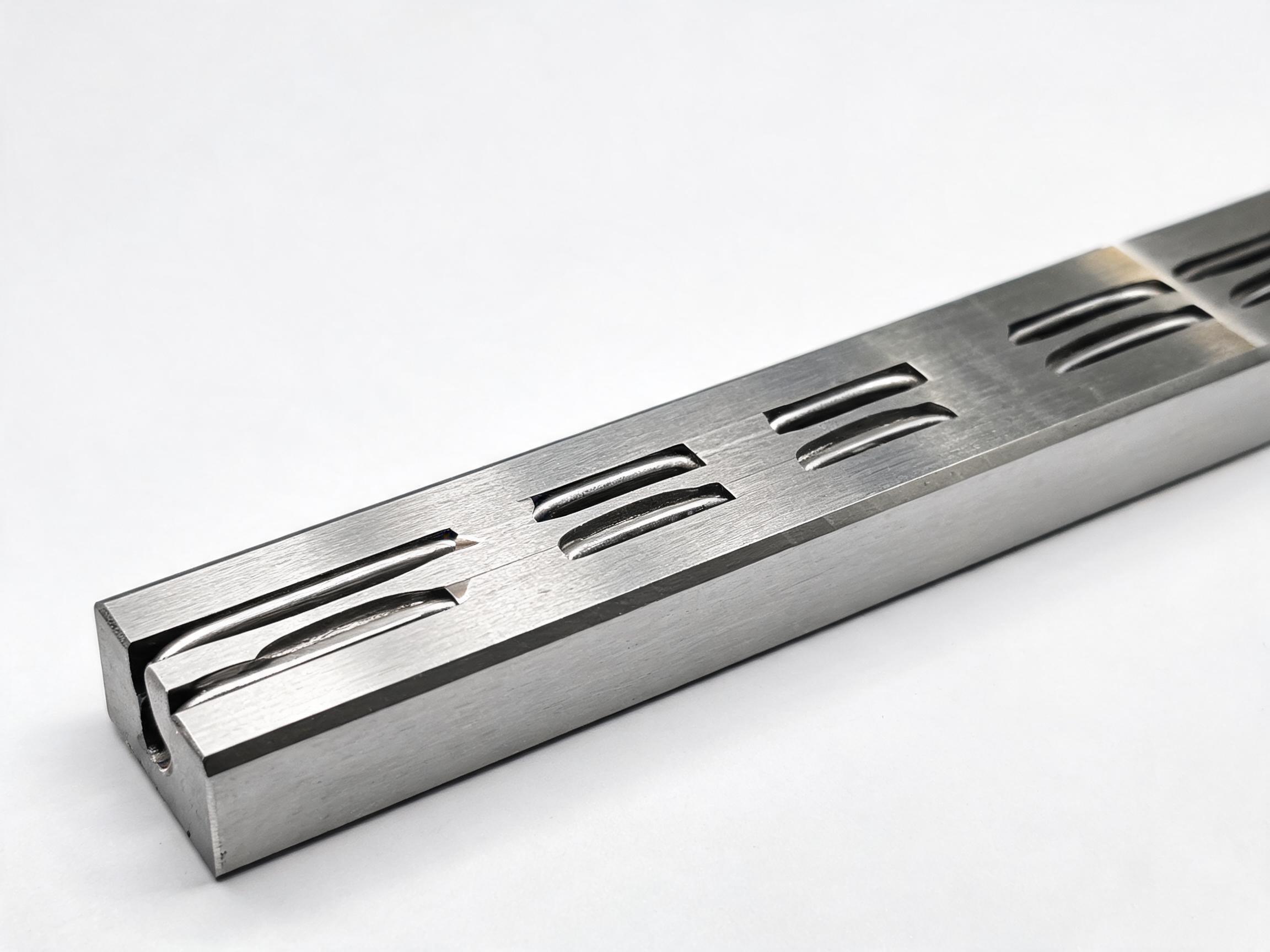
A guided reading of an HGR linear guide rail catalog: how to break down a part number, which columns matter, and how to compile an order checklist before contacting a supplier.
Buyer's Guide · Linear Guide Rail Catalog
A linear guide rail catalog is not a list of products to pick from by price. It is a specification document, and the HGR series pages show why: the model code carries the series, the rail width, the precision grade and (in some catalogs) accessories, while separate columns carry length, hardness, lubrication and packing details. If you read the code and the columns separately, you can build an order line that a supplier can quote without back-and-forth. This article walks through an HGR part number, explains the columns that actually affect an order, and ends with an order checklist you can fill in before sending an RFQ.
Key takeaways
- The HGR prefix is a series name; the number after it (15/20/25/30/35/45) is the rail width series, not the overall length.
- Precision grade is shown as Ground H (P5) or Rolled N (P7); surface hardness is stated as 58–62 HRC on 55# steel.
- Standard maximum length is 4000 mm; custom lengths can be enquired.
- Lubrication is handled through oil grooves plus grease nipples on the rail/block interface.
- MOQ is 50 pieces and common sizes ship in 7–10 working days.
- Block model codes, including any style or seal suffix, are not spelled out in the excerpt used here — confirm the block model code against the full catalog before ordering.
Reading the part number, one segment at a time
Take a typical line from the HGR series heavy-duty linear guideway rail. The model begins with “HGR” followed by a number. For example, HGR25 means an HGR series rail in the 25 rail-width size. The number is not a length, a load rating or a price band — it references the rail width family. That distinction matters because the rail width determines mounting-hole spacing and block compatibility, which are fixed by the series, while the length is a separate column you specify yourself.
After the rail width, catalogs append a precision grade. The HGR pages list two grades: Ground H (P5) and Rolled N (P7). Ground H is the higher-accuracy grade; Rolled N is produced from rolled stock. When you read a code that includes one of these suffixes, treat it as the accuracy class you are requesting, not a manufacturing option you can infer from the rail width alone. If a quote does not state the grade, ask for it explicitly.
Surface hardness is listed as 58–62 HRC, with material stated as 55# steel. Hardness is a process column, not part of the model code in the excerpt provided, so do not assume it varies by length — it belongs to the rail specification as a whole.
Lubrication is expressed through oil grooves and grease nipples. This is a physical feature of the rail and block interface. Whether your application uses manual greasing or an automatic line, the catalog’s lubrication interface is what you match against; the catalog excerpt does not define alternative lubrication methods, so confirm the interface arrangement with the supplier for your setup.
The columns that change an order line
Most first-time buyers read the model number and stop. The columns beside it are what turn a model into a purchase order. Here is how they translate into an actual line item.
| Catalog field | What it tells you | What you must specify or confirm |
|---|---|---|
| Rail Series | HGR15, HGR20, HGR25, HGR30, HGR35, HGR45 — the rail width family | Pick the width that matches the block and your mounting bolt pattern |
| Precision grade | Ground H (P5) or Rolled N (P7) | State the grade in the quote request; it is not assumed |
| Surface hardness | 58–62 HRC on 55# steel | Confirm if your application needs a documented hardness certificate |
| Length | Standard max 4000 mm; custom lengths available on enquiry | Give finished length and whether cutting is included |
| Lubrication | Oil grooves + grease nipples | State manual or automatic greasing; confirm nipple thread if replacing existing rail |
| Block model | The excerpt requires a block model but does not spell out style or seal codes | Confirm block model code against the catalog before ordering; do not guess the suffix |
| Commercial | MOQ 50 pieces; common sizes 7–10 working days | Ask whether the MOQ applies per item or per order before mixing rail and block quantities in one order |
The table above deliberately separates the fields you choose from the fields you confirm. For example, the rail width and precision grade are buyer choices; the block suffix is something the catalog excerpt does not fully define, so it belongs in a confirmation question, not an assumption. Suppliers who work from a catalog excerpt will usually honour a confirmation request — but only if you ask before the order is placed.
Length is a decision, not a number
The catalog states a standard maximum length of 4000 mm and notes that custom lengths can be enquired. This affects how you write the order line. If your design requires a rail longer than 4000 mm, the catalog excerpt does not define a standard response, so the correct step is to state the required length and ask what the supplier can offer. If your design uses a shorter rail, decide whether you are ordering a stock length or a cut-to-length rail; those are different line items in a purchase order. A request for “HGR25, 2000 mm” without stating whether 2000 mm is a stock length or a finished cut is ambiguous.
Lead time depends on the size
The catalog lists a 7–10 working-day lead time for common sizes, alongside an MOQ of 50 pieces. This is a statement about common sizes, not a guarantee for all sizes or for custom lengths. If your line needs HGR45 with a custom length, the lead time may not match the common-size figure; the request should ask for it separately. For mixed orders (rails plus blocks), do not assume mixing is allowed — the catalog excerpt states the MOQ figure but does not break it down by block or rail, so ask whether the MOQ applies per item or per order before you combine quantities.
If you are comparing across rail families, the MGN series stainless-steel miniature linear guide is a different rail width series and should be read in the same column-by-column way; it is not a drop-in substitute for HGR sizes. The SBR16 linear motion guide rail unit is a different product format again, and its model code should be read against its own catalog page rather than the HGR page.
Compiling the order checklist
Before sending an RFQ, write one line per item that covers every column above. The checklist below is what an order line should contain — not every question needs to be raised on the first email, but every field should be answered or explicitly deferred.
- Rail series and width — e.g. HGR25, not just “25 mm rail”
- Precision grade — Ground H (P5) or Rolled N (P7)
- Quantity per rail size — matching your bill of materials, not just the total piece count
- Length — stated as stock length or finished length, with tolerance if relevant
- Lubrication interface — manual grease nipple or automatic line; confirm thread if replacing an existing rail
- Block model code — confirmed against the catalog, including seal code
- Commercial fields — MOQ acknowledgement stating whether it applies per item or per order, lead-time request for chosen sizes, and whether custom lengths need a separate enquiry
A worked example shows how the known and the unconfirmed fields sit in one line: HGR25, Ground H (P5), 2 rails at 2000 mm finished length, grease-nipple lubrication, quantity 4 rails; block model — [state your block code or ask the supplier to match it]; seal code — [confirm with the supplier]; MOQ basis — [per item or per order, to be confirmed]. The bracketed fields are exactly the ones the excerpt does not answer. Writing them as explicit questions instead of leaving them blank is what turns the checklist into an orderable RFQ.
One confirmation worth making early: the catalog excerpt used here does not spell out block style or seal suffix meanings. If your drawing or existing machine uses a block suffix, send that code to the supplier and ask them to match it against the catalog. Do not read a suffix as a guaranteed feature without that confirmation.
What the catalog does not tell you
An HGR catalog page gives you the rail width, grade, hardness, length and lubrication interface. It does not give you: the block’s load capacity under your specific mounting condition, the mounting-hole tolerance for your machine bed, or the block suffix meaning beyond what the page states. Those are application-specific and belong in the confirmation step. The goal of using a catalog well is not to know everything from the page — it is to know exactly which fields the page answers and which fields need a question.
When you send the checklist, the supplier can respond with a quote that matches your line item, rather than a generic catalog number. That is the practical difference between reading a linear guide rail catalog and actually ordering from it.