
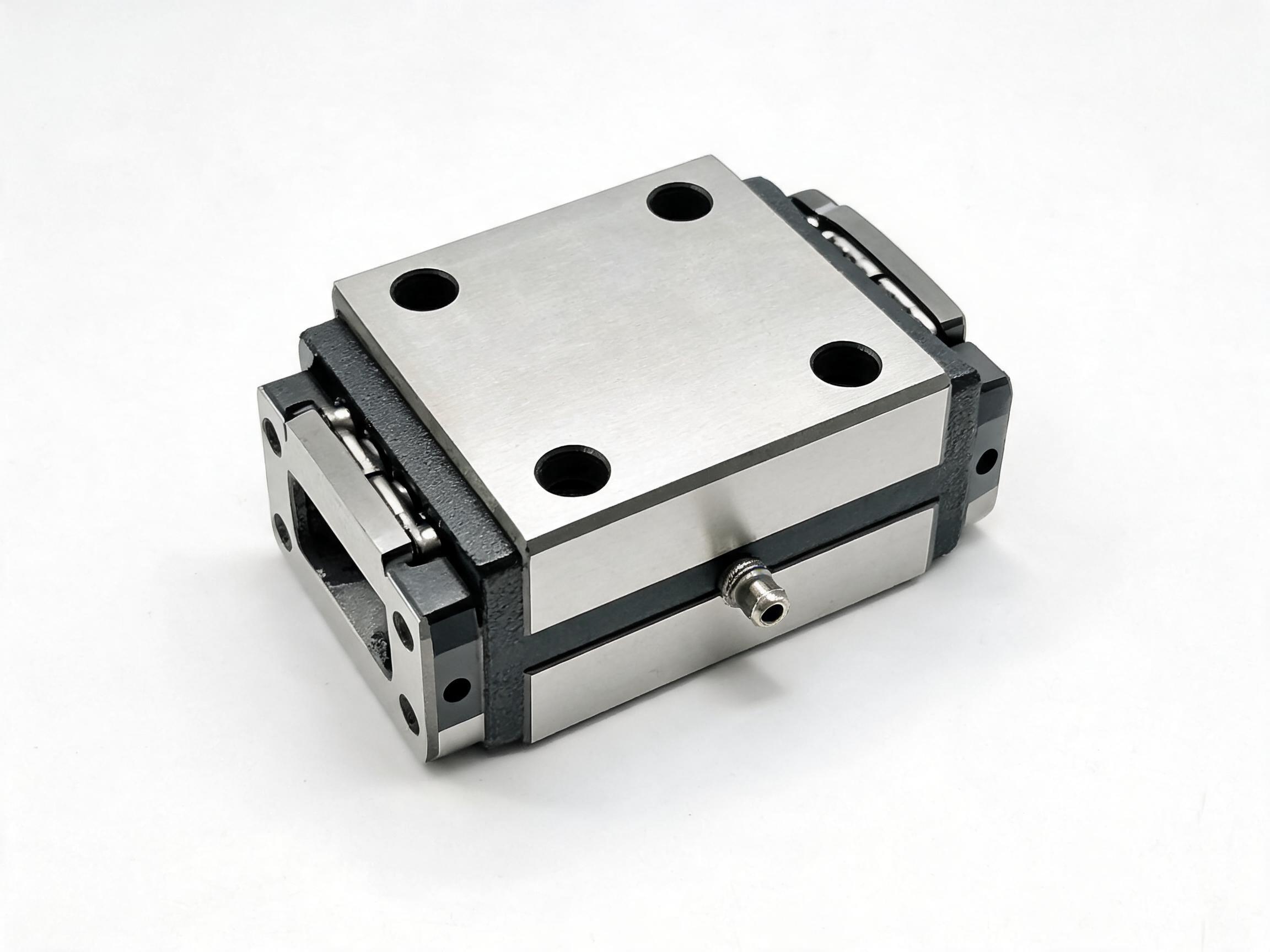
Locate the grease nipple on HGR, HGW, and MGN linear guides, compare manual greasing with centralized lubrication, and set realistic re-grease intervals. Practical guidance for maintenance technicians and equipment buyers.
Finding the Grease Nipple and Lubricating Your Linear Guide
If you maintain linear guide rails, you have likely asked two questions: where is the grease nipple, and how often should I grease? The answers depend on the carriage family and the machine orientation. This guide covers the common HGR, HGW, and MGN series and explains manual versus centralized lubrication. For intervals, the MGN series has a concrete factory baseline of 3–6 months or roughly 100 km of indoor travel; HGR and HGW do not have a published interval, so their re-grease schedule must be set from the datasheet for your rail, load and duty cycle, with the MGN baseline as a conservative starting point.
Key Takeaways
- HGR rails use an oil groove plus grease nipple interface; the continuous oil groove retains lubricant between re-greasing.
- HGW carriages have dual ports: a top-face M6 grease nipple and a side oil port for centralized lubrication.
- MGN rails ship pre-lubricated; re-grease every 3–6 months or after roughly 100 km of travel.
- HGR and HGW have no published interval: confirm against the datasheet and set your schedule from inspection results.
- Vertical axes drain lubricant faster due to gravity, so shorten intervals accordingly.
Where the Grease Nipple Sits on Common Carriage Families
Grease nipple location varies by series. Knowing the interface helps you plan access and choose between manual and automated lubrication.
HGR Series: Oil Groove and Grease Nipple
The HGR series heavy-duty linear guideway rail uses an oil groove plus grease nipple compatible interface. A continuous oil-groove channel runs the full rail length and retains a lubricant film between re-greasing intervals. This design matters on vertical axes, where gravity drains surface lubrication quickly. The oil groove helps keep lubricant distributed along the raceway, reducing metal-to-metal contact during travel.
HGW Series: Dual Lubrication Ports
The HGW series wide-body linear guideway carriage block has two lubrication ports: a top-face M6 grease nipple and a side oil port. This dual arrangement supports both manual greasing and centralized lubrication hookup. The side port is especially useful when adjacent structures block access to the carriage top—common in machine tools where the carriage sits under a shield or in a confined enclosure.
MGN Series: Factory Pre-Lubrication
The MGN12 linear rail ships pre-lubricated with grease. The carriage includes a grease nipple for re-lubrication; its exact position varies by carriage block, so confirm it against the datasheet for your specific model before planning access. For typical indoor use, re-grease every 3–6 months or after roughly 100 km of travel. In dusty or high-cycle environments, use side wiper seals and shorten the interval.
Manual Greasing vs Centralized Lubrication
Both methods are viable, but they suit different machine designs and maintenance resources.
| Aspect | Manual Greasing | Centralized Lubrication |
|---|---|---|
| Typical connection | Grease nipple (e.g., M6 on HGW top face) | Side oil port or tubing to a pump |
| Best for | Single carriages, low-duty cycles, accessible machines | Multi-axis systems, hard-to-reach carriages, high-duty cycles |
| Interval control | Manual schedule; depends on technician | Timer or cycle-based pump; more consistent |
| Risk | Missed intervals, over-greasing | Clogged lines, pump failure, incorrect grease volume |
Manual greasing with a hand pump is straightforward but relies on a disciplined schedule. Centralized systems reduce labor and improve consistency, but they require clean grease and periodic line checks. On HGW carriages, the side oil port allows you to connect a centralized system even when the top nipple is blocked. For HGR rails, the oil groove helps distribute grease from a single point, making both methods workable.
Realistic Re-Grease Intervals
Interval recommendations vary by series and operating conditions. Only the MGN series carries a published factory baseline; the schedule for HGR and HGW is set from the datasheet and from what inspection finds on your machine. The table below summarizes the starting points.
| Series | Typical Indoor Interval | Dusty / High-Cycle Interval |
|---|---|---|
| MGN | Every 3–6 months or ~100 km | Shorten from the baseline based on inspection |
| HGR | Confirm against datasheet; inspect at service | Shorten based on inspection; check oil groove condition |
| HGW | Confirm against datasheet; inspect at service | Shorten based on inspection; inspect both ports |
How much to shorten an interval is not a fixed rule in any of these datasheets. Set the amount from what you find at each service: if the raceway film looks thin or the grease has picked up contamination, shorten; if it looks fresh, hold the schedule. Check the raceway condition and grease appearance every time the machine is serviced, and record the date and travel distance so the pattern over several services tells you the real interval for your duty cycle.
The 3–6 month or 100 km guidance for MGN is a baseline for typical indoor use. High-cycle environments—such as automated assembly lines running multiple shifts—will require more frequent attention. Dusty environments call for side wiper seals and shorter intervals to prevent abrasive particles from entering the carriage.
Why Vertical Axes Drain Faster
On a vertical axis, gravity pulls lubricant down the rail and away from the carriage raceway. Surface lubrication drains more quickly than on a horizontal axis, increasing the risk of starved contact. The HGR series addresses this with its continuous oil groove, which retains a lubricant film along the rail length. Even so, vertical axes generally need shorter re-grease intervals than horizontal ones. If your machine has a vertical Z-axis or a lift application, plan to inspect and re-grease more frequently, and consider a centralized system that delivers small, frequent doses.
Step-by-Step Manual Greasing
- Clean the grease nipple and surrounding area with a lint-free cloth to prevent dirt ingress.
- Connect a hand grease gun filled with the grease specified in the datasheet. Do not substitute without confirming compatibility.
- Pump slowly until grease appears at the carriage seals or until resistance indicates the cavity is full. Avoid over-greasing, which can damage seals.
- Wipe away excess grease and move the carriage through its full travel to distribute lubricant.
- Record the date and travel distance to maintain a schedule.
Common Mistakes to Avoid
- Using the wrong grease grade or mixing incompatible thickeners. Always use the grease specified in the datasheet.
- Ignoring the side port on HGW carriages when top access is blocked.
- Over-greasing, which can cause seal distortion and excess drag.
- Skipping wiper seals in dusty environments—wiper seals are essential for keeping contaminants out.
- Assuming all carriages have the same nipple location. Check the specific series and datasheet.
FAQ
Where is the grease nipple on an HGW carriage?
The HGW series has a top-face M6 grease nipple and a side oil port. The side port is useful when the top is obstructed.
Can I use any grease in my linear guide?
No. Use the grease specified in the datasheet. Specialty greases are available on request for specific conditions.
How often should I re-grease a vertical axis?
More frequently than a horizontal axis due to gravity drainage. For MGN, start with the 3–6 month or 100 km baseline and shorten it based on inspection; for HGR and HGW, set the schedule from the datasheet and your inspection findings.
Do MGN rails come pre-lubricated?
Yes, MGN series rails ship pre-lubricated with grease from the factory.
Need help selecting the right linear guide or lubrication accessories for your application?
Contact our technical team