
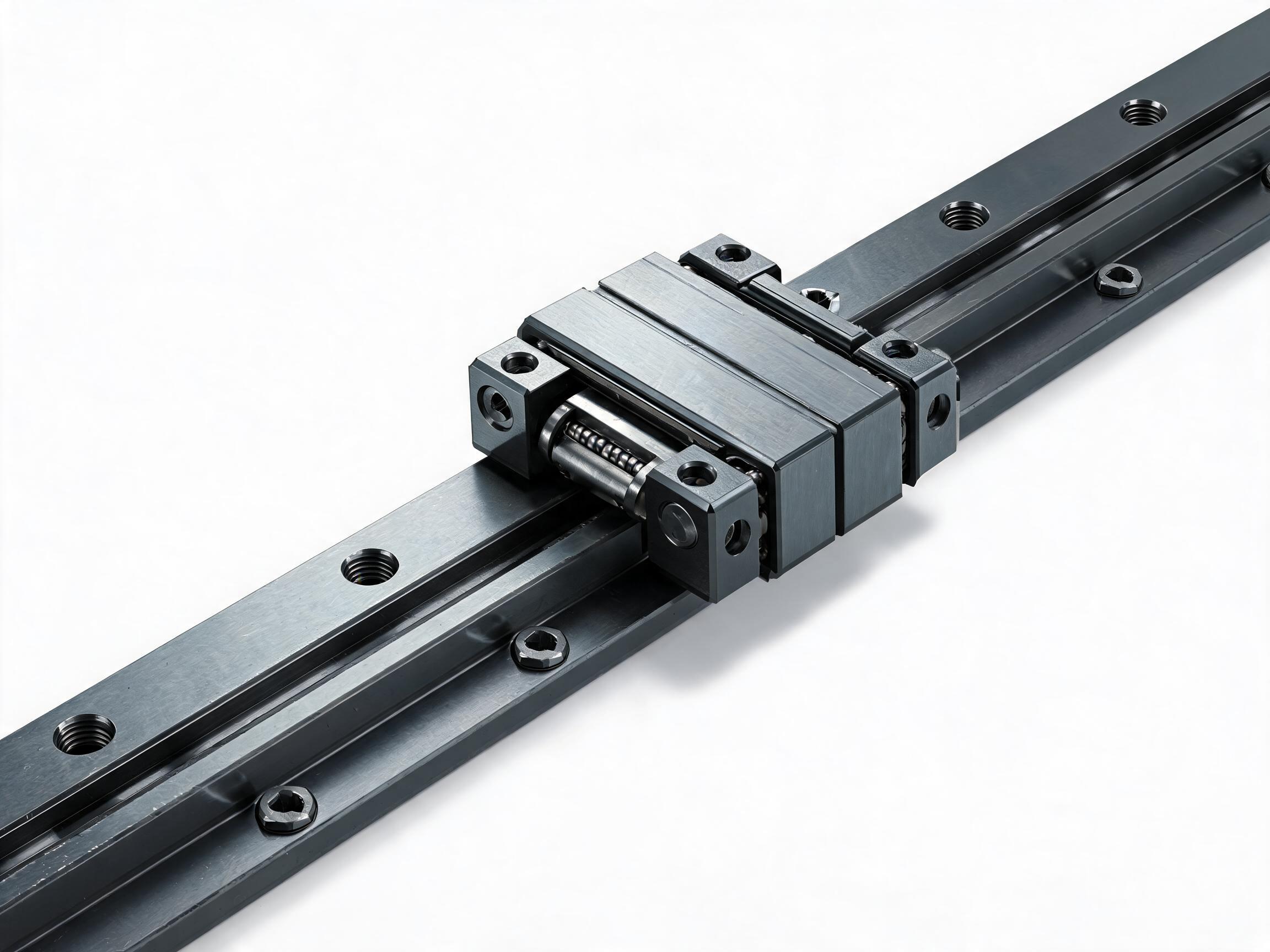
Preload on a linear guide rail carriage sets the running drag and noise against rigidity. This guide explains what the C0, C1 and C2 grades in this site’s HGH catalog mean, which axis duty each is written for, and how rail mounting flatness affects whether that preload survives in service.
Preload is the small internal compression a carriage maker builds into the ball circuit. It removes play between the balls and the raceways, and that is all it does: it trades running drag and noise against rigidity, nothing more. The grade you order should follow the duty of the axis, not habit or a higher number on the drawing.
- In this site’s HGH catalog, C0 is the clearance grade, C1 is light preload and C2 is medium preload.
- C1 covers most CNC milling and turning axes; C2 is reserved for heavy-cutting spindle heads where deflection under load must stay low.
- Preload is a separate dimension from rail precision grade: Ground H (P5) and Rolled N (P7) are not preload classes. Verify the supplier’s own grade table before ordering.
What preload does to a carriage
A linear guide rail carriage preload is set at assembly by selecting ball size relative to the gap between the block and the rail raceway. With C0, the assembly runs with internal clearance; the balls roll with the least resistance the design allows. With C1 and C2, slightly larger balls press the raceways together, so the carriage resists deflection and lift-off better but needs more driving force and generates more noise at speed. Exact preload force and drag torque are not fixed by the grade label — confirm with the datasheet for the specific series and size.
That is the whole trade. There is no grade that gives both minimum drag and maximum stiffness; choosing a carriage is choosing where on that line your axis needs to sit.
The three HGH preload grades on this site
The HGH series in this site’s catalog lists three preload grades, defined by the duty each is written for:
| Grade | Catalog definition | Written for |
|---|---|---|
| C0 | Clearance | High-speed linear transfer where noise matters |
| C1 | Light preload | Most CNC milling and turning axes |
| C2 | Medium preload | Heavy-cutting spindle heads where deflection under load must stay low |
These three grades describe the range this catalog offers, not a universal scale. Other makers use different letters and numbers for the same idea, and a “C1” from one supplier is not guaranteed to correspond to a “C1” from another. Always treat the supplier’s own grade table as the governing document for what you are buying.
C0: clearance
C0 suits high-speed linear transfer where noise matters — pick-and-place gantries, transfer slides and similar axes that carry light loads and need to move quickly and quietly. On these axes, the extra drag of a preloaded block buys stiffness the application does not use, and shows up as noise and motor load instead. If the axis reverses direction frequently under cutting load, C0 is the wrong starting point.
C1: light preload
C1 covers most CNC milling and turning axes. It removes play without imposing the heavy drag of C2, which is why it is the common specification for general machining axes. If your axis is a typical milling or turning slide and you have no specific reason to go higher or lower, C1 is the grade the catalog assigns to that duty.
C2: medium preload
C2 is specified for heavy-cutting spindle heads where deflection under load must stay low. The additional preload stiffens the carriage against the cutting force pushing and lifting it, at the cost of higher running drag and more heat. C2 on a lightly loaded high-speed axis would add friction and noise the machine does not need; C0 on a heavy-cutting head would let the block deflect where stiffness is the whole point.
Match the grade to the axis, not to a habit
The grade is a function of what the axis does. Three questions settle it most of the time:
- Does the axis cut under load? If yes, the carriage has to resist deflection, which points toward C1 or C2. If the axis only moves a load from A to B, C0 deserves a look.
- How heavy is the cut relative to the block size? A heavy-cutting spindle head is the case the catalog writes C2 for. A standard milling or turning axis sits at C1.
- Does noise or drag dominate? On a high-speed transfer axis, noise and running resistance are what the operator notices, and C0 is the catalog’s answer for that duty.
Where two axes of the same machine carry different duties, they do not have to share a grade. A common configuration is C1 on the cutting slides and a lighter grade on the transfer axis — but that is a decision to state on the order, not a default to assume.
Preload is not accuracy class
Rail precision grade and carriage preload are set independently. Ground H (P5) and Rolled N (P7) describe how accurately the rail itself is made; C0, C1 and C2 describe how tightly the carriage is assembled onto it. A P5 rail does not imply a C2 carriage, and a C2 carriage on a P7 rail is a valid combination if the axis duty calls for it. Order both dimensions explicitly.
Protecting preload: rail mounting flatness
Preload is set at the factory, but it is maintained — or lost — at installation. A carriage only keeps its designed preload if the rail under it stays straight. On welded bases or long-span frames, accumulated misalignment along the rail can distort the raceway enough that the carriage no longer runs at its assembled preload. The machine then shows the symptoms of a looser grade — play, chatter, poor finish — even though the block left the factory correctly preloaded.
The HGH20CA carriage in this catalog is built with a four-row ball circuit and a ±0.5° self-aligning angular tolerance, so minor rail misalignment is absorbed without re-shimming. That tolerance has a limit: it covers minor deviation, not a base that is out of flatness across its full length. Machining the mounting surface flat and checking it before the rail goes down protects the preload you paid for.
What to check before the rail is bolted down
- Confirm the base is machined and flat along the full rail length, not only at the ends.
- On welded or long-span bases, check for accumulated misalignment rather than assuming the rail will pull the base straight.
- Keep the seals in place: the HGH20CA carries an end seal and side seal strip, and a clean raceway is part of keeping drag and preload as designed.
Load reference for the HGH20CA
The HGH20CA carriage in this catalog is listed at 18.0 kN dynamic load and 29.5 kN static load, with a four-row ball circuit. These figures describe the block’s load capacity, not its preload. Preload grade and load rating are separate columns on the order: a C2 block and a C0 block of the same size share the same basic load rating but run differently. When specifying, state both the size and the preload grade, and check the load rating against the actual axis load rather than against the preload choice.
How to write the requirement
A clear order line removes most of the ambiguity. It states:
- The series and size, for example HGH20CA.
- The preload grade, using the supplier’s own grade table — C1 for a standard CNC milling or turning axis, C2 for a heavy-cutting spindle head, C0 for high-speed transfer where noise matters.
- The rail precision grade separately, Ground H (P5) or Rolled N (P7), as its own line.
- The mounting condition the rail will sit on, particularly for welded or long-span bases, so the supplier can confirm the self-aligning tolerance covers the expected deviation.
Where the application sits between two grades — a medium cut on a large block, for example — the datasheet gives the preload force and drag torque that let you compare; confirm those figures with the datasheet for the specific size rather than inferring them from the grade name.
Summary
Linear guide rail carriage preload is a stiffness-versus-drag choice, and the C0, C1 and C2 grades in this catalog map that choice to specific duties: C0 for high-speed transfer where noise matters, C1 for most CNC milling and turning axes, C2 for heavy-cutting spindle heads where deflection must stay low. Rail precision grade is a separate dimension. Preload is set at assembly but preserved only if the rail mounting surface stays flat, so base flatness and accumulated misalignment on welded or long-span frames are part of the preload decision, not an installation afterthought. Grade names differ between makers — confirm the supplier’s own table before ordering.
Related products on this site:
- HGH series flange-type linear guideway carriage block — the carriage series whose C0, C1 and C2 preload grades are described above.
- HGR series heavy-duty linear guideway rail — the rail that carries these carriages, available in Ground H (P5) and Rolled N (P7) precision grades.
- HGR45 heavy-duty large linear guideway rail — for heavier machine structures where base flatness and preload stability need attention.