
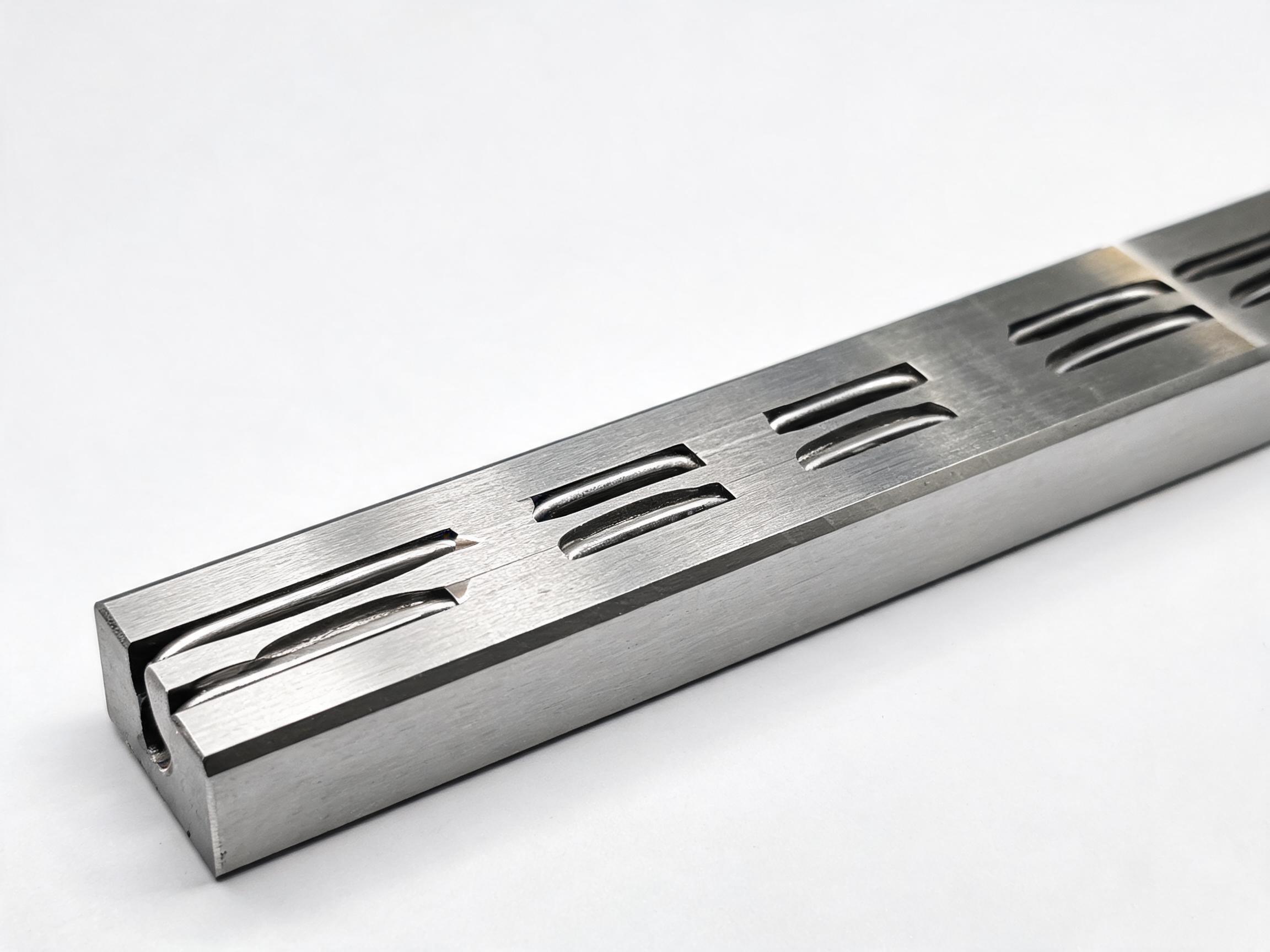
Linear guide rail price is driven by five factors you can see in the datasheet: size series, precision grade, length and custom machining, order quantity, and MOQ tier. This article breaks down each factor using real HGR product data and gives you a checklist to make supplier quotes comparable.
Buyer's guide · linear guideway quotation
A linear guide rail price is not one number applied to every HGR rail. Five variables change what a supplier quotes you: the size series, the precision grade, the length and any custom machining, the order quantity, and the MOQ tier you land in. This article explains each one using our published HGR and HGH data, then gives you a checklist that makes two quotes actually comparable.
Key takeaways
- The size series (HGR15 to HGR45) sets the base material and load capacity that the rest of the quote is built on.
- Precision grade is a direct cost choice: Ground H (P5) and Rolled N (P7) are different manufacturing routes, and both are stocked.
- Length is capped at 4000 mm for a single rail; longer runs are joined sections with precision splice joints, which is a separate machining item.
- Order quantity and MOQ tier change the per-piece price, with the standard MOQ at 50 pieces per size.
- A comparable quote lists model, grade, length, quantity, and carriage preload in the same format, or it cannot be checked against another.
Factor 1: Size series sets the base
HGR rails are stocked in six sizes: HGR15, HGR20, HGR25, HGR30, HGR35 and HGR45. The number is not a marketing label; it correlates with the rail's cross-section and load capacity. HGR20, for example, is rated at 16.7 kN dynamic load and 26.7 kN static load. HGR45 is the largest stocked size in this range.
A larger size uses more steel per meter and requires heavier machining, so size is the first line that moves in a quote. When you compare prices across sizes, compare them against the load case you actually need. A quote for HGR20 and a quote for HGR30 are not interchangeable, and a supplier who quotes one without asking about load is skipping the question that sets the base price.
The full HGR range is listed on the HGR series heavy-duty linear guideway rail page, including the size options and the rail construction.
Factor 2: Precision grade is a manufacturing route
We stock two precision grades for HGR rails: Ground H (P5) and Rolled N (P7). They are not the same product finished to different tolerances. Ground rail goes through a grinding operation after hardening; rolled rail is formed by a rolling process. The grinding step adds machine time and handling, which is why the grade appears as a separate line in a quotation.
Both grades use a 55# high-carbon steel rail body with an induction-hardened raceway at 58-62 HRC. The hardness range applies to the raceway, not the whole section. If a quote lists only "HGR20" with no grade, you cannot tell whether you are being offered Ground H or Rolled N, and the two should not be compared on price alone.
Match the grade to the machine. A positioning axis that needs tight running accuracy is a different requirement from a transfer axis where the rail mainly carries load. State the grade you want in the inquiry, or ask the supplier to quote both so you can see the cost difference for your application.
Factor 3: Length and custom machining
Standard HGR rail is available up to 4000 mm in a single length. Custom lengths are available on request. When a required length exceeds 4000 mm, the rail is supplied as joined sections with precision splice joints rather than one continuous piece.
Length affects price in two ways. First, the raw rail is priced by length, so a 3000 mm rail costs more in material than a 1000 mm rail of the same size and grade. Second, any cut-to-length or end machining is a separate operation. Drilled mounting holes, tapped ends, and splice-joint preparation are machining items that should appear as their own lines, not be buried in a per-meter rate.
If your drawing calls for a non-standard length, send the drawing with the inquiry. A quote that assumes a standard length and then adds machining later is not comparable to one that prices the finished part up front.
Factor 4: Order quantity
Per-piece price depends on quantity. Setup, programming, and handling are spread across the batch, so a 50-piece order and a 500-piece order of the same rail do not carry the same unit cost. This is normal in guideway manufacturing and it is one of the first things to check when two quotes look far apart: confirm both are for the same quantity.
Quantity also interacts with the carriage. If you are buying rail and carriage together, the HGH series flange-type linear guideway carriage block is available in HGH15, HGH20, HGH25, HGH30, HGH35 and HGH45, with preload grades C0 (clearance), C1 (light) and C2 (medium). For reference, HGH20CA is rated at 18.0 kN dynamic and 29.5 kN static load. A quote that lists rail and carriage separately is easier to audit than a bundled per-set figure.
Factor 5: MOQ tier
The standard MOQ is 50 pieces per size. Below that, a supplier may still quote, but the per-piece price will reflect a smaller batch. The MOQ tier is therefore a price boundary, not just a purchasing rule. If your project needs 20 pieces of HGR25 and 60 pieces of HGR30, you are in different tiers for the two sizes, and the quotes should show that.
Stock status is a related factor. In-stock sizes HGR20, HGR25 and HGR30 typically ship within 7-10 business days. For sizes or quantities outside stock, the lead time and price come from the production schedule, so ask for both in writing. A low price with no stated lead time is not a complete quote.
Checklist: make two quotes comparable
Two quotes for "HGR25 rail" can differ for reasons that have nothing to do with the supplier's pricing. Use this checklist to line them up before you compare the numbers.
- Model and size: confirm both quotes are for the same series and size (for example HGR25, not HGR20 or HGR30).
- Precision grade: confirm Ground H (P5) or Rolled N (P7) on both quotes.
- Length: confirm the cut length and whether it is a single rail or a joined section with splice joints.
- Machining: list drilled holes, tapped ends, and any other operations as separate lines.
- Quantity: confirm the piece count matches on both quotes.
- MOQ tier: note whether the quantity is at or above the 50-piece standard MOQ for that size.
- Carriage: if included, confirm the HGH size and preload grade (C0, C1 or C2).
- Lead time: ask for the ship date in writing, especially for sizes outside HGR20, HGR25 and HGR30 stock.
- Currency and Incoterm: confirm both quotes use the same basis.
When the quotes are laid out in this format, the differences that remain are the real commercial differences. Anything still missing is a question for the supplier, not a number to guess.
What to do next
Send your inquiry with the size, grade, length, quantity, and carriage requirement stated in the checklist format. If you are still selecting a size, the HGR series rail page lists the full range, and the HGR45 page covers the largest stocked size. A complete inquiry is the fastest way to get a quote you can actually compare.