
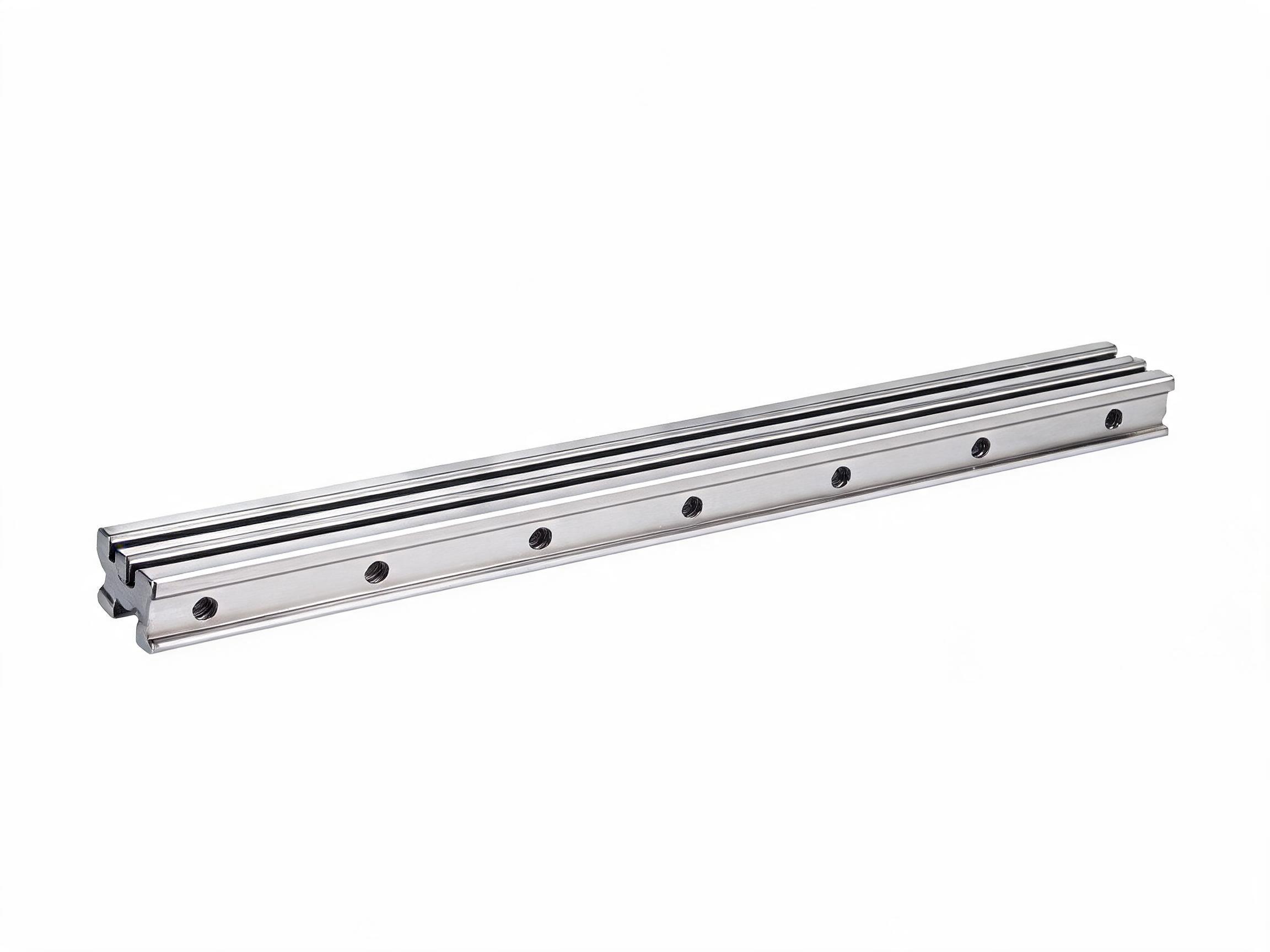
A profile rail's working life is decided less by a rated formula and more by four physical things: raceway surface wear, ball circulation, seal and scraper condition, and what the lubricant is doing. This article breaks down each wear site, explains how induction-hardened high-carbon steel resists raceway fatigue, and shows why lubrication and contamination usually matter more than load on the datasheet.
Profile rail wear analysis
A linear guide rail rarely dies of one cause. It wears at the raceway, inside the ball recirculation path, and at the seals — and lubricant and contamination decide how fast each of those moves. This article separates those mechanisms and shows what buyers should look at beyond a rated life number.
Why "service life" is not one number
Buyers evaluating a profile rail often start by asking how many kilometres it will last. The honest answer is that a rail has several independent wear sites, and the machine stops for whichever one fails first. A rail can have plenty of theoretical raceway capacity left and still be taken out of service by a hardened grease film, a cut wiper lip, or a worn recirculation channel.
So the useful question is not "what is the rated life" but "what wears, and which of those wear paths does my application accelerate?" The rest of this article answers that for steel profile rail systems.
What actually wears on a profile rail
1. The raceway surface
The raceway is where the load goes through the rolling elements. Under repeated passes, the contact surface can develop micro-pitting, polishing and, in heavy or poorly lubricated service, surface-origin flaking. The measurable result is geometry loss — the groove profile changes, and with it the running clearance and smoothness.
Raceway wear is usually the slowest of the four paths in a clean, lubricated application, and the fastest in a dry or contaminated one. It is not purely a load problem; a lightly loaded rail with a broken seal can wear its raceway faster than a heavily loaded one that stays clean.
2. Ball recirculation
Each ball is loaded only while it is in the load zone; it then re-enters the block through the recirculation path. That path is a separate wear site that buyers tend to overlook. Repeated ball entry and exit wears the guide channel and the end cap, and slight play building up there shows up as noise, vibration and lost positioning repeatability long before the raceway itself is exhausted.
Recirculation wear is driven by speed and cycle count rather than by load, so high-frequency, low-load machines can reach this limit before anything else. It is also where debris ingress does damage that the raceway never sees.
3. Seals, wipers and scrapers
End seals, side seal strips and the bottom scraper are the rail's first line of defence. They are also consumable parts. A wiper lip that hardens, tears or packs with chips stops wiping, and contamination reaches the raceway and the ball path directly.
On many machines the seal is the earliest wear item and the cheapest to replace — which is why an inspection interval that includes the seals is often more valuable than a longer theoretical rail life. A triple-seal arrangement on the carriage block — end seal, side seal strip and bottom scraper — addresses three different exposure directions, but it does not remove the need to check the lips.
4. The lubricant film
Lubricant is not an accessory to the rail; it is the layer that keeps the steel surfaces from touching. As long as a film separates the rolling elements from the raceway, metal-to-metal wear is limited. When the film breaks down — through age, heat, washout or a starved supply — wear accelerates sharply.
This is why lubrication is best treated as a life variable rather than a maintenance chore. A continuous oil reservoir inside the carriage and grease-nipple compatibility both matter here: they determine how reliably the film is maintained between service intervals.
How material and hardening resist raceway wear
Raceway wear resistance comes from the steel and the heat treatment, not from the catalogue's load figure. In the HGR series, the rail body is high-carbon steel and the raceway is induction hardened to 58–62 HRC; the steel grade is confirmed on the datasheet for the exact size ordered. That hardness range is what gives the groove resistance to indentation and surface fatigue under concentrated rolling contact.
The depth of the hardened layer matters as much as its surface hardness, because raceway stresses act below the surface. On the HGR45 profile rail, the effective hardened case is 2.0–2.5 mm; smaller sizes run at roughly 1.5 mm. A case of this order supports the contact zone rather than leaving a hard skin over soft core steel that would collapse under load. Buyers comparing rails from different suppliers should ask for hardness and case depth as measured values on the specific size they are ordering, not as a family-wide claim.
Full product details are on the HGR series heavy-duty linear guideway rail page, and the HGR45 heavy-duty large linear guideway rail page covers the 45-size rail specifically.
Lubrication and contamination: the two dominant variables
If you rank the influences on linear guide rail service life for a typical industrial machine, load often sits behind these two:
- Lubrication continuity — whether a film is present on every pass, including at low speed and after weekend shutdowns.
- Contamination control — whether chips, coolant mist, casting sand or fine dust reach the raceway and ball path.
Both act faster than load does. A rail run at moderate load with a maintained film and intact seals will typically outlast a more lightly loaded rail in a dirty, dry environment. That is a mechanical statement about film separation and abrasive ingress, not a guarantee about any particular installation.
In practice, this shifts part of the buying decision toward the carriage block and its sealing. A wide-body carriage with a triple-seal arrangement — like the HGW series wide-body linear guideway carriage block — is aimed at applications where the seal, not the raceway, is the limiting factor. The HGW design combines an end seal, side seal strips and a bottom scraper, which covers the front, sides and underside of the block.
Key takeaways for buyers
- Raceway wear is one of four wear paths, and often not the first to limit a machine.
- Ball recirculation wears with cycle count and speed; it shows up as noise and lost repeatability.
- Seals and scrapers are consumables — plan to inspect them, not just the rail.
- Hardness (58–62 HRC) and case depth (2.0–2.5 mm on HGR45) are the raceway's wear resistance.
- Lubricant film and contamination usually decide the outcome more than catalogue load does.
Wear site vs. what drives it
| Wear site | Main driver | Typical symptom | Buyer action |
|---|---|---|---|
| Raceway surface | Abrasive ingress, film breakdown, heavy contact stress | Increased clearance, rougher running, surface pitting | Confirm hardness and case depth for the ordered size |
| Ball recirculation | Cycle count, speed, debris in the return path | Noise, vibration, lost repeatability | Match seal type to the contamination environment |
| Seals and scrapers | Wear of the lip, hardening, chip packing | Visible contamination on the rail, seal damage | Set a seal inspection interval from day one |
| Lubricant film | Starvation, ageing, washout, high temperature | Dry running, discoloration, accelerated wear elsewhere | Check reservoir capacity and re-greasing route |
Symptoms are indicative of each mechanism; confirming the actual cause requires inspection of the specific machine.
A supplier-reported case
One field example illustrates how the wear paths above behave when lubrication and sealing are controlled. A Turkish injection-moulding machine manufacturer was supplied with 3,200 m of HGR45 rail and HGW45CA carriage blocks. The machines ran continuously for four years with zero rail replacement, and measured raceway wear was below 0.01 mm.
This is a supplier-reported case. The figure describes one customer's installation, duty cycle and maintenance regime; it is not a service-life rating and should not be read as a guaranteed wear value for other applications. What it does show is that where film and sealing are maintained, raceway wear can remain very small over a long continuous run — consistent with the mechanism described above, where the raceway is the slow path and the seal and lubricant are the fast variables.
What to specify when service life matters
When rail life is a real cost driver in a machine design, the specification should carry the wear-relevant facts, not just a load class:
- Rail body material and raceway hardness range for the exact size ordered.
- Effective case depth, and how it was measured.
- Sealing configuration on the carriage block, matched to the contamination present.
- Lubrication route — reservoir capacity inside the carriage and nipple compatibility with your lube system.
- An inspection plan that covers seals and lubricant, not only rail geometry.
If you are comparing suppliers, the questions that separate them tend to be about measured hardness and case depth, seal construction, and how lubrication is meant to be maintained in service. Those are the variables that move linear guide rail service life in the field. To discuss a specific rail size, stroke and environment, send the operating conditions to the supplier so the rail and carriage block can be matched to them.