Buying a complete linear guide track means deciding two things together: how many blocks each rail carries, and whether the rail ships as one piece or as joined segments. This guide walks through the standard length limits for HGR, MGN, and SBR rails, when a single rail makes sense, when you should order a spliced length, and how block count changes load sharing — with the exact questions to put to your supplier.
Linear motion ordering guide
A complete linear guide track is not one part number. It is a rail profile cut to a length, plus a stated number of bearing blocks that run on it. Two sourcing decisions travel together: how many blocks each rail should carry, and whether the run ships as a single rail or as joined segments. Get these right at the enquiry stage and the mounting, load sharing and alignment follow; get them wrong and you either over-buy carriages or discover a joint in the middle of a working stroke.
Key takeaways
- HGR profile rails are available up to 4000 mm in one standard length; runs longer than that use precision joining sections rather than a single cut.
- MGN miniature rails are available up to 1000 mm and can be joined for longer strokes.
- SBR16 shaft rails are standard up to 2000 mm, with custom lengths up to 4000 mm.
- Block count changes how load is shared between carriages — SBR20 is supplied as a dual-block unit, and the manufacturer's listed rating halves per-block stress compared with a single block.
- Standard rail lengths are not a per-millimetre length menu. If your required stroke sits just past a standard length, the splicing question comes first.
Start with the rail length your catalogue actually offers
Each rail family has its own maximum standard length, and that ceiling — not the overall machine bed — is what determines whether you can order one continuous piece. The three families most often specified for automation and woodworking machinery differ in this respect:
| Rail family | Standard maximum length | Longer runs |
|---|---|---|
| HGR series (profile guideway) | 4000 mm | Precision joining sections |
| MGN series (miniature guide) | 1000 mm | Joining sections possible |
| SBR16 (supported shaft rail) | 2000 mm | Custom length up to 4000 mm |
Read the table as an ordering limit, not a performance ranking. A 3 m travel on a machine bed can be built from one 4000 mm HGR rail, because the rail is comfortably over the stroke. The same 3 m travel on an SBR16 axis needs either a custom length up to 4000 mm or a joined arrangement — the standard 2000 mm unit will not cover it.
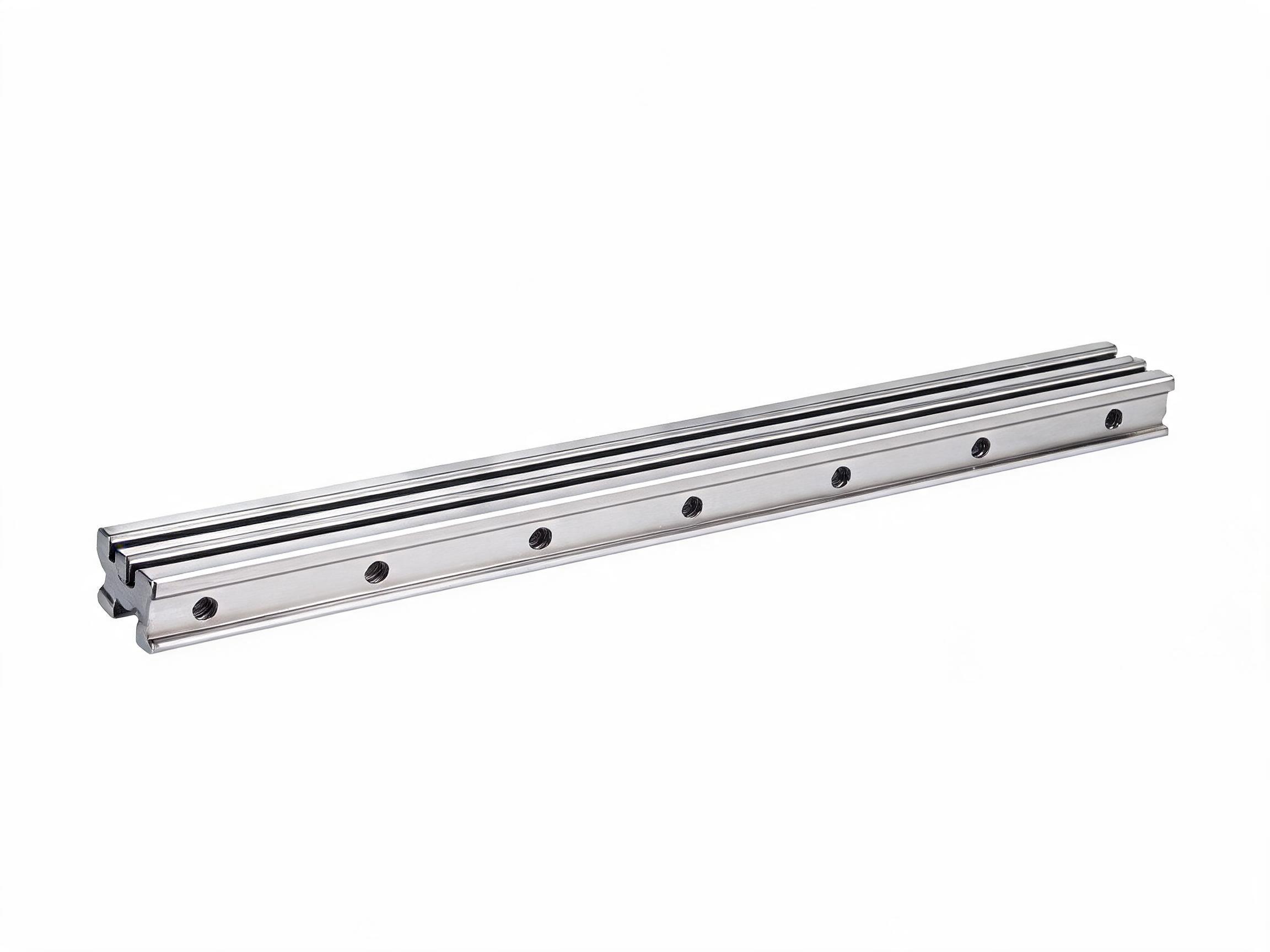
SBR profile rails are supplied with a pre-drilled aluminium support rail, with holes at 50 mm pitch along the length. That fixed pitch is useful when you are laying out the bed: the support rail mounting pattern is already defined by the pitch, so the length you specify should land on a usable hole interval at both ends. Confirm the end-hole condition with the supplier when you order a cut length.
When a single rail is the right order
A single continuous rail is the simplest choice whenever your travel fits inside the standard maximum with some margin at each end:
- Stroke plus block overhang fits the standard length. The carriage needs room to sit beyond the stroke ends; the rail must be longer than the working stroke by at least the block length at each end.
- Alignment matters more than length economy. A single rail cannot introduce a joint into the running surface, so straightness comes from one piece.
- The machine frame can accept the handling. A 4000 mm HGR rail is a long, relatively heavy item to move and seat. If the frame is built in bolt-together modules shorter than the rail, a single piece may complicate assembly even though the catalogue can supply it.
In these cases the length you write on the order is simply the cut-to-length figure, and the only remaining question is block count.
When to order a spliced or joined rail
Two different mechanisms push an order past the single-piece option, and they should not be confused:
1. Beyond the family maximum
A run longer than 4000 mm on HGR, or longer than 1000 mm on MGN, requires precision joining sections. The supplier's joining method is the only route to that length within the family — you are not choosing between a single rail and a join, because a single rail does not exist at that length in the standard range.
2. Between a custom length and a standard one
SBR16 illustrates the second case: standard length stops at 2000 mm, custom length goes to 4000 mm. A stroke that needs, say, 2600 mm sits in territory where you either request the custom continuous length or plan a joined layout. Which is preferable depends on the joint you are willing to accept in the running surface, and that is a decision for the supplier and your assembly team to confirm against the joint detail, not something to assume from the length figure alone.
Blocks per rail: what the count actually changes
Block count affects two things that matter to a machine builder: how the load is distributed across the rail, and how rigid the carriage assembly is against pitch and roll. It does not change the rail's length requirement.
The clearest documented example is the SBR20 unit, which is supplied as a dual-block assembly. Its listed dynamic load rating is 11.2 kN per block and 22.4 kN for the unit as a whole, and the manufacturer describes the dual-block arrangement as halving the stress carried by each block. That is the mechanism in plain terms: two carriages share the load rather than one carrying all of it through a single contact zone.
For single-block units, the SBR16 lists a dynamic load of 7.8 kN per block. This is a different size and a different configuration — it should not be read as a per-block figure that you can scale across families, and it is not a statement that one block is inadequate.
A general rule that is not a number
For profile rails such as HGR and MGN, the number of blocks per rail is set by the load case and the moment stiffness you need, not by a fixed ratio of stroke length. Common practice is more than one block on a load-bearing carriage and a single block where the carriage is short and the load is light, but the acceptable count for your machine — and the spacing between blocks — must be confirmed with the supplier against your load and moment figures. This article does not give a multiplier or a block-spacing number, because those depend on the specific rail size and application.
The ordering worksheet
These four items, sent together in the enquiry, let a supplier quote a complete track rather than a rail alone:
- Rail family and size — for example HGR20, MGN12, SBR16.
- Working stroke and required rail length — state the travel and the cut length, and note which end of the rail must carry the extra length for block overhang.
- Single piece or joined — say whether the run exceeds the standard maximum, and if you are inside the maximum but want a custom length, say so explicitly.
- Blocks per rail and the load case — the number of carriages, the load they carry, and whether the load is centred or offset.
Questions worth confirming before the order is placed
- For a cut length, does the rail end land on a usable support-rail hole interval at both ends?
- If a joined rail is proposed, what is the joint detail and does it affect the running surface where the carriage crosses it?
- For a multi-block arrangement, what block spacing does the supplier recommend for your moment load?
- For a custom SBR length beyond 2000 mm, is the length within the stated custom maximum, and is the delivery basis the same as the standard item?
Specifications quoted in this article are the standard and rated values published for the linked product families. Confirm the length, joint and block arrangement for your specific application with the supplier before ordering, as the correct configuration depends on stroke, load and mounting conditions.