
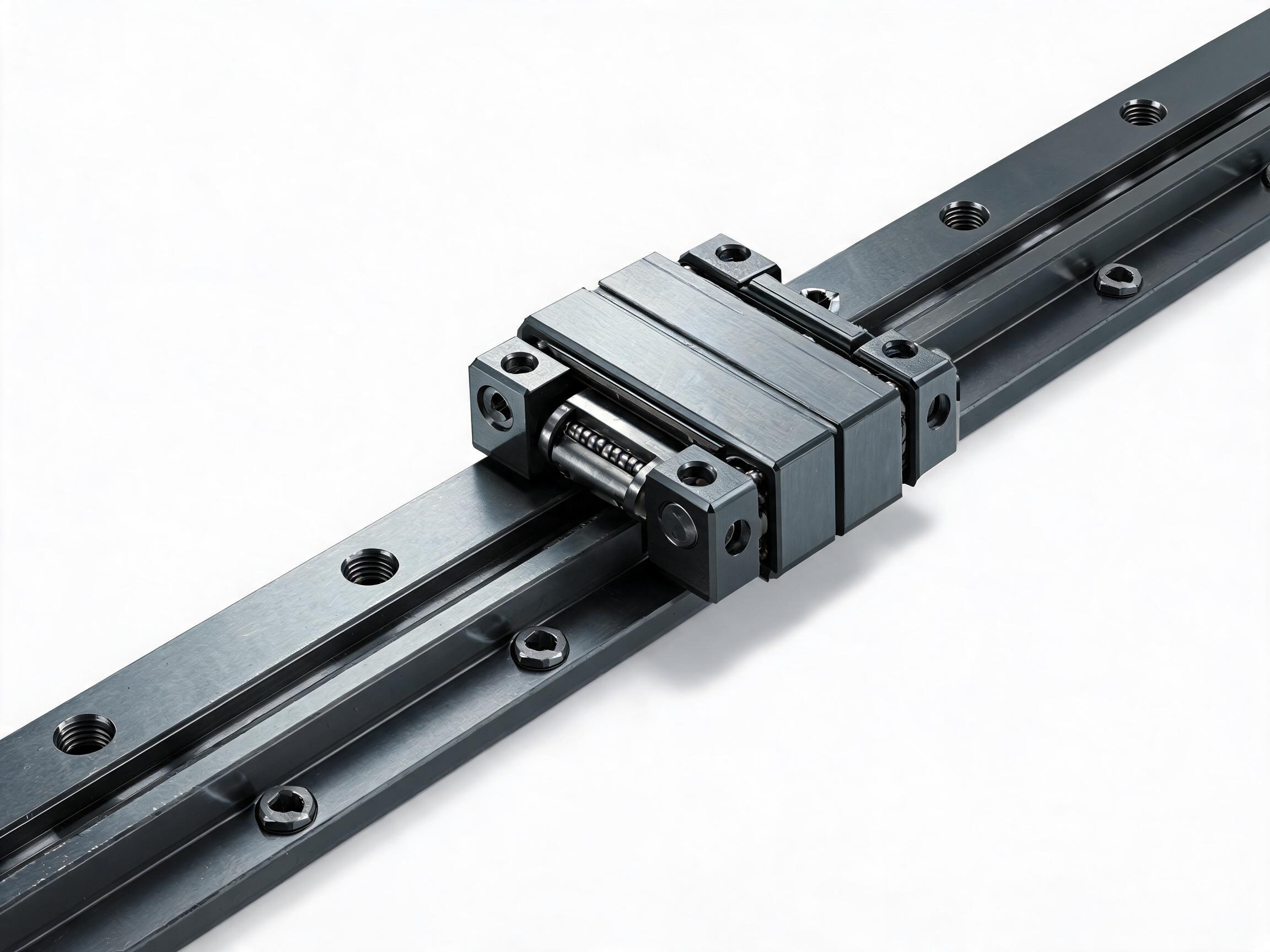
A datasheet HRC number describes the hardness of the surface it was measured on — not the case depth, the base steel grade, or the load rating of the finished assembly. This article explains what material and hardness claims actually mean across profile rails, ball bushes, plain bushes and aluminium housings, which failure each claim is meant to prevent, and what should appear on the incoming inspection document that ships with the goods.
Incoming Inspection
An HRC number on a datasheet is not a verdict on the part. It is a reading taken on one surface, at one depth, at one point in the process. Two suppliers can both print "58-62 HRC" and deliver parts that behave very differently in service, because the number says nothing about case depth, base metal grade, or the load rating of the finished assembly. This article translates the material and hardness claims you see across linear motion part families into the failures they are meant to prevent, and lists what should appear on the inspection document that ships with the goods.
Key takeaways
- An HRC figure describes a heat-treatment window on a measured surface, not the whole part.
- Hardness and case depth must be read together on a case-hardened profile rail.
- Plain composite bushes and aluminium housings carry load, friction, PV or alignment claims instead of hardness.
- The document that matters is the lot-level material and dimensional record, not the system certificate.
What an HRC claim does and does not guarantee
The Hardness Rockwell C scale measures resistance to indentation on a hardened steel surface. When a profile rail datasheet states 58-62 HRC, that range describes the hardness of the raceway surface after heat treatment. It is a process window, not a certificate for the finished rail.
Three things follow directly from that:
- Hardness is a surface property. It does not describe how deep the hardened layer goes. A 58-62 HRC reading on a 0.3 mm case and the same reading on a 2.0-2.5 mm case are indistinguishable by the Rockwell test alone, yet they behave differently under rolling contact.
- Hardness is not load capacity. Dynamic and static load ratings come from geometry, ball size, number of load-bearing rows and material quality together. A block rated 62.8 kN dynamic and a block rated 16.7 kN dynamic can both sit on 58-62 HRC steel.
- A company-level certificate does not certify a single part. A system certificate such as ISO 9001:2015 covers a plant's quality management system. It is not evidence that any particular rail left that plant within the printed hardness range. That evidence comes from the material report and dimensional records tied to the batch.
So the working rule for buyers: read the HRC line as a claim about a heat-treatment process window, then ask separately for the case depth, the base steel grade, and the lot-level document that shows both were measured.
Material and hardness by part family
Linear motion covers several different constructions, and the hardness claim plays a different role in each. The table below summarizes the type of claim you should expect to see for each family.
| Part family | Typical material claim | Hardness claim | What the claim is protecting |
|---|---|---|---|
| Heavy-duty profile rail (e.g. HGR45, 45 × 38 mm) | 45# high-carbon steel; case depth 2.0-2.5 mm | 58-62 HRC | Raceway fatigue resistance under repeated ball contact at high load |
| Compact profile rail (e.g. HGR20) | 55# high-carbon steel | 58-62 HRC | Same mechanism at lower load; rail retention of preload over cycles |
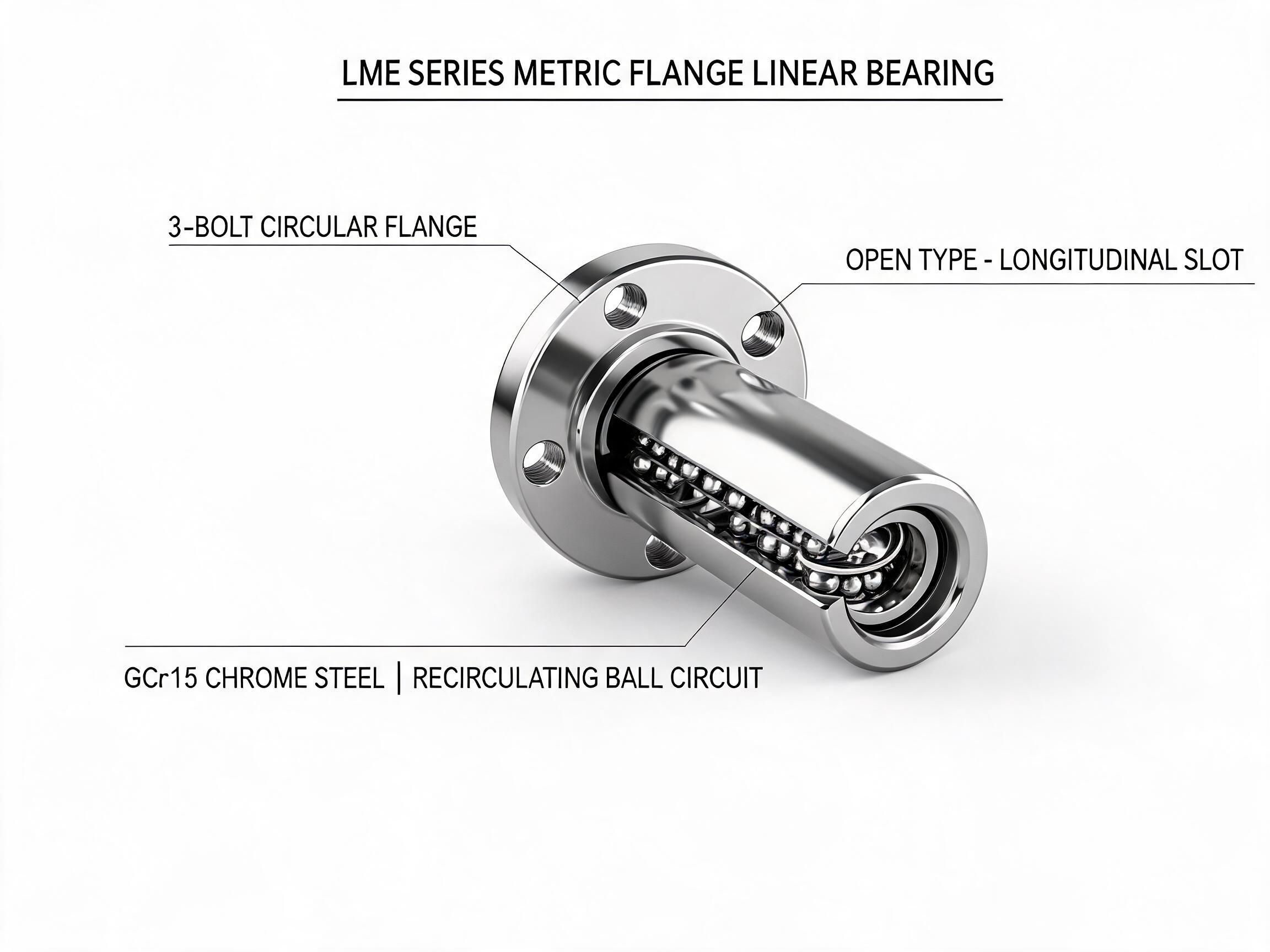
| Linear ball bearing bush (LM series) | GCr15 chrome steel; PA66-GF retainer | 60-64 HRC | Shaft/bushing raceway wear under continuous linear reciprocation |
| Plain bush (SC series) | PTFE-impregnated bronze composite with steel backing ring | No HRC claim — friction and PV define the part | Dry-running friction, seizure and PV-limit exceedance |
| SBR supported rail | GCr15 shaft at 58-62 HRC on 6063-T5 aluminium support rail | Shaft 58-62 HRC; rail is not hardened | Shaft wear, while the aluminium rail carries and locates the shaft |
| Housing unit (KH series) | ADC12 die-cast aluminium, pre-fitted LM..UU bearing | No housing hardness claim; self-aligning ±3° | Mounting alignment error absorption, not wear resistance |
Note the pattern: HRC applies to the hardened steel raceways and shafts. On composite bushings and aluminium housings, the meaningful claim is a different one entirely.
Which claim prevents which failure
Profile rail: HRC plus case depth
A profile rail carries load through steel balls rolling on a hardened raceway. If the surface is too soft, the raceway deforms plastically under repeated contact and the rail develops a running track that increases clearance and destroys preload. If the hardened case is too thin, the ball load can push through to the softer core, and the raceway spalls from below.
This is why the HGR45 data pair matters together: 58-62 HRC on a 2.0-2.5 mm case. The HRC answers "is the surface hard enough to resist fatigue?" The case depth answers "is there enough hardened material under the ball to keep the load away from the core?" A datasheet that gives only the first number has told you half the story.
For scale, the HGR45 block cited above carries 62.8 kN dynamic and 112 kN static load, in lengths up to 4000 mm with 60 mm hole pitch and M12 mounting holes, at 6.2 kg/m. The HGR20 carries 16.7 kN dynamic and 26.7 kN static. Hardness is identical on both; the load difference comes from size and geometry, not from the heat treatment.
Ball bush: GCr15 and its hardness window
GCr15 is a through-hardening chrome bearing steel, and the LM series bush cites 60-64 HRC — a narrower and harder window than the profile rail. The reason is that a bushing and its shaft form a rolling pair, and both surfaces see the same contact stress. If the shaft is soft and the bush is hard, the shaft wears; if the bush is soft, the bush wears. Matching the two is the real requirement, which is why a GCr15 shaft at 58-62 HRC paired with a 60-64 HRC bushing is a normal combination, and why mixing a hardened bush onto an unhardened shaft is not.
The retainer is a separate material decision. PA66-GF (glass-filled nylon) retains the balls and guides them; it does not carry the load, but it does set the temperature and speed envelope in practice. The LM16UU in this family is rated 980 N dynamic, and the series is specified to JIS B 1185 / ISO 10285.
Plain bush: hardness is the wrong question
An SC series plain bush has no rolling elements and no hardened raceway. It is a PTFE-impregnated bronze composite on a steel backing ring, with a friction coefficient of 0.08-0.12 dry. The claims that matter are the ones that define where the part stops working:
- Maximum static load, e.g. 12 kN on the SC20
- Maximum PV, 2.8 MPa·m/s dry
- Temperature range, -50°C to +200°C
- Bore tolerance, H7
If a supplier quotes you an HRC figure for a plain bush, ask what surface it was measured on. The steel backing ring is a structural support, not a bearing surface.
Housing units: alignment, not hardness
A KH series housing is ADC12 die-cast aluminium with a pre-fitted LM..UU bearing and ±3° of self-aligning movement. The property that keeps it working is the ability to absorb mounting misalignment so the bearing inside is not side-loaded. There is no hardness claim to read here, and none is needed.
What to ask for on the incoming inspection document
The datasheet tells you what the part is supposed to be. The inspection document tells you what this batch actually is. For linear motion parts, a useful document should cover the following. Use it as a checklist when you review what a supplier proposes to ship with the order.
- Steel grade and heat number for the rail or shaft, stated as the mill designation (45#, 55#, GCr15).
- Hardness reading with location and method — for example, surface Rockwell C on the raceway, with the measured value inside the claimed window.
- Case depth measurement where a case-hardened claim is made, such as the 2.0-2.5 mm figure for the HGR45.
- Dimensional record for the features that set fit: rail width and height, hole pitch and thread size, bushing bore tolerance.
- Batch or lot identification linking the document to the physical parts and their packaging.
- For plain bushes, the composite specification and the PV, temperature and load limits being applied.
- For assembled units, a note on what was fitted and the alignment tolerance.
A material report at 58-62 HRC is a useful document, but check that it names the steel grade, the measurement location and the batch. A report that gives only a hardness range and a company letterhead cannot be traced to the rails in the crate. If your supplier can provide a per-batch SGS material report and dimensional records, that is the standard to hold them to. Our own quality documentation is available for review during supplier qualification — you can request the current document set for a specific part number rather than a generic sample.
FAQ
What is linear material, in the context of a linear guide?
The term usually refers to the steel of the load-bearing raceway. On profile rails that is a high-carbon steel such as 45# or 55#; on ball bushes and shafts it is typically GCr15 chrome steel. The aluminium parts, retainers and housings are structural or retention components, not the bearing material.
What are linear components, and do they all have a hardness spec?
Linear components cover profile rails and blocks, ball bushes, plain bushes, shafts and supported rails, and housing units. Only the hardened rolling surfaces carry an HRC claim. Plain composite bushes and aluminium housings are specified by load, friction, PV, temperature and alignment instead.
Is a higher HRC always better for a linear guide rail?
No. An excessively hard or brittle surface with insufficient case depth can still fail, and the mating surface has to be considered as a pair. What you want is a controlled window — 58-62 HRC for the profile rails and shafts in the data above, 60-64 HRC for the GCr15 bush — together with a stated case depth.
What is GCr15 hardness, and why is it different from rail hardness?
GCr15 is a through-hardening bearing steel, and the LM series bush claims 60-64 HRC — slightly harder and narrower than the 58-62 HRC window used on profile rails and supported shafts. The bush and shaft run against each other, so matching the pair matters more than maximizing either number alone.
Does an SBR16 rail have the same hardness throughout?
No. The GCr15 shaft is 58-62 HRC, while the support rail beneath it is 6063-T5 aluminium and is not hardened. The double-row bearing block on this assembly is rated 7.8 kN dynamic and 12.0 kN static. When you inspect the document, expect the hardness reading to apply to the shaft only.
Can I use the HRC figure to compare two suppliers' rails before ordering?
Only as a first filter. Two rails both printed 58-62 HRC can differ in case depth, steel grade and geometric tolerance. Compare the base steel (45# versus 55#, for example), the case depth, the load ratings and the inspection documentation before treating them as equivalent.