
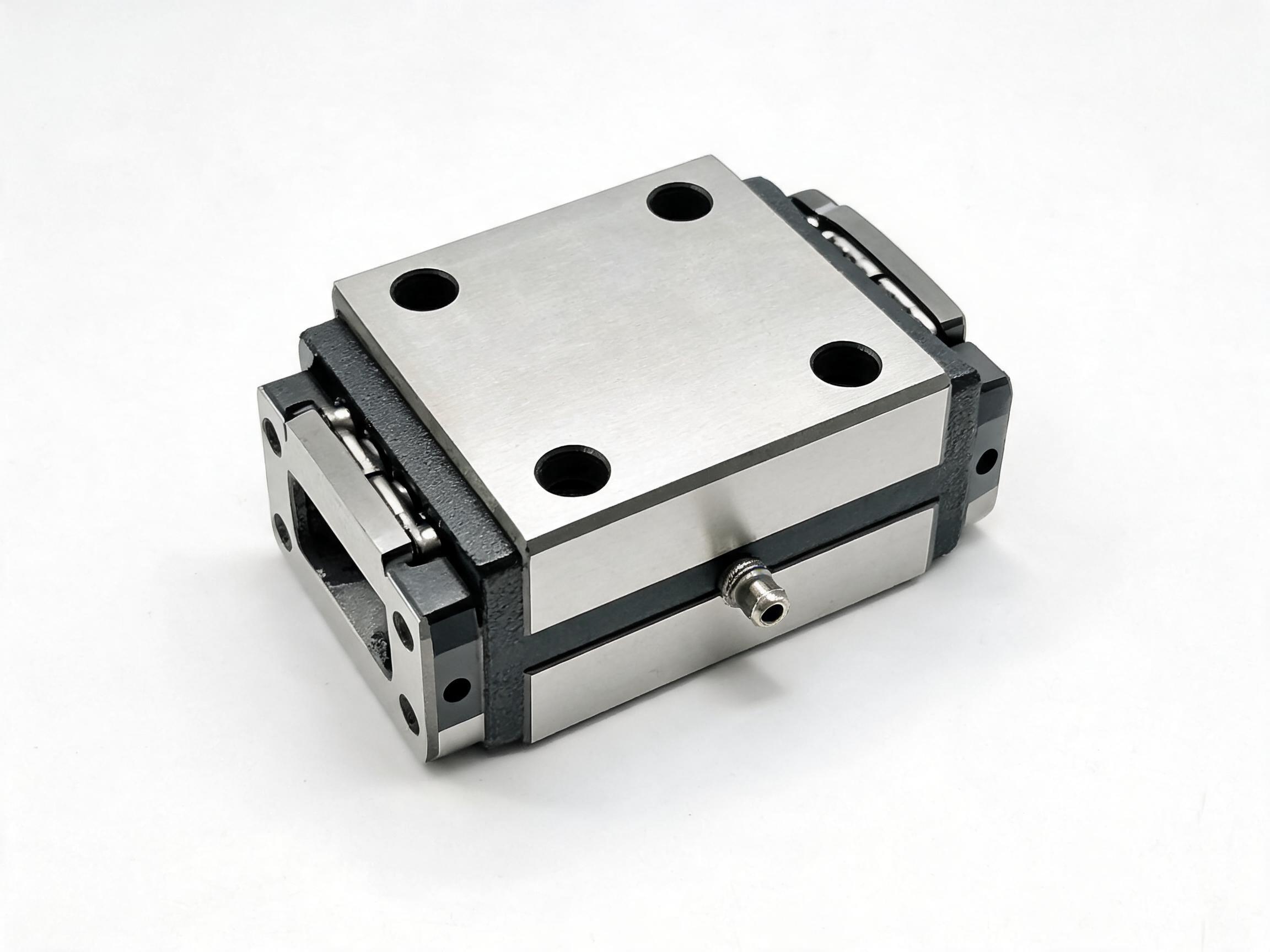
A rail and a carriage are only interchangeable on paper until five fields match: profile size, height code, preload grade, precision grade pairing and MOQ per SKU. This checklist walks through each field against our HGR and HGH data so you can confirm fit before placing a bulk order.
Linear Rail and Carriage: How to Order Them as a Set
A linear rail and carriage ordered together is one purchase but two part numbers. The rail is fixed by profile size and length; the carriage is fixed by size, height code, preload and precision. When these fields line up, the assembly slides; when one field is off by a code, the parts arrive and do not fit. The checklist below organizes the five fields that decide whether a rail and carriage can be used as one compatible set, using our HGR rail and HGH carriage data as the working example.
- Profile size number: the first field that must match
- Height code: standard CA vs high HA
- Preload grade C0 / C1 / C2 and how it pairs with precision
- Precision grade pairing: Ground H (P5) and Rolled N (P7)
- MOQ per SKU: 50 pieces, rail and carriage counted separately
Why ordering rail and carriage as a set is different
Buyers who order a carriage separately usually have a rail already on the machine, and the question is whether the new carriage will run on it. Buyers who order both together have a simpler question: do these two part numbers form a compatible set in the first place? The answer depends on matching fields, not on the brand printed on either part.
Our HGH carriages are dimensioned to the standard HGR rail cross-section and mount on rails ground to that profile regardless of brand. That is a statement about dimensional compatibility, not a guarantee of fit in every case. Fit accuracy depends on rail width and raceway radius tolerances matching the carriage bore. For a rail of unknown origin, verify against the dimensional drawing before bulk ordering. This article deals with the case where you control both halves of the purchase, so the fields can be locked before the order is placed.
Field one: the profile size number
The size number is the anchor. HGR rails are made in sizes 15, 20, 25, 30, 35 and 45. HGH carriages are made in the same six sizes: 15, 20, 25, 30, 35 and 45. A size 20 rail takes a size 20 carriage. There is no adapter and no overlap between sizes.
The reason for strict matching is the geometry of the cross-section. The rail cross-section and bolt-hole pitch follow the standard Taiwanese HGR profile, and the carriage bore is dimensioned to that cross-section. Size 25 has a different rail width and a different raceway radius than size 20, and the carriage bore follows accordingly. Two parts with the same size number are dimensioned to the same profile; two parts with different size numbers are not related.
In a mixed order this is where quoting errors appear. A BOM line asking for "HGR25 rail, 1200 mm, 6 pieces" next to "HGH20CA, 12 pieces" describes two systems, not one. When we quote mixed-size orders, the size field is checked line by line for this reason.
Rail length and hole count
Length is a rail-only decision, but it should be settled in the same request, because the bolt-hole pitch is fixed by the profile. State the required length and either the desired hole count or the intended mounting pitch, and the rail drawing can be matched to it. For the size 45 rail, the same profile rules apply; it is listed separately as a heavy-duty large rail on the HGR45 product page.
Field two: the height code
HGH carriages carry a height code in the model number. CA is the standard height; HA is the high height. The distinction matters when the carriage shares a mounting plane with other components, because the two codes place the top mounting face at different heights.
- CA (standard height) suits the common case where the carriage top face is the reference for the load plate.
- HA (high height) raises that face relative to the rail, which changes the stack height of everything mounted on it.
The height code is written into the part number, so it cannot drift between quotation and shipment without a model change: HGH20CA and HGH20HA are two distinct SKUs. When both codes appear on one BOM, treat them as separate order lines, each with its own MOQ. If the machine design fixes the stack height, the code must be confirmed against the assembly drawing before ordering, not after the carriages arrive.
Field three: preload grade
Preload is the internal clearance or interference between the carriage and the rail raceway. HGH carriages are offered in three preload grades:
| Grade | Preload state | Practical meaning for the design |
|---|---|---|
| C0 | Clearance | Light running, minimal drag; suited to applications where a small amount of play is acceptable. |
| C1 | Light preload | Takes up play while keeping running resistance modest. |
| C2 | Medium preload | Higher stiffness, higher running resistance; used where rigidity is the priority. |
Preload is chosen from the stiffness requirement of the machine, not from the rail. The rail itself does not have a preload grade; preload is set by the carriage bore relative to the rail. That is why preload belongs on the carriage line of the order, and why changing preload means changing the carriage model number, not the rail.
Field four: precision grade pairing
HGR rails come in two precision grades: Ground H (P5) and Rolled N (P7). The grade describes how the rail's running surfaces were produced and finished, and it is a property of the rail, not the carriage.
- Ground H (P5) rail is the finer of the two grades we list.
- Rolled N (P7) rail is the standard rolled grade.
When rail and carriage are ordered as a set, the pairing question is whether the selected carriage is intended for the rail grade you specified. The carriage mounts on the rail cross-section and is dimensioned to it, but the finished running accuracy of the assembly follows the rail grade, because that is where the running surface is formed. A P7 rail with a C2 preloaded carriage is not an error in itself; it is a combination to state explicitly in the request, with the accuracy requirement of the machine as the reason for the choice.
Write the grade into the rail line of the order, for example HGR25 H (P5) rather than HGR25. Leaving the grade to the supplier's default is how a quotation returns a part that meets the drawing but not the accuracy plan.
Field five: MOQ per SKU
Minimum order quantity is 50 pieces per SKU for both rail and carriage. The word to note is per SKU: rail pieces and carriage pieces are counted separately, and each distinct size, height code, preload and precision grade is its own SKU.
Mixed-size orders are accepted. MOQ applies per SKU, not per order, so a single shipment can carry several sizes side by side. In practice the per-SKU rule changes how a BOM is built. A project needing a modest quantity of several combinations still meets minimums, but only if each combination is called out as its own SKU. A BOM that lists "HGH25 carriage, 60 pieces" without splitting CA from HA will come back split into two lines of 30 pieces each, and neither meets the minimum. Splitting it in the request avoids the round trip.
One SKU, one model string
The cleanest way to keep this straight is to define every carriage by its full model string and keep the rail as its own line. HGH25CA with C1 preload is one SKU, and the Ground H (P5) rail it runs on is a second SKU counted separately; HGH25HA with C2 preload and its Rolled N (P7) rail make two more. Each line on the order carries its own quantity against its own minimum.
The compatibility checklist
Before a bulk order, run each rail and carriage pair through the following list. Each row is a field that must be stated on both sides or on the side where it applies.
| Field | On the rail | On the carriage | Check |
|---|---|---|---|
| Profile size | 15 / 20 / 25 / 30 / 35 / 45 | 15 / 20 / 25 / 30 / 35 / 45 | Numbers must be identical |
| Height code | n/a | CA or HA | Matches the stack height on the assembly drawing |
| Preload | n/a | C0 / C1 / C2 | Set by stiffness requirement |
| Precision | H (P5) or N (P7) | n/a | Stated on the rail line; accuracy plan confirms |
| Length and hole pattern | Length, hole count or pitch | n/a | Matches the mounting drawing |
| Quantity | 50 pcs per SKU | 50 pcs per SKU | Counted per SKU, not per order |
For a rail purchased from a third party, add one more step: obtain the rail manufacturer's dimensional drawing and check rail width and raceway radius tolerances against the carriage bore drawing. Our carriages are dimensioned to the standard HGR profile and mount on rails ground to that profile regardless of brand, but the fit of any specific third-party rail should be verified against the drawing before a bulk order is placed.
What the combined set is rated for
The load rating belongs to the carriage, not to the pair. HGH20CA is listed at 18.0 kN dynamic and 29.5 kN static. Those figures describe the carriage under its rated conditions; they do not change when the carriage is ordered together with a rail, and they should not be scaled across sizes or height codes without the datasheet for that specific model.
Sealing is built into the carriage: HGH blocks carry an end seal and side seal strip. The self-aligning tolerance of the HGH carriage is ±0.5 degree. Mounting is through four top-face mounting holes on a flange-type body, which is the pattern most machine plates are drilled to accept.
A worked ordering example
Take a machine that needs three axes: two horizontal at size 25 and one vertical at size 30. The horizontal axes call for Ground H (P5) rail, standard height CA carriages and C1 preload. The vertical axis calls for Rolled N (P7) rail, high height HA carriages and C2 preload. With rail and carriage counted separately, the BOM then has four SKUs:
- HGR25 Ground H (P5) rail, length per drawing, holes per drawing
- HGH25CA, C1 preload
- HGR30 Rolled N (P7) rail, length per drawing
- HGH30HA, C2 preload
Each line is quoted against the 50-piece per-SKU minimum, and spare carriages, if needed, are added as their own lines with their own quantities. The rail and carriage lines are ordered together so the size, height and preload pairing is settled before anything is cut.
Where ordering as a set saves a return
The fields above are not independent. A height code chosen for stack height can force a recheck of the mounting plate; a precision grade chosen for accuracy can change which rail is acceptable; a preload grade chosen for stiffness can change running resistance in a way the drive sizing has to absorb. Ordering rail and carriage together puts all of these on one request, where the pairing can be confirmed as a whole instead of discovered at assembly.
The full rail range, with grades and sizes, is listed on the HGR series rail page; the flange-type carriages with height codes, preload grades and load figures are on the HGH series carriage page. Any field not covered there, including dimensions for a specific length or a third-party rail check, should be confirmed against the datasheet or dimensional drawing.
The next step is to write your BOM as one line per SKU, with size, height code, preload, precision grade and quantity on every line, and match it against the two product pages. That request can be quoted as a set rather than as separate parts.