A system-selection guide for buyers matching linear ball bushings to round shafting. Learn when to use closed-type versus open-type bushes, how flanged variants solve mounting constraints, which sealing suits dusty environments, and the key fit and grade checks to confirm before ordering.
Specifying a linear rod bearing by shaft diameter alone is a common and costly shortcut. The bush, the shaft, the housing, and the seals form one system: change the shaft grade and the fit changes; change the mounting method and the bush type may need to change with it. This guide walks through the decisions that actually determine whether a bushing will run its rated life or fail early, using the LMK series as a working example where useful.
- Closed-type bushes suit supported shafts; open-type bushes are for long unsupported spans where shaft supports are added along the length.
- Flanged variants (square or round flange, double-length) solve mounting problems when a press-fit housing is not practical.
- Seal choice depends on the dust and debris in the environment, not on the load rating.
- Confirm shaft diameter and grade, housing bore fit, seal type, and lubrication access together before ordering.
Closed-type or open-type: start with the shaft support layout
The first branch in the selection tree is not load or speed; it is how the shaft is supported. A closed-type linear ball bushing fully encircles the shaft and relies on the shaft having adequate support over its length. When the shaft is short and rigidly mounted at both ends, or fully supported by a continuous rail, a closed bush gives you a full ball circuit around the shaft and the most straightforward installation.
Open-type bushes exist for the opposite case: a long span where the shaft cannot be supported at both ends without excessive deflection, or where shaft supports are placed at intervals along the run. The open sleeve lets the bush travel past those supports instead of hitting them. If your design needs intermediate shaft supports, an open-type bush is usually the only workable choice. If the shaft is fully supported, the closed type is simpler and avoids the alignment sensitivity that open bushes can introduce.
A practical check before you commit: draw the shaft support points on the layout. If the bush would collide with any support, open type. If every support is outside the travel zone, closed type.
Flanged variants: when bolts replace a press-fit housing
Housing bore fit is the second decision. A standard cylindrical bush needs a housing bore machined to the correct fit; if the housing cannot hold that tolerance, or if the mounting plate is thin, a flanged bush lets you bolt the bearing directly to the structure. That removes the need for a separate housing block and simplifies assembly and replacement.
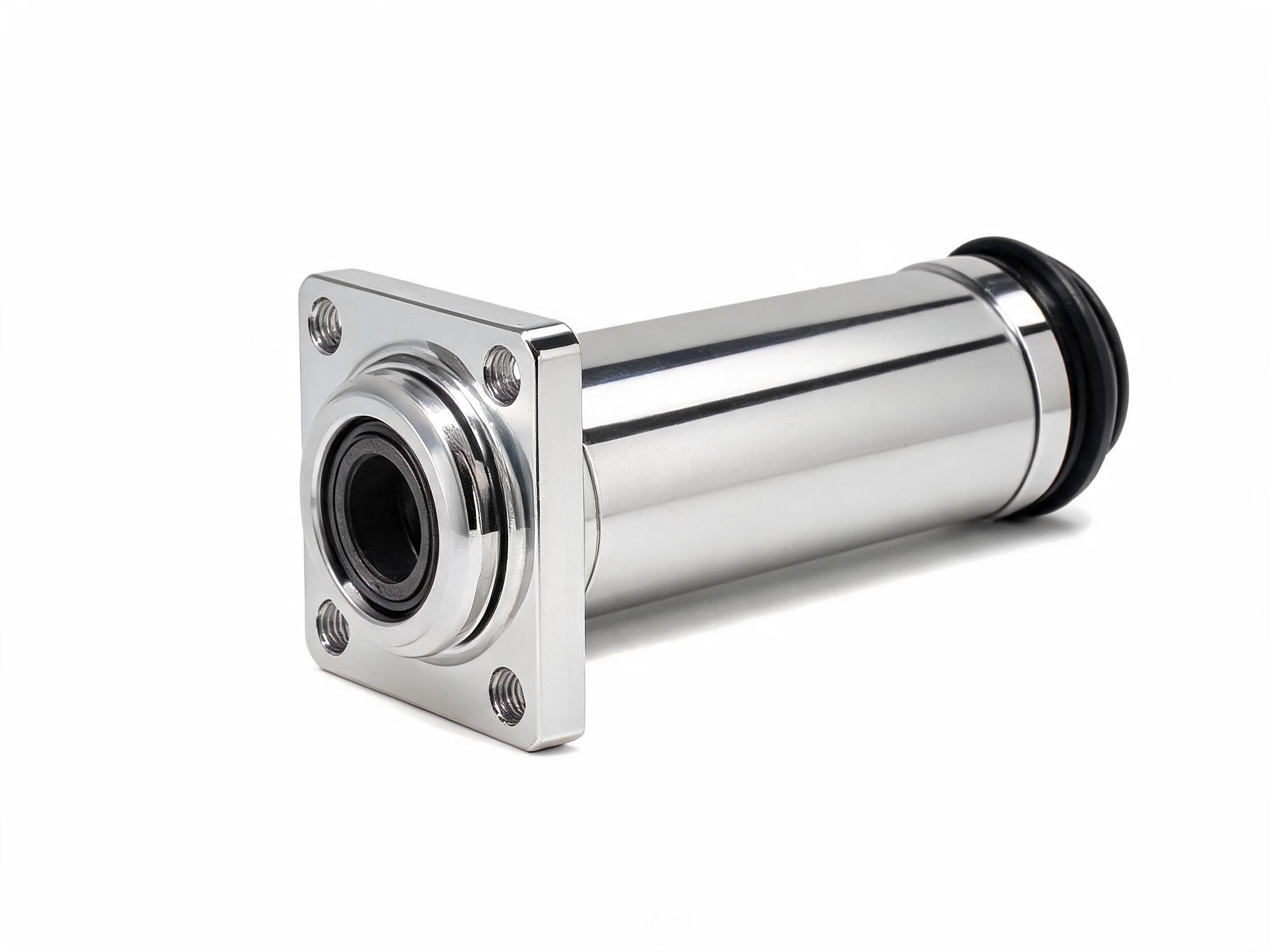
Flange geometry matters as much as flange presence. Square flanges with four bolts, such as the LMK series double-length square-flange bearing, follow a defined four-bolt flange pattern (bolt specification referenced to JIS B 1185) and spread the mounting load across four points. Round flanges suit tighter envelopes where the diagonal of a square flange would interfere with adjacent components. Double-length variants add a second ball recirculation circuit, giving two independent circuits that spread load over roughly 1.8x the contact length of a single-length bush and increase both dynamic and static capacity. At LMK16UU, for example, dynamic load is 2,350 N and static load is 3,680 N, against 1,370 N dynamic for the standard single-circuit LMF16UU. The LMK series covers shaft diameters from 6 mm to 50 mm.
The trade-off is axial length: a double-length bush needs more room along the shaft and a longer supported span. Use it when the load or the moment requires the extra capacity, and use a single-length flanged bush when space is tight and loads are moderate.
Sealing: match the seal to the dust, not to the load
Seal selection is often decided last, after the bush type and size are fixed, but it should be decided with them. A standard open bush lets dust into the ball circuit, and once abrasive particles are inside, the recirculation path wears quickly. Double rubber seals, designated UU, close both ends of the bush and are the usual choice for general workshop, packaging, and outdoor-adjacent machinery where fines or coolant mist are present.
The LMK series uses UU double rubber seals as standard. That does not make it a sealed-for-life bearing: the seals protect the ball circuit, but they also retain the lubricant film, so lubrication access still has to be planned. Where the environment is clean and the priority is low friction, a non-sealed or lightly sealed variant may be acceptable; where washdown or heavy dust is present, plan for more frequent relubrication and check with the supplier whether a heavier seal option is available for the specific size.
The selection checklist: confirm these together
Individual data points are easy to check; the risk is confirming them in isolation and then finding a mismatch at assembly. Use the checklist below as a single pass before releasing the order.
- Shaft diameter and grade. The bush bore is matched to the nominal shaft diameter, but the shaft tolerance grade determines the actual running clearance. Confirm the shaft grade and the resulting fit with the datasheet or supplier; do not assume a standard ground shaft will give the same fit as a different grade.
- Housing bore fit. For cylindrical bushes, confirm the housing bore tolerance and material with the supplier. For flanged bushes, confirm the bolt pattern, bolt size, and flange thickness against your mounting plate.
- Seal type. Confirm UU double rubber seals or the alternative specified for your environment, and confirm the seal material is compatible with any coolant or cleaning agent present.
- Lubrication access. Confirm whether the bush has a lubrication hole or groove and how it will be reached after assembly. A sealed bush that cannot be relubricated in place will have a shorter service life than its rating suggests.
- Travel and load. Check that the selected bush's dynamic and static ratings cover the actual load, including moment loads from offset mounting. For the LMK16UU, the 2,350 N dynamic and 3,680 N static figures apply to that size; confirm ratings for other sizes from the datasheet.
- Precision grade. If the application needs tighter running accuracy, confirm whether a precision grade such as H5 is available on request for the size you need.
Putting the system together: a worked example
Suppose a packaging machine needs a linear guide on a 16 mm shaft, with the shaft supported at both ends and a stroke that stays clear of the supports. The load is moderate but there is dust from carton board. A closed-type, double-length bush with UU seals would be a reasonable starting point: the closed sleeve gives full ball contact, the double-length circuit provides margin against the load and any minor misalignment, and the UU seals keep the carton dust out. If the mounting plate cannot be bored to a press fit, the square-flange LMK variant lets you bolt the bush directly to the plate. The LMK series double-length square-flange linear ball bearing matches this combination, with dynamic load 2,350 N at LMK16UU, static 3,680 N, and — per the LMK series datasheet — approximately 60% longer rated travel life than a standard single-circuit bush of the same size. That rated figure still assumes correct alignment, a clean environment and a proper relubrication schedule; actual service life depends on all three.
If the same machine had a stroke longer than the supported span, the decision would flip: an open-type bush running past intermediate shaft supports would be needed instead, and the housing and seal choices would follow from that.
What to confirm with the supplier before ordering
The catalog gives nominal dimensions and ratings; the fit and grade details that determine running life usually need confirmation. Prepare a short list for your supplier:
- The shaft grade you plan to use, and the recommended bush bore fit for that grade.
- The housing bore tolerance and material, or the flange bolt pattern for flanged variants.
- The seal type for your environment, and the relubrication interval for that seal.
- Availability of precision grades such as H5 on request for your size.
- Load ratings for the specific size, since the LMK16UU figures above do not transfer to other diameters.
Matching the bush to the shaft is a system decision. Send the checklist above, together with your shaft grade, load and stroke details, to the supplier for fit confirmation and a quotation before releasing the order — the bearing you install will then have the best chance of reaching its rated travel life.