A practical procurement guide covering the critical specifications of linear rods and rail linear systems—material selection, hardness requirements, precision grades, and what to verify with suppliers before placing an order.
BUYER GUIDE · LINEAR MOTION COMPONENTS
Why the Spec Sheet Matters More Than the Price
When you source linear rods and rail linear systems for production equipment, the purchase decision comes down to three numbers: the material grade, the hardness value, and the precision class. These three parameters determine whether your machine holds tolerance at 200 cycles per minute or fails after three months of operation.
This guide walks through what each specification actually means, how to read a supplier's datasheet critically, and which questions to ask before committing to a batch order. It is written for procurement engineers and buyers who need to compare quotes across suppliers—not for end users.
- Material grade drives corrosion resistance and load capacity—confirm the exact grade (e.g., GCr15, 440C, 60Si2Mn) in writing, not just "bearing steel."
- Hardness is a range, not a single number. Verify both the HRC range and the case depth for induction-hardened or through-hardened products.
- Precision grades follow standards (ISO, JIS, GB). Match the grade to your application—over-specifying adds cost, under-specifying adds scrap.
- Surface finish and straightness are often where low-cost suppliers cut corners. These are measurable and should appear on the certificate of inspection.
- Ask for the test method behind each claimed value. A hardness number without a test standard is not a specification.
Material Selection: Matching the Grade to the Operating Environment
The material of a linear rod or rail determines its load capacity, wear resistance, and corrosion behavior. Most linear motion components fall into three material families.
1. High-Carbon Chromium Bearing Steel (GCr15 / SUJ2 / 52100)
This is the default choice for general-purpose linear rods and rails. GCr15 (the Chinese designation, equivalent to SUJ2 in JIS and 52100 in AISI) offers high hardness after heat treatment—typically 58–62 HRC—and good wear resistance. It is suitable for dry or lightly lubricated environments where corrosion is not a primary concern.
If a supplier lists "bearing steel" without a grade, ask for the specific designation. GCr15, SUJ2, and 52100 are similar but not always interchangeable in heat treatment response, especially in larger cross-sections.
2. Martensitic Stainless Steel (440C / 9Cr18)
For food processing, medical equipment, or any wash-down environment, stainless linear rods and rails are required. 440C (or the Chinese equivalent 9Cr18) achieves hardness around 56–58 HRC after heat treatment—slightly lower than GCr15 but with meaningful corrosion resistance.
Note: "Stainless" does not mean "stain-proof." 440C offers better corrosion resistance than GCr15, but it is not suitable for prolonged immersion in salt water or strong acids. For those conditions, you may need a different material family entirely—discuss this with your supplier.
3. Alloy Spring Steel (60Si2Mn / SUP6)
Less common for precision rails but occasionally used for shafting that requires some flexibility or shock absorption. Hardness is typically lower (45–50 HRC), and surface finish is usually not as fine as bearing steel. This material appears more in agricultural machinery and heavy equipment than in precision automation.
| Material | Common Grades | Typical Hardness | Corrosion Resistance | Typical Applications |
|---|---|---|---|---|
| Bearing Steel | GCr15 / SUJ2 / 52100 | 58–62 HRC | Low | General automation, machine tools, packaging equipment |
| Stainless Steel | 440C / 9Cr18 | 56–58 HRC | Moderate | Food processing, medical, cleanroom, wash-down |
| Alloy Spring Steel | 60Si2Mn / SUP6 | 45–50 HRC | Low | Heavy equipment, shock-load applications |
Hardness: What the Number Actually Tells You
Hardness is the most frequently quoted—and most frequently misunderstood—specification on a linear component datasheet. When a supplier states "60 HRC," you need to know three things:
- The hardness range, not just a single point. A batch of rods will show variation across parts and across the length of a single part. A realistic range is 58–62 HRC, not a fixed 60.
- The case depth. Many linear rods are induction-hardened or case-hardened rather than through-hardened. The hard layer may be only 1–3 mm deep. For applications with point loading or impact, through-hardening may be required. Ask for the effective case depth in millimeters.
- The test method. Rockwell C (HRC) is standard for hardened steel. But a supplier quoting "HRC" may be using a different scale or a converted value from a Vickers or Brinell test. Confirm the test standard (e.g., ISO 6508 for Rockwell).
A hardness number without a test method and a case depth is a marketing claim, not a specification. Get both in writing.
Precision Grades: Reading the Numbers Correctly
Precision for linear rods and rail linear systems is expressed through several measurable parameters: diameter tolerance, straightness, surface roughness, and—for rails—the parallelism and height tolerance of the raceway.
Diameter Tolerance
For linear rods, the diameter tolerance is typically expressed as a letter-and-number code (e.g., g6, h6) or as a direct micron value. A g6 tolerance on a 20 mm shaft means the diameter can vary within a range of approximately 0 to −13 microns. That is a common choice for applications requiring a sliding fit with a linear bearing.
Straightness
Straightness is specified as a deviation over a given length—for example, 0.05 mm per 1000 mm. This is critical for long-stroke applications. A rod that is perfectly round but bent will cause premature bearing wear and vibration.
Surface Roughness
For hardened and ground rods, surface roughness is typically Ra 0.2–0.4 μm. Lower Ra values (smoother surfaces) reduce friction and wear on the mating bearing. If a supplier cannot provide a measured Ra value, treat the product as unverified.
| Parameter | Typical Value (Precision Grade) | What to Verify |
|---|---|---|
| Diameter tolerance | g6 / h6 | Actual micron range, not just the code |
| Straightness | 0.05 mm / 1000 mm | Measured over full length, not a sample section |
| Surface roughness | Ra 0.2–0.4 μm | Test method and position of measurement |
| Hardness | 58–62 HRC | Range, case depth, test standard |
| Effective case depth | 1–3 mm (induction) | Through-hardened vs. case-hardened |
Rail Linear Systems: More Than Just a Rod with a Flat Side
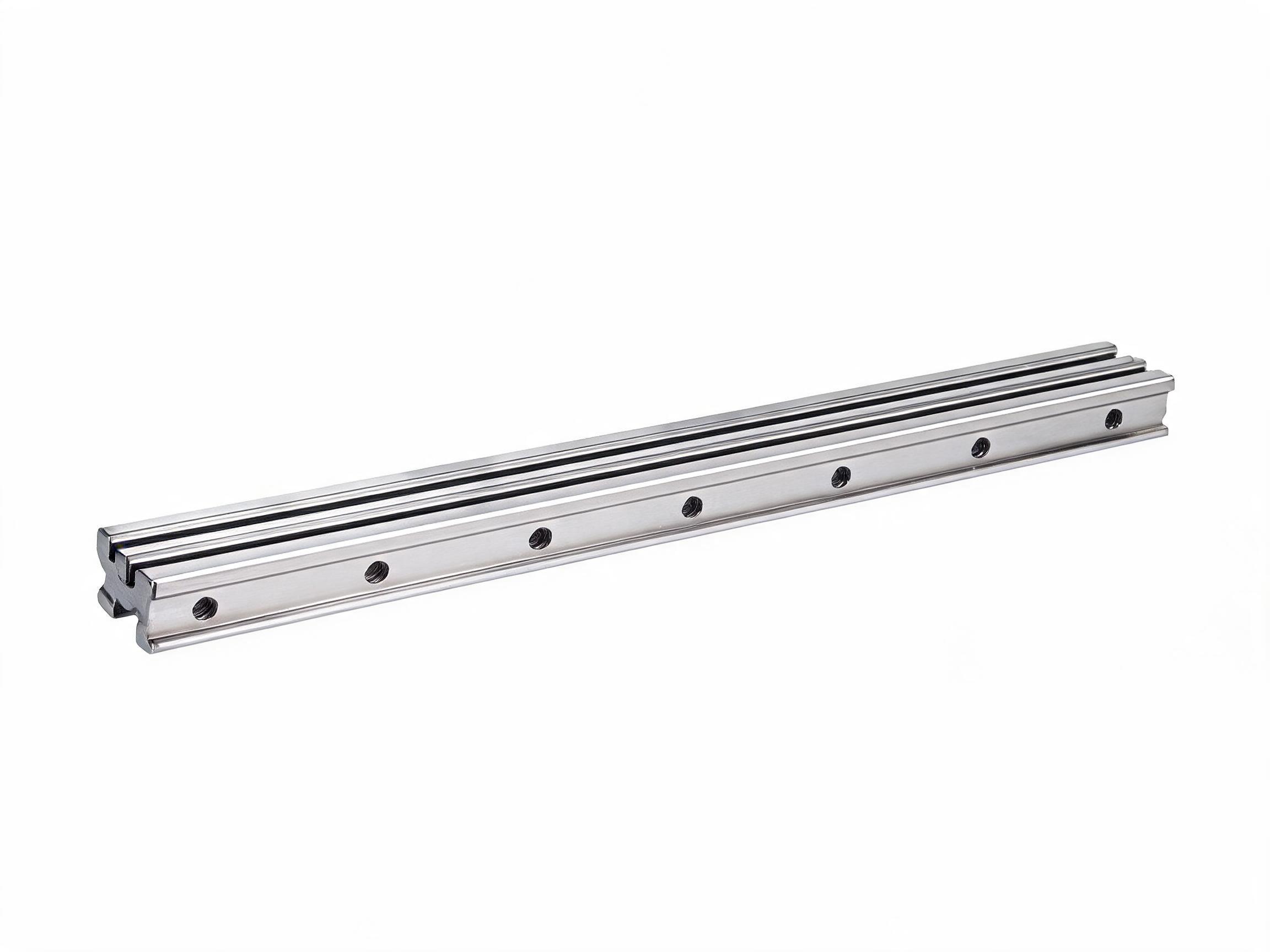
Rail linear systems—often called linear guides or profiled rails—are more complex than plain shafts. They consist of a hardened rail and a carriage with recirculating ball bearings. The specifications that matter here include:
- Raceway hardness and depth. The raceway (the groove where the balls run) must be hard and deep enough to resist Brinelling (permanent indentation from static load).
- Parallelism. The two raceways on a rail must be parallel to each other and to the mounting surface. This is measured in microns over the rail length.
- Carriage preload. Preload classes (clearance, light, medium, heavy) determine the rigidity of the carriage. A medium preload is common for general automation; heavy preload for machining applications. Confirm the preload class in your order.
- Mounting surface flatness. The rail's bottom surface and the carriage's mounting surface must be flat within a specified tolerance. If not, the rail will distort when bolted down, and precision is lost.
Common Specification Traps in Supplier Quotes
When comparing quotes from different suppliers, watch for these discrepancies:
- Hardness quoted as "above 60 HRC." This is not a spec. Ask for the exact range and the test report.
- Straightness quoted per 300 mm instead of per 1000 mm. A rod that is straight within 0.02 mm per 300 mm may still be 0.2 mm off over a meter. Always normalize to the same reference length.
- Surface finish quoted without a parameter. Ra, Rz, and Rq are different measurements. Ra is the most common for linear components, but confirm it.
- Material grade listed as "equivalent to." "Equivalent to" is not the same as "certified to." If your application is critical, request the mill certificate or a material test report.
Quality Control: What a Reliable Supplier Should Provide
A professional supplier of linear rods and rail linear systems should be able to provide, upon request:
- Material certificates (mill certificates) for the raw material batch.
- Heat treatment records, including hardness range and case depth.
- Inspection reports for diameter, straightness, and surface roughness.
- Dimensional inspection reports for rail parallelism and carriage mounting surfaces.
- Packaging details for export (rust prevention, protective wrapping, wooden crating for long lengths).
If a supplier hesitates to provide these documents, treat it as a red flag. In B2B procurement, the paperwork is part of the product.
Matching the Spec to Your Application
Over-specifying is as costly as under-specifying. A precision-grade stainless rail for a dry, indoor, low-load application is wasted money. Conversely, a standard-grade bearing steel rod in a wash-down environment will rust and fail quickly.
Use this rough decision path:
- Indoor, dry, moderate load: GCr15 bearing steel, 58–62 HRC, g6 tolerance, Ra 0.4 μm.
- Wash-down or humid environment: 440C stainless, 56–58 HRC, confirm corrosion resistance meets your cleaning chemicals.
- High-speed, high-precision automation: Premium precision grade, tighter straightness (0.03 mm/1000 mm or better), medium preload carriage.
- Shock or impact loading: Through-hardened material, verify case depth, consider larger diameter or rail size.
Questions to Ask Before You Place the Order
Before finalizing your purchase order, send the supplier this checklist. The answers should come back in writing.
- What is the exact material grade, and can you provide the mill certificate?
- What is the hardness range (not a single point), and what test standard was used?
- Is the product through-hardened or case-hardened? If case-hardened, what is the effective case depth?
- What is the straightness tolerance, normalized to 1000 mm?
- What is the surface roughness (Ra), and where on the part was it measured?
- For rail linear systems: what is the preload class of the carriage?
- What is the packaging standard for export, and how is rust prevention applied?
- Can you provide an inspection report for the specific batch you are shipping?
Final Note for Buyers
Linear rods and rail linear systems are commodity items only when your requirements are loose. The moment you need a specific material, hardness range, and precision grade, the supplier's quality system becomes the differentiator. A cheap quote that skips the paperwork will cost more in machine downtime and rejected parts than the price difference you saved.
When in doubt, request samples or a small trial batch before committing to full production quantities. Measure the delivered parts against the agreed specifications. The supplier who passes that test is the one worth scaling with.
If you are currently sourcing linear rods or rail linear systems and need a supplier who provides full material certificates and inspection reports, contact us with your drawings or target specifications. We will confirm feasibility, lead time, and packaging options against your requirements.