
A buyer's guide to the LM16UU linear bearing: how the model code reads, the verified 980 N dynamic load rating, closed versus open type selection, and the shaft and housing fit checks that decide whether a 16 mm bearing runs smoothly in your assembly.
Linear Motion Components
The LM16UU is a 16 mm closed-type linear ball bearing bush. Before you add it to a BOM, you need three answers: does the code match your shaft, what load can it carry, and will it sit correctly in the housing bore. This guide covers all three with the rating data for this model.
Quick facts for LM16UU
- Model code reads as 16 mm shaft diameter, UU = closed type
- Dynamic load rating: 980 N
- Outer ring: GCr15 chrome steel, hardness HRC 60-64
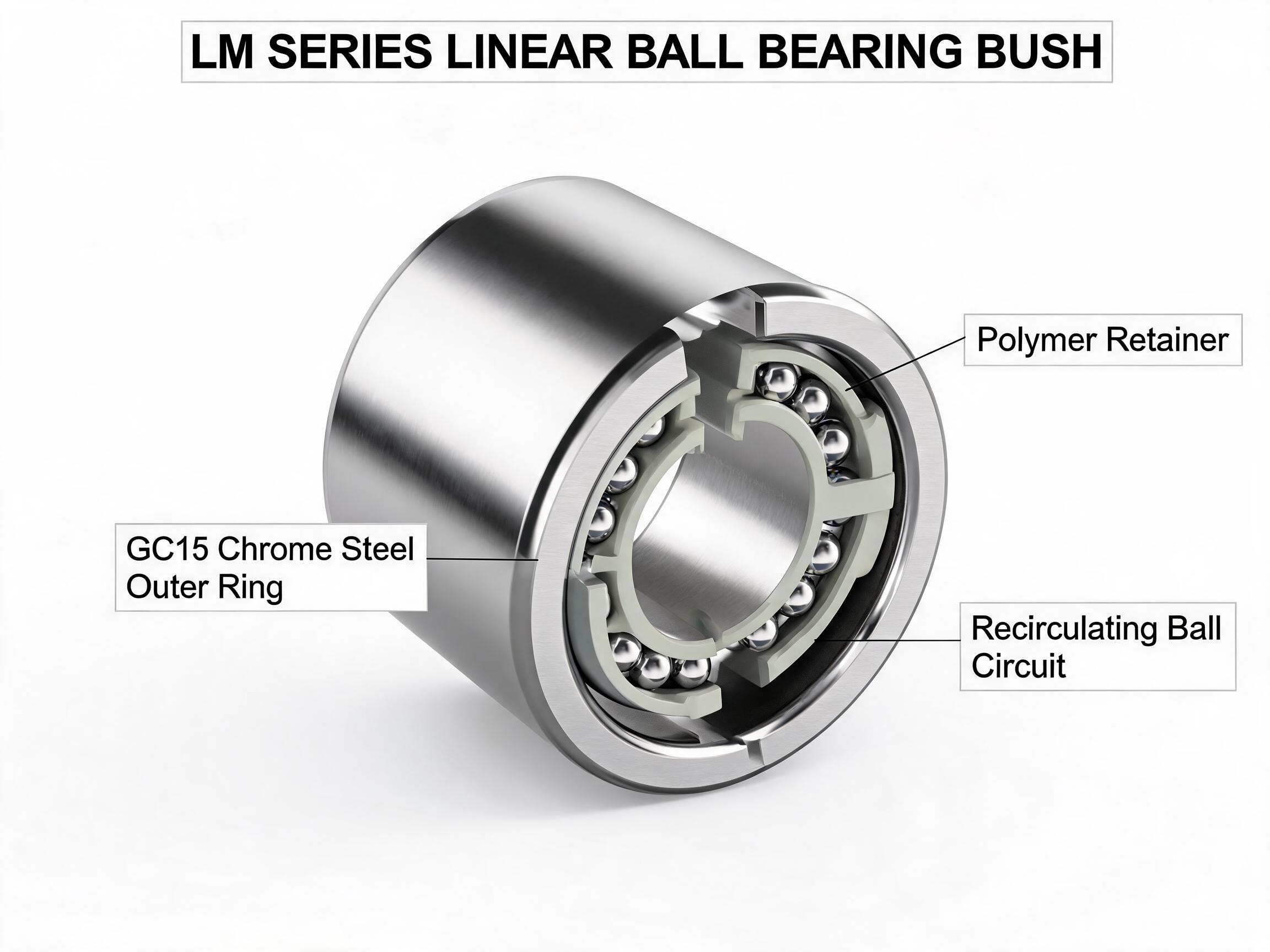
- Retainer: PA66-GF polymer, recirculating ball circuit
- Standards: JIS B 1185 / ISO 10285
- MOQ: 100 pieces
What this article covers
- Reading the LM16UU model code
- Verified load and material specifications
- Closed (UU) versus open (OP) type selection
- Shaft checks: diameter, hardness and alignment
- Housing fit and bore considerations
- Buyer checklist and FAQ
What the LM16UU Model Code Tells You
Linear bearing codes are not arbitrary. In the LM series, the number in the model designation is the nominal shaft diameter in millimetres. For the LM16UU, that is a 16 mm shaft. The letters after the number describe the sealing and body configuration.
The UU suffix indicates a closed type bearing. This is the standard configuration for a shaft that is fully supported along its length and passes through the housing bore. It gives you the full ring of contact around the shaft.
The LM series as a whole covers shaft diameters from 6 mm to 60 mm, so the 16 mm version sits in the lower-middle of the range. That size range matters when you are standardising a machine design: the same housing layout and fit logic can be reused across a family of assemblies with different shaft sizes, as long as you confirm each individual model's rating.
If you are sourcing this part directly, the catalog entry for the LM Series Linear Ball Bearing Bush (SKU LM-16UU) lists the same model designation, so you can cross-check the code against your drawing before ordering.
Verified Specifications and Load Rating
Load capacity is the number most buyers check first, and it is also the number most often misquoted in generic catalogs. For the LM16UU, the published dynamic load rating is 980 N. Treat that as the working figure when you compare the bearing against the actual radial load in your application, with a safety margin appropriate to your duty cycle and vibration environment.
Construction details that affect durability and running behaviour:
| Parameter | Specification |
|---|---|
| Model | LM16UU |
| Shaft diameter | 16 mm |
| Type | Closed type (UU) |
| Dynamic load rating | 980 N |
| Outer ring material | GCr15 chrome steel |
| Outer ring hardness | HRC 60-64 |
| Retainer material | PA66-GF polymer |
| Ball circuit | Recirculating |
| Standards | JIS B 1185 / ISO 10285 |
| Minimum order quantity | 100 pieces |
The GCr15 chrome steel outer ring at HRC 60-64 is the hardened raceway surface the balls run on. This is a through-hardened bearing steel, not a case-hardened or coated part, and the hardness range is the one to cite if your drawing or quality plan calls out a surface hardness requirement.
The PA66-GF retainer holds the ball circuit in position as the balls recirculate through the return channel. A polymer retainer keeps mass and running friction down compared with a full-metal cage, and it is the standard configuration for this series. If your application involves high ambient temperatures or aggressive solvents, confirm the retainer's suitability with the supplier before committing to a batch, since operating limits are not part of the specification table above.
The recirculating ball circuit is what allows continuous linear travel: balls roll along the loaded zone, then return through the unloaded channel inside the bush. This is the design that produces low friction compared with a plain sliding bush, and it also means the bearing needs a shaft surface hard and smooth enough for the balls to roll on without brinelling.
Closed (UU) vs Open (OP) Type: Which One Fits Your Machine
The LM series offers both closed and open versions. Critically, the open type (OP) shares the same outer dimensions as the closed type, so you can substitute one for the other in the same housing bore without redesigning the mounting.
When closed type (UU) is the right choice
- The shaft is fully supported and the bearing slides along it as a complete ring
- You need the full circumference of ball contact for load distribution
- The assembly is a straightforward through-bore housing with a retaining feature
When open type (OP) is the right choice
- The shaft is supported at intervals by pedestals or blocks, and the bearing must straddle the supports
- You need to mount or remove the bearing sideways from an already-installed shaft
- The housing must be split or adjustable, requiring the open body
Because the outer dimensions are identical, the decision is mechanical, not dimensional. Look at how the shaft is supported and how the bearing will be assembled. A fully supported shaft in a rigid housing normally means closed type. Interrupted shaft support, or assembly that requires the bearing to be slipped on from the side, points to open type.
Shaft Selection and Fit Checks
The shaft is half the bearing system. A correctly specified LM16UU on an out-of-spec shaft will still run rough, wear early, or fail to achieve the expected travel life. Work through these checks before you place an order.
Nominal versus actual shaft diameter
The 16 mm in the model code is a nominal designation. Your shaft drawing should specify the actual tolerance band for the bearing seat, and the finished shaft should be measured to confirm it falls inside that band. Do not assume that a shaft described as "16 mm" is automatically within the tolerance the bearing requires.
Surface hardness
Recirculating ball bearings transfer load through small contact points. A soft shaft will deform under that contact and develop indentations that the balls then roll over, which shows up as roughness and accelerated wear. Specify a hardened shaft for the ball raceway zone, and confirm the hardness with your shaft supplier against your own design requirement.
Surface finish and straightness
Raceway surfaces should be ground and smooth. Straightness matters as much as diameter: a bowed shaft will load the bearing unevenly along its travel, and the outer ring will follow the bend, transmitting that error into the housing. If your shaft is long relative to its diameter, check straightness as a separate inspection item.
Two-bearing alignment
Most linear axes use two bearings on the same shaft or two shafts in parallel. If the two bores are not aligned, the bearings will fight each other and load will rise well beyond the nominal 980 N figure. Align the housings to each other, not just to the shaft, and check parallelism across the full travel length.
Housing Fit Checks
The housing bore controls how the outer ring sits. Too loose and the outer ring can creep or rotate; too tight and the ring can be distorted, pinching the ball circuit and raising running friction.
- Bore tolerance: specify the bore to the tolerance band your design requires and inspect the finished bore, not just the drawing callout.
- Bore roundness and taper: an out-of-round or tapered bore deforms the outer ring unevenly. Check roundness at both ends of the bore.
- Retention: confirm how the bearing is held axially. The closed type sits in a through-bore and needs a shoulder, snap ring, or end cap to prevent walking.
- Assembly access: if the housing is blind or difficult to reach, verify that the bearing can be pressed in squarely without loading the retainer.
A common mistake is to treat the housing as a simple clearance hole and rely on the shaft to locate the bearing. That works only if the bore is genuinely concentric and sized correctly. Where the bore size is uncertain, measure a sample housing before committing to the full batch of bearing bushes.
Buyer Checklist Before Ordering
- Confirm the shaft is 16 mm nominal and check the measured diameter against your tolerance band
- Confirm shaft hardness and surface finish in the raceway zone
- Decide closed (UU) or open (OP) based on shaft support and assembly direction
- Verify the housing bore size, roundness and axial retention method
- Compare the actual radial load against the 980 N dynamic rating with your chosen safety margin
- Confirm the retainer material is acceptable for your environment, or ask the supplier about limits
- Plan for the 100-piece minimum order quantity
The LM series linear ball bearing bush range covers 6 mm to 60 mm shafts, so if this 16 mm size is part of a larger machine family, you can source the full set from the same series and keep your fit logic consistent.
Frequently Asked Questions
Does LM16UU fit a 16 mm shaft?
Yes. The 16 in the model code is the nominal shaft diameter, so LM16UU is the 16 mm size in the LM series.
What is the load rating of the LM16UU?
The dynamic load rating is 980 N. Compare that figure against the actual radial load in your application, with a margin suited to your duty cycle.
Can I use an open type in the same housing?
The open type (OP) shares the same outer dimensions as the closed type (UU), so it fits the same bore. The choice depends on how your shaft is supported and how the bearing is assembled.
What is the minimum order quantity?
MOQ is 100 pieces.
Which standards does the LM16UU follow?
The series is specified to JIS B 1185 and ISO 10285.
Need the LM16UU for a 16 mm shaft?
Send your shaft tolerance, housing bore size and expected radial load, and we can confirm the bearing configuration against your drawing.
View LM Series Linear Ball Bearing Bush