
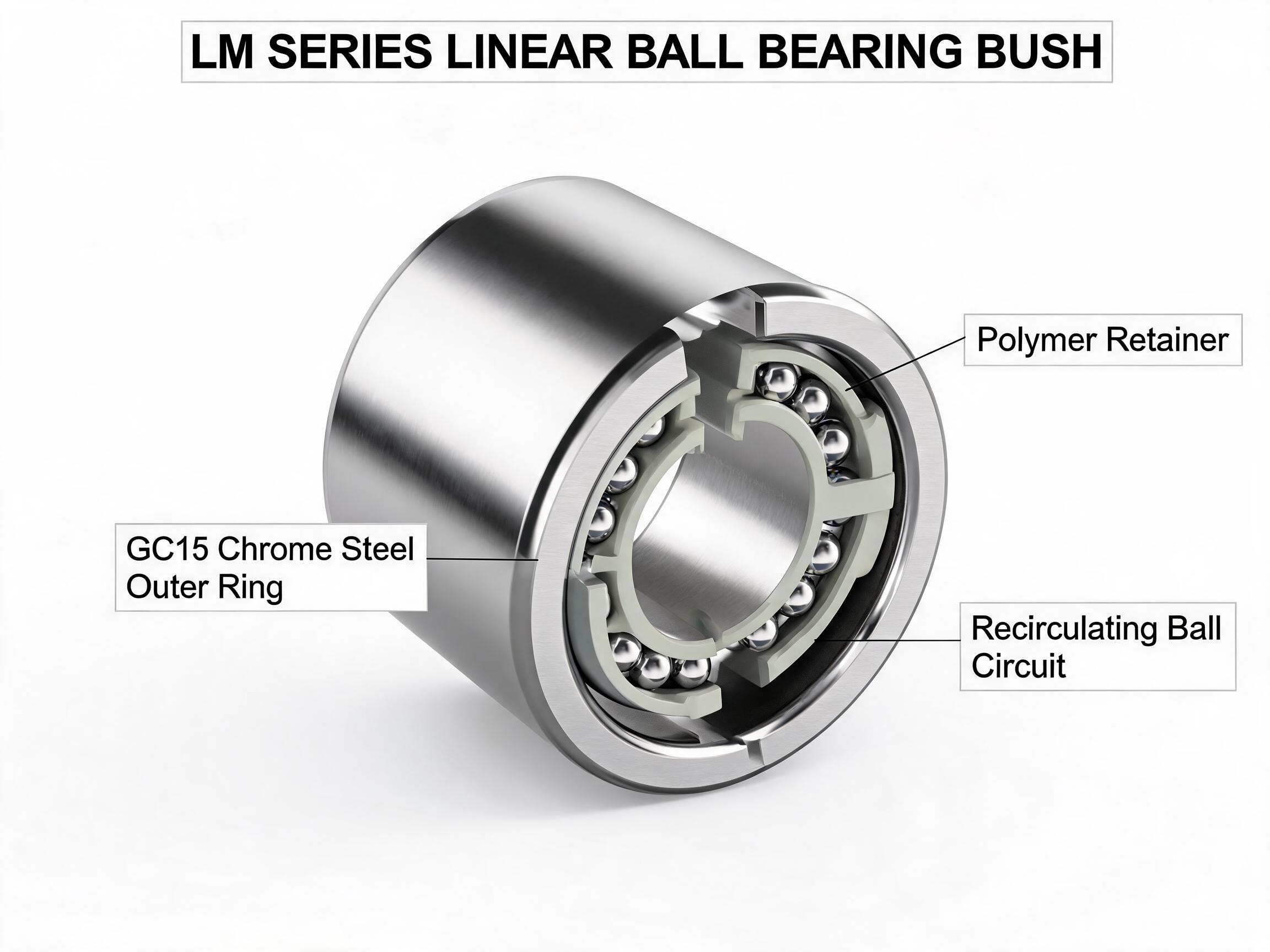
The LM8UU is an 8 mm closed-type linear ball bearing bush for hardened shafts. It suits small CNC axes, 3D printer motion and automation frames. This article decodes the name, explains the fit rules, and lists the checks that prevent a wrong part.
An LM8UU linear bearing is an 8 mm closed-type ball bushing that runs on a hardened shaft. Buyers searching for an lm8uu bearing usually need to confirm three things: whether the 8 mm bore matches their shaft, whether the closed or open type is appropriate for the way the shaft is supported, and whether the surrounding bore in the housing is machined to take a press fit without distorting the raceway. This article covers the name decoding, internal construction, fit rules and the checks that avoid a wrong part. Where a specific value is not in our product data, we say to confirm it on the datasheet rather than invent a number.
Key takeaways
- LM8UU = LM series, 8 mm nominal shaft diameter, UU sealed variant.
- Closed type fully encircles the shaft; open type is for supported shafts.
- Shaft hardness, surface finish and housing alignment decide service life more than the bearing brand.
- Small CNC, 3D printer motion systems and automation frames are typical applications.
- For high stiffness, guided parallelism or long stroke, a profile rail may be the better choice.
In this article
- Decoding the LM8UU name
- How the bearing is built
- Fit rules: closed vs open, shaft and housing
- Where buyers use an 8 mm linear bearing
- When a profile rail is the better call
- Ordering checks before you commit
- FAQ
Decoding the LM8UU name
The string breaks into three parts. LM is the series designation for this family of linear ball bearing bushes. 8 is the nominal shaft diameter in millimetres, so the bore accepts an 8 mm shaft when the bearing is in its pressed state. UU marks the sealed variant, with a lip seal at each end to retain lubricant and keep dust out of the ball circuit. An unsealed version carries no UU suffix; an adjustable or open type changes other letters in the code.
Our LM series linear ball bearing bush covers shaft diameters from 6 mm to 60 mm in both open and closed types. That range is useful because a single project often mixes sizes: one 3D printer may use an 8 mm bush on the X and Y axes and a larger size on the Z axis. The series code stays the same; only the number after LM changes with the shaft.
Buyers often search for lm8uu linear bearing and 8mm linear bearing as if they were different parts. They refer to the same bush. The number 8 is a nominal designation: use the measured shaft diameter and the datasheet dimensions to check fit, not the catalogue number alone.
How the bearing is built
Inside an LM8UU you find three functional layers. The outer ring is hardened chrome steel, ground on the outside diameter for the press fit into a housing and on the raceway for the balls to roll on. A polymer ball retainer holds the balls in a recirculating circuit, so they travel from the loaded zone, around the return path and back into load. The seal at each end closes that circuit against dust and chips.
The construction explains the behaviour buyers notice. A ball bush allows linear motion with low friction and slight self-alignment, but it does not resist moment loads on its own. Two bushes spaced apart on parallel shafts share the moment; a single bush on one shaft cannot. The retainer material and ball grade affect noise and running smoothness, and those details belong on the datasheet for the specific size rather than being assumed across the series.
Fit rules: closed vs open, shaft and housing
A closed bush fully encircles a hardened shaft. The shaft passes through the bore, and the housing holds the outer ring. This is the type most 8 mm applications use because the shaft is usually a simple round rod supported at both ends. An open type has a slot along its length so it can sit over a shaft that is continuously supported by a rail or a flat mounting surface; the slot lets the bearing straddle the support. Choosing an open bush for an unsupported shaft removes the support the open design assumes, and choosing a closed bush for a continuously supported shaft is often impossible to assemble.
Three variables decide how well any of these bushes performs:
- Shaft hardness. The raceway of the bearing is hard; the shaft must be hard enough to carry the ball load without brinelling. The required hardness range for a given size should be confirmed on the datasheet or with the shaft supplier.
- Surface finish. A rough shaft wears the balls and the seal lips. A ground and polished shaft is the normal expectation for linear ball bushes.
- Alignment. If the two shaft ends are not parallel, or the housing bore is not square to the shaft, the ball circuit runs misaligned and life drops. Alignment of the housing bores matters as much as the bearing tolerance.
Housing bore tolerance, shaft tolerance and permissible misalignment for the LM8UU are not listed here. Confirm them on the current datasheet before machining a housing.
Where buyers use an 8 mm linear bearing
The 8 mm size sits in the light-duty band of linear motion. Typical uses include:
- Small CNC and engraving machines where the moving mass is low and strokes are short to medium.
- 3D printer motion on axes that carry a print head or a bed with modest load.
- Automation frames for pick-and-place slides, adjustment axes and light transfer mechanisms built from aluminium extrusion.
- Test and laboratory fixtures where a smooth manual or motorised slide is needed.
In these applications the bush is usually paired with a shaft from the same supplier so that hardness and finish are controlled together. Buyers who source the shaft separately should check that the shaft meets the hardness and finish the bearing assumes.
When a profile rail is the better call
A ball bush on a round shaft is a good fit for light loads and simple assemblies. It becomes the weaker choice when the design demands high stiffness, tight parallelism between two rails, or a long stroke with a cantilevered load. In those cases a profile rail carries the load in four directions and resists moment, and the carriage is guided by the rail itself. Our MGN series stainless steel miniature linear guide is an example of that alternative: a rail and carriage pair rather than a bush on a shaft.
The decision is not about quality. It is about which geometry carries the load path. A single 8 mm bush on a round shaft suits a light moving axis; a profile rail suits a machine frame that must hold position under offset load. If the application sits between the two, the load case and the required parallelism should be confirmed with the supplier before the housing is designed.
Ordering checks before you commit
Most wrong-part orders trace back to a mismatch that was visible before purchase. Run these checks:
- Measure the shaft. Confirm the actual shaft diameter, not just the nominal callout. The 8 in LM8UU is a designation, and the fit depends on the measured shaft and the datasheet bore.
- Decide closed or open. Check whether the shaft is supported only at the ends (closed) or continuously along its length (open).
- Check the housing bore. The bore must match the outer ring diameter and the intended fit; confirm the tolerance on the datasheet before machining.
- Confirm sealing needs. UU seals suit dusty or chip-prone environments. If the application is clean and low-drag, check whether an unsealed variant is available for the size.
- Confirm the quantity and pairing. Bushes are often ordered with shafts and housings; confirm that all three come from the same size family.
Xiamen Dongfeng Bearing Mechanical & Electrical Co., Ltd. has manufactured linear motion bearings and linear guideways in Xiamen, Fujian, China since 2014. The company holds ISO 9001:2015 and CE certification, and can provide SGS material test reports for the materials used. Products carry a 24-month warranty. Specification values not shown in this article should be confirmed on the datasheet or with the sales team before ordering.
FAQ
Is LM8UU the same as an 8 mm linear bearing?
Yes in common usage. LM8UU is the specific sealed closed bush with an 8 mm nominal bore. Other 8 mm linear bearings exist in different series and types, so the series code and the type letter still matter.
Can I use an LM8UU on a soft shaft?
The shaft must be hard enough for the ball load. A soft shaft will wear or indent under the balls. Confirm the required hardness for your size on the datasheet or with the shaft supplier.
Does the UU suffix mean the bearing is lubricated for life?
UU indicates seals at both ends, which retain lubricant and exclude dust. Lubrication intervals depend on the application, speed and environment; follow the datasheet recommendation for the specific size.
When should I choose a profile rail instead?
When the axis must resist moment loads, hold tight parallelism between two rails, or carry a cantilevered load over a long stroke. A ball bush on a round shaft is a lighter-duty solution.
For sizes, tolerances and current availability of the LM series, request the datasheet for the exact size you need.