
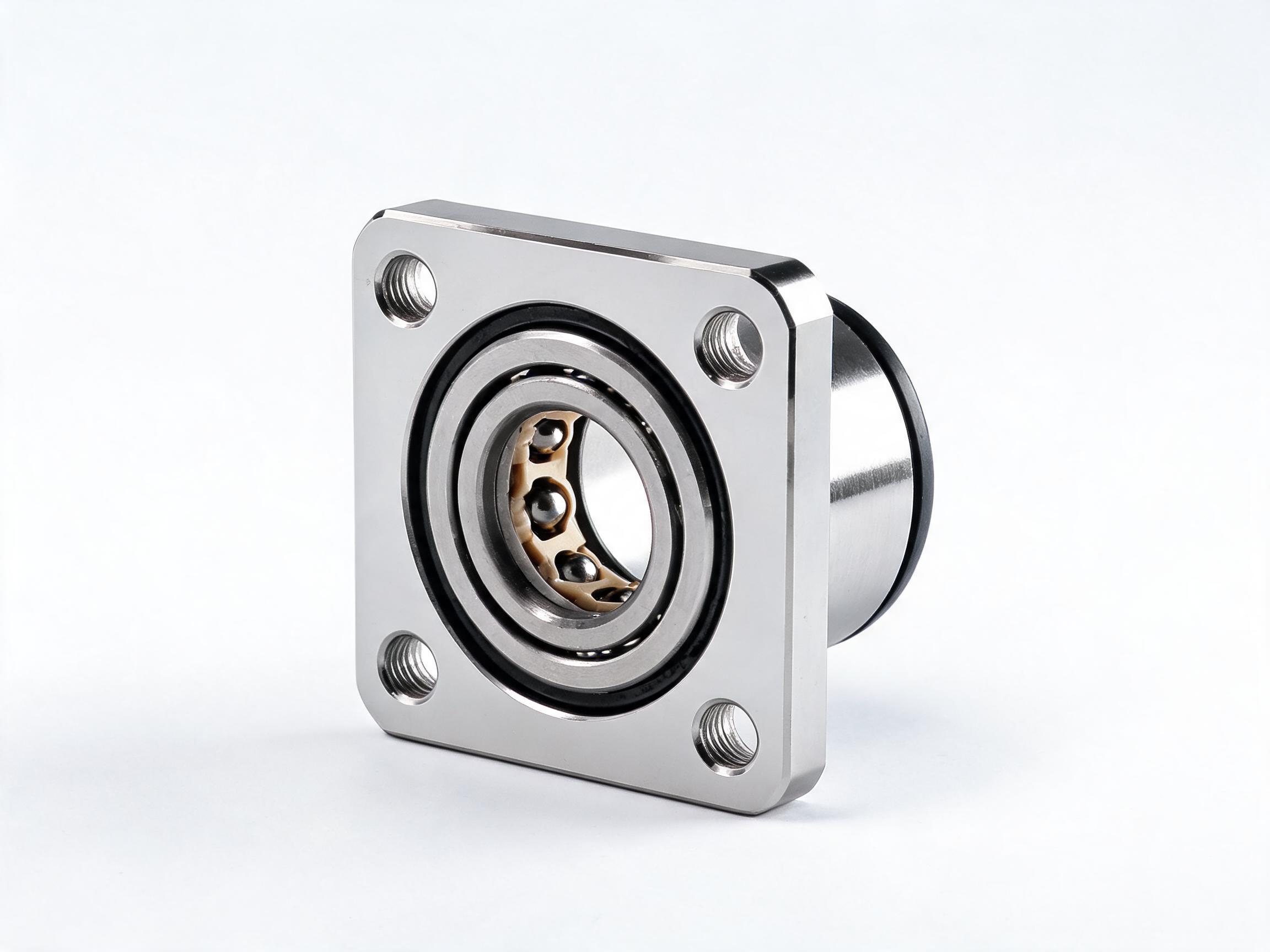
LMF square-flange linear bearings mount directly to aluminum extrusion T-slot plates with a 4-bolt pattern, eliminating press-fit housings. This guide explains when the bolt-on flange beats a press-fit LM bushing, how the bolt pattern maps to standard extrusion plates, and the size and load checks to run before ordering.
Why bolt-on square flanges change the mounting decision
A press-fit linear bushing needs a machined housing: you bore a hole to tolerance, press the bearing in, and hope the housing alignment is right. An LMF square-flange linear bearing skips that step. The bearing sits in a square flange with a four-bolt diagonal pattern, and you bolt it straight onto an aluminum extrusion T-slot plate or a square housing block. No press tools, no boring, no separate retainer.
That difference matters most when you are building prototypes, short-run automation frames, or modular test rigs. If the frame is already made from T-slot extrusion, the LMF flange becomes a direct bolt-on component. If you are designing a high-volume welded steel housing, the press-fit LM bushing may still be the right call. This article covers the bolt-on flange decision: when it wins, how the bolt pattern maps to common extrusion plates, and what to check before you order.
- LMF bearings mount with four bolts to T-slot plates and square blocks, eliminating press-fit tooling and housing boring.
- The series covers shaft diameters from 6 mm to 50 mm in 10 sizes, with JIS B 1185 as the standard reference.
- At LMF16UU, rated loads are 1,370 N dynamic and 2,160 N static.
- Dimensionally interchangeable with THK, IKO, MISUMI, and NB square-flange bearings of the same size.
- Confirm bolt spacing and plate thickness before ordering; the flange is rigid, but the plate must be flat and stiff enough to keep the shaft aligned.
When a bolt-on square flange beats a press-fit LM bushing
The LMF series is a good fit when the surrounding structure is already flat and bolted together. Aluminum extrusion frames are the obvious case: the T-slot face gives you a mounting plane, and the four-bolt pattern lets you position the bearing without machining. Square housing blocks work the same way. The bearing arrives with its own flange, so the housing is just a flat plate with four holes.
A press-fit LM series linear ball bearing bush still makes sense when the housing is a single machined block that you are producing in volume, or when the design already has a bored housing and you are replacing like-for-like. The trade-off is tooling: press-fit requires a boring operation and a controlled interference fit, while the LMF flange requires only a flat plate and four bolts.
For buyers comparing the two, the practical question is not which bearing is better in isolation. It is which mounting method fits the frame you already have or plan to build. If the frame is extrusion-based and you want to avoid machining, the flange is the simpler path. The LMF series square flange linear ball bearing page lists the full size range and flange dimensions for that comparison.
How the four-bolt pattern maps to extrusion T-slot plates
The LMF flange uses a diagonal four-bolt pattern. On a T-slot plate, the bolts pass through the flange and into the extrusion slot, typically with T-nuts or a tapped plate behind the slot. The diagonal layout spreads the clamping force across the flange face, which helps keep the bearing square to the shaft axis.
Two dimensions decide whether the bolt pattern fits your plate: the bolt hole spacing and the flange outer size. The LMF series runs from LMF 6 to LMF 50, covering shaft diameters from 6 mm to 50 mm in 10 sizes. Each size has its own flange footprint. Before ordering, check that the bolt spacing on your plate matches the flange, and that the flange does not overhang the extrusion face in a way that interferes with adjacent slots or components.
The mounting plate itself should be flat and stiff. A thin plate that deflects under load will tilt the bearing and misalign the shaft, even if the bolt pattern is correct. For short stroke lengths and light loads, a standard extrusion plate is usually enough. For longer strokes or higher loads, use a thicker plate or a machined square block to keep the bearing face true.
Size and load checks before ordering
Sizing an LMF bearing starts with the shaft diameter you need, then moves to the load rating for that size. The series covers 6 mm to 50 mm shafts. The load capacity grows with size, and the published rating for LMF16UU is 1,370 N dynamic and 2,160 N static. Use those figures as the reference point for the 16 mm size, and treat other sizes as having their own ratings that you should confirm from the product data.
Dynamic load is the rating for a bearing in motion; static load is the rating for a stationary or slowly moving load. If your application combines radial and moment loads, the moment load is often the limiting factor for a flange bearing, because the flange cantilevers the load away from the shaft. A longer flange-to-load distance increases the moment. In that case, check the moment capacity or reduce the overhang.
| Check | What to verify | Why it matters |
|---|---|---|
| Shaft diameter | Match the bore to the shaft; LMF covers 6 mm to 50 mm. | Wrong bore means the bearing will not fit or will run loose. |
| Bolt spacing | Flange hole pattern must match the plate or block. | Prevents redrilling and misalignment. |
| Flange footprint | Check clearance against adjacent slots and components. | Overhang can interfere with the frame. |
| Load rating | Compare dynamic and static loads to the application. | Undersizing shortens service life. |
| Moment load | Estimate the overhang and check moment capacity. | Flange bearings are sensitive to cantilevered loads. |
Materials, seals, and precision options
The LMF series uses GCr15 chrome steel (52100 equivalent) for the outer ring and balls, induction hardened to HRC 60-64. The retainer is PA66-GF glass-fiber nylon, and both ends have UU double rubber seals. Those seals help keep dust and debris out of the ball path, which is relevant on extrusion frames that sit in workshop environments.
Precision grade is Normal as standard. H5 is available on request for LMF8 to LMF40, with a bore tolerance of plus or minus 2 microns. That tighter bore tolerance is useful when you need low clearance between the shaft and bearing, for example in positioning applications where play affects accuracy. For general guidance and transfer applications, Normal grade is usually sufficient.
The series is dimensionally interchangeable with THK, IKO, MISUMI, and NB square-flange linear bearings of the same size. That interchangeability matters for maintenance and second-sourcing: if your design already uses one of those brands, the LMF bearing can drop into the same bolt pattern and shaft size.
Ordering and sample quantities
The minimum order quantity is 100 pieces per size. For qualified buyers, samples of 10 to 20 pieces are available. If you are testing a new frame design, a sample order lets you confirm the bolt pattern and plate fit before committing to production quantities.
When you request a quote, include the shaft diameter, the bolt spacing on your plate, and the expected load direction. That information lets the supplier confirm the correct size and flag any moment-load or alignment concerns before the order is placed.
Frequently asked questions
Can I mount an LMF bearing directly to a T-slot extrusion without a plate?
The flange bolts to a flat surface, so a T-slot plate or a square block is the normal mounting interface. Bolting directly into a slot without a plate depends on the slot geometry and the bolt size; confirm the fit with the supplier for your specific extrusion profile.
Is the LMF series a replacement for a press-fit LM bushing?
It is an alternative mounting method, not a drop-in replacement for a press-fit bore. The LMF flange requires a flat plate and four bolts; a press-fit LM bushing requires a machined housing. If your design already has a bored housing, the press-fit type is the direct replacement.
What load can an LMF16UU carry?
The rated load at LMF16UU is 1,370 N dynamic and 2,160 N static. For other sizes, use the product data for that size.
Do I need H5 precision?
H5 is available on request for LMF8 to LMF40 and gives a bore tolerance of plus or minus 2 microns. Choose it when low clearance is required; otherwise Normal grade is standard.
What is the minimum order quantity?
MOQ is 100 pieces per size. Samples of 10 to 20 pieces are available for qualified buyers.
Next step
If your frame is built from aluminum extrusion or square blocks, the LMF square-flange bearing removes the need for press-fit tooling and housing boring. Check the bolt spacing, flange footprint, and load rating against your design, then request a sample or a quote for the size you need. The LMF series product page lists the available sizes from 6 mm to 50 mm.