
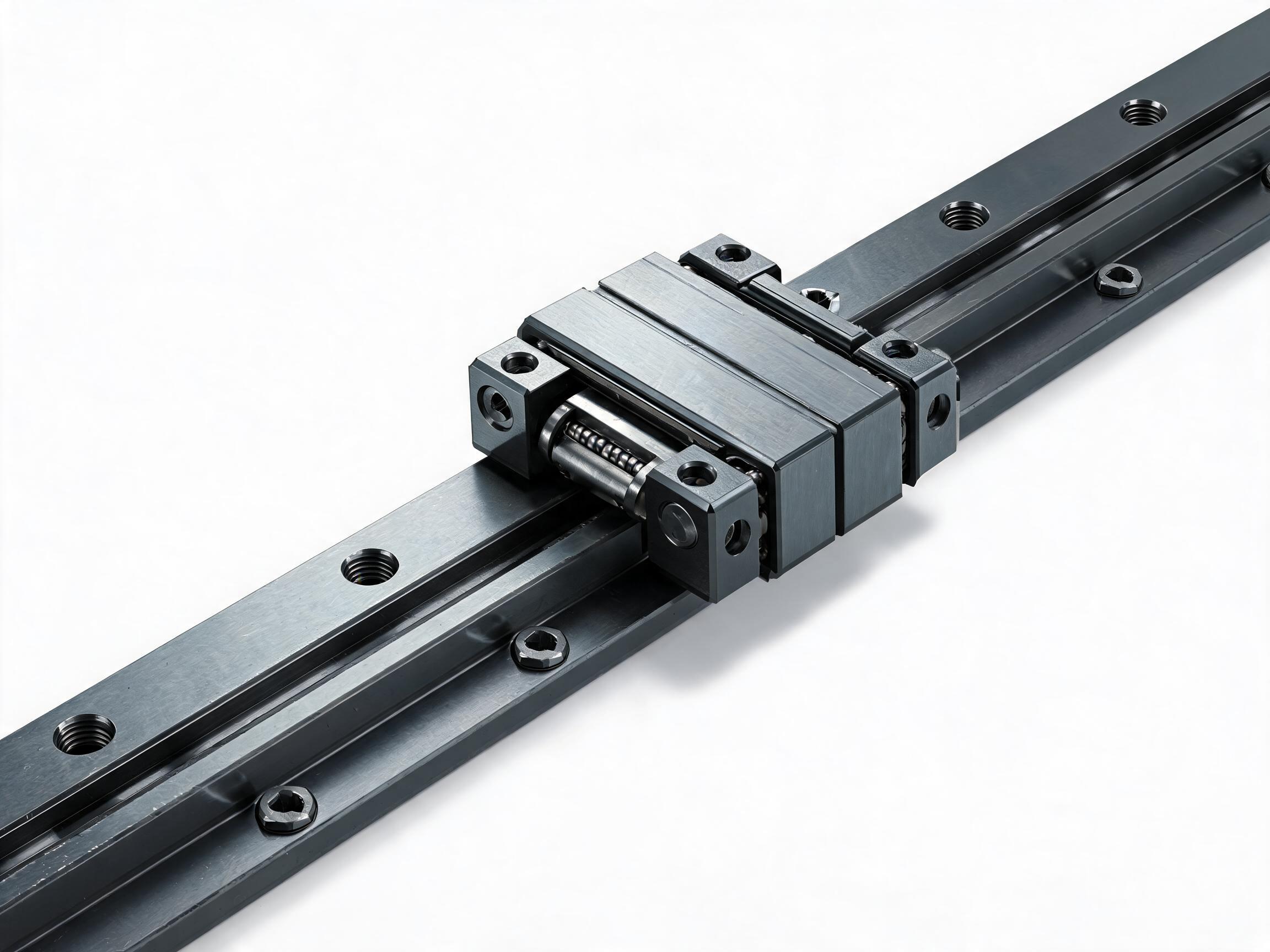
A practical guide to the three lubrication interfaces on linear guide rails — rail oil groove, rail grease nipple compatibility, and carriage top port — plus grease selection and re-greasing intervals for HGR, HGH and MGN12 series.
Lubricating Linear Guide Rails: Ports, Grease and Intervals
Lubrication is the maintenance task most often done either too little or too much on linear guide systems. The consequences are familiar to maintenance engineers: dry raceways, worn seals, or over-packed carriages that push excess grease onto the rail. This guide covers the three lubrication interfaces you will encounter on DF Linear guide rails and carriages, the grease that suits most applications, and the interval starting points from the product records — plus what changes them.
Key takeaways
- HGR rails use an oil groove plus grease-nipple compatibility; a continuous oil-groove channel runs the full rail length.
- HGH carriage blocks have a lubrication port on the top face that accepts standard M6 grease nipples or a central lube line connector.
- Lithium-based grease NLGI Grade 2 suits most HGH applications.
- A starting re-greasing reference is every 100 km of travel or every 3 months, whichever comes first.
- MGN rails ship pre-lubricated; typical indoor use re-greases every 3–6 months or after roughly 100 km.
In this article
The three lubrication interfaces
Linear guide lubrication points are not all on the carriage. Depending on the series, the rail itself may carry an oil groove, the carriage may have a top-face port, or both may be present. Identifying which interface your hardware uses is the first step before selecting grease or setting an interval.
Rail oil groove (HGR series)
On the HGR series heavy-duty linear guideway rail, the lubrication interface is an oil groove plus grease-nipple compatibility. A continuous oil-groove channel runs the full rail length, retaining a lubricant film between re-greasing intervals. This design is particularly relevant for vertical-axis installations, where gravity drains conventional surface lubrication quickly. The groove keeps lubricant distributed along the rail rather than letting it run off the working zone.
Rail grease nipple compatibility
The HGR rail’s grease-nipple compatibility means the rail can be fed through a standard nipple interface where the application requires direct rail lubrication. This is separate from the carriage port described below. When specifying a rail, confirm with the supplier which end or position carries the nipple interface, because it affects how you route a lube line on the machine frame.
Carriage top port (HGH series)
The HGH series flange-type linear guideway carriage block has a lubrication port on the carriage top face. That port accepts standard M6 grease nipple fittings or a central lube line connector. For manual maintenance, an M6 nipple is the practical choice; for automated or centralized lubrication, the central lube line connector lets one supply point feed the carriage without removing it from the rail.
Because the port is on the top face, access is straightforward on horizontal mounting. On inverted or side-mounted carriages, the same port may be harder to reach — a point worth checking at the design stage if manual re-greasing is planned.
MGN12 factory pre-lubrication
All MGN12 linear rails are pre-lubricated with high-quality grease at the factory. There is no separate rail oil groove or carriage port to service at installation; the first re-greasing interval is measured from commissioning. This makes MGN12 a fit-and-run option for light-duty indoor applications, with the caveat that the factory fill is a starting point, not a permanent supply.
Which grease to use
Lithium-based grease NLGI Grade 2 is suitable for most HGH applications. Grade 2 is the consistency most maintenance teams already stock. Keep the following in mind:
- Use one grease type consistently. Mixing incompatible thickeners can degrade the lubricant film.
- For food-grade applications, specific grease schedules and products are available on request from the supplier — do not assume the standard NLGI 2 lithium grease is acceptable in a food-contact zone without confirmation.
- For high-speed applications, re-greasing frequency and grease choice may differ from the standard reference; specific schedules are available on request.
Note: this article does not specify grease quantities, injection pressures, brand names or temperature limits. Those depend on the carriage size, the lube method and the application, and should be confirmed with the supplier for your specific model.
Re-greasing intervals and what changes them
For HGH carriage blocks, the re-greasing interval depends on travel speed, load and environment. A starting reference is every 100 km of travel or every 3 months, whichever comes first. For MGN12 rails, typical indoor use re-greases every 3–6 months or after roughly 100 km of travel.
These are starting points, not fixed schedules. Four factors move the interval:
| Factor | Effect on interval | Practical action |
|---|---|---|
| Travel speed | Higher speed increases lubricant demand per unit time | Shorten the interval; request a specific high-speed schedule |
| Load | Heavier load raises contact stress and film breakdown | Shorten the interval and inspect the film at each service |
| Dust and contamination | Dust absorbs grease and accelerates wiper wear | Use side wiper seals on MGN12; shorten the interval |
| Vertical mounting | Gravity drains surface lubricant | Rely on the HGR oil-groove channel; do not extend the interval |
Dusty or high-cycle CNC environments
In dusty or high-cycle CNC environments, use side wiper seals on MGN12 rails and shorten the interval. Wiper seals keep dust out of the raceway, but they also make the visible grease film harder to judge — so base the interval on travel distance and duty cycle rather than appearance alone.
Vertical mounting and gravity
Vertical-axis installations are the case where the rail interface matters most. Gravity drains conventional surface lubrication quickly, so a carriage that is adequately greased on a horizontal axis can run dry on a vertical one between the same service points. The HGR rail’s continuous oil-groove channel is designed to retain a lubricant film along the full rail length between re-greasing intervals, which makes it the relevant interface for vertical axes. For procurement engineers specifying a vertical axis, this is a reason to choose an HGR rail over a plain surface-lubricated rail, and to confirm the grease-nipple access position at the design stage.
FAQ
Where are the lubrication points on a linear guide rail?
They depend on the series. HGR rails use an oil groove plus grease-nipple compatibility, with a continuous oil-groove channel running the full rail length. HGH carriage blocks have a lubrication port on the top face. MGN12 rails are pre-lubricated at the factory and have no separate rail groove or port to service at installation.
What size grease nipple fits the HGH carriage?
The HGH carriage top-face port accepts standard M6 grease nipple fittings, or a central lube line connector for automated lubrication.
What grease should I use for a linear guide rail?
Lithium-based grease NLGI Grade 2 is suitable for most HGH applications. For food-grade or high-speed applications, specific schedules are available on request from the supplier.
How often should I re-grease a linear guide rail?
A starting reference for HGH is every 100 km of travel or every 3 months, whichever comes first. For MGN12 in typical indoor use, every 3–6 months or after roughly 100 km of travel. Shorten these intervals for high speed, heavy load, dusty environments or vertical mounting.
Can I use a central lubrication system on an HGH carriage?
Yes. The carriage top-face port accepts a central lube line connector as an alternative to a manual M6 grease nipple. Route the line so the connector is accessible on your actual mounting orientation.
For model-specific lubrication schedules or interface questions, contact the supplier with your rail series, mounting orientation and duty cycle.