
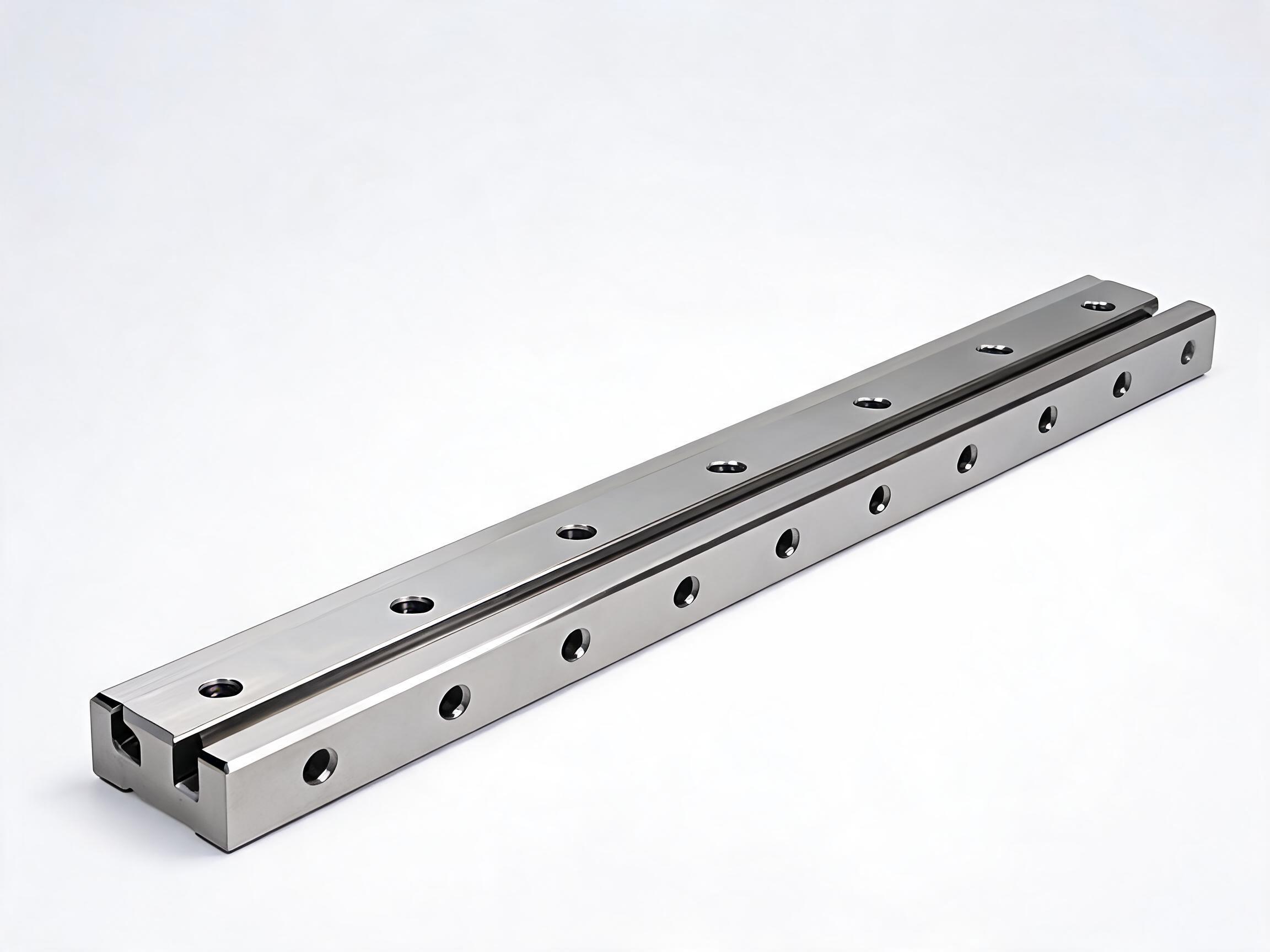
A practical guide for engineers and buyers sizing a 9 mm miniature linear guide. Learn where MGN9 sits in the MGN series, how to interpret load ratings, choose the right carriage, and when to step up to MGN12 or MGN15. Includes application insights and sourcing considerations.
If you are sizing a small linear motion axis, the MGN9 miniature linear guide is often the first candidate. Its 9 mm rail width keeps the stack compact, which matters in 3D printers, desktop CNC machines, and medical devices where space is tight. But it also carries less load than larger sizes, so understanding exactly what it can handle—and when to move up—is essential for reliable design.
Key takeaways: MGN9 sits at the light-duty end of the MGN series (9, 12, 15 mm). Use it for compact, low-load axes. For load ratings, always check the size-9 datasheet rather than extrapolating from the MGN12C figures (3.7 kN dynamic, 5.4 kN static). Carriage choice (standard vs. long) affects stiffness and load spread. Step up to MGN12 or MGN15 when stroke, overhung load, or rail length grows.
In this article
Where size 9 sits in the MGN series
Our MGN series includes three miniature rail sizes: 9 mm, 12 mm, and 15 mm. All are made from 9Cr18Mo martensitic stainless steel and use a two-row Gothic-arch ball circuit. The smaller size means a more compact stack and lower load capacity. Size 9 is the most space-efficient option, but it also has the least stiffness and load margin.
The table below summarises the size range. For complete specifications, including the size-9 dynamic and static load ratings, refer to the MGN series stainless steel miniature linear guide product page and the individual datasheet.
| Size | Rail width | Typical load range | Common use |
|---|---|---|---|
| MGN9 | 9 mm | Light duty | Compact axes with low load and short stroke |
| MGN12 | 12 mm | Medium duty (e.g., MGN12C: 3.7 kN dynamic, 5.4 kN static) | General-purpose small automation |
| MGN15 | 15 mm | Higher load | Larger desktop CNC, medical stages |
Load ratings vary by carriage type and preload class. Always confirm with the specific datasheet.
The load reference point
When sizing, engineers often look for a reference point. For the MGN12C carriage, our data shows a dynamic load rating of 3.7 kN and a static load rating of 5.4 kN. This gives a useful benchmark: the 9 mm size, with a smaller ball circuit and rail, will have lower ratings. Treat MGN9 as the light-duty choice below the MGN12C figures.
Do not extrapolate from the 12 mm ratings to the 9 mm rail. Load capacity does not scale linearly with width; it depends on ball size, number of balls, carriage geometry, and preload. To get the correct size-9 rating, consult the MGN9 datasheet or contact the supplier. In designs where the load is unknown, use a safety factor based on your application requirements.
Also consider the direction of the load. MGN guides are typically rated for loads in four directions (radial, reverse radial, and two lateral). The Gothic-arch ball circuit provides equal load capacity in all four directions, which is beneficial for cantilevered or side-loaded axes.
Carriage choice: standard vs. long
The carriage you select affects load distribution and stiffness. MGN carriages are available in standard and long versions. The long carriage has more balls and a longer ball track, which spreads the load over a greater area and increases stiffness—especially for moment loads. The standard carriage is more compact and lighter, suitable for tight spaces and lower moment loads.
When selecting the block code, match it to the axis requirements:
- Standard carriage (e.g., MGN9C): Best for short strokes, low moment loads, and space-constrained designs.
- Long carriage (e.g., MGN9H): Better for higher moment loads, longer strokes, and applications requiring greater rigidity.
For example, the MGN9H linear rail uses a long carriage that provides a wider stance, reducing deflection under overhung loads. The trade-off is additional length and mass. Always verify the exact carriage code and dimensions in the product datasheet, as codes may vary by manufacturer.
Applications where MGN9 excels
The 9 mm size is well-suited to applications where space is at a premium and loads are relatively low:
- 3D printers: The lightweight carriage and compact rail help reduce moving mass, allowing faster acceleration and smoother motion.
- Desktop CNC: For small routers and engravers, MGN9 can handle the cutting forces if the load is kept within its rating and the axis is well-supported.
- Medical devices: Clean, quiet operation and stainless steel construction resist corrosion in humid or sanitised environments.
- Humid or wash-down environments: The 9Cr18Mo martensitic stainless steel provides corrosion resistance, making MGN9 suitable for applications where standard carbon steel would rust.
In all these cases, the stainless steel grade is a key advantage. It maintains hardness and corrosion resistance without plating, which simplifies design and ensures long-term reliability.
When to step up to MGN12 or MGN15
MGN9 is not always the right choice. Consider moving up to a larger size when:
- Stroke length increases: Longer rails can deflect more under load. A larger rail size provides higher stiffness and reduces the risk of vibration or misalignment.
- Overhung loads grow: If the load is offset from the carriage centre, moment loads increase. A larger carriage (or a long carriage at the same size) can better handle these moments.
- Rail length exceeds a certain threshold: As rail length grows, manufacturing tolerances and thermal expansion become more critical. Larger sizes offer more robust performance over long distances.
- Load requirements exceed the size-9 rating: If your calculated load (including safety factors) exceeds the MGN9 capacity, step up to MGN12 or MGN15.
The MGN12 size is a common step-up. For detailed specifications on the 12 mm rail, see the MGN12 linear rail product page. The MGN15 offers even higher load capacity and stiffness for heavier applications.
When stepping up, re-check the carriage code and preload. A larger rail may require a different carriage type to match the desired stiffness and load distribution.
Frequently asked questions
What is the load rating of the MGN9 linear guide?
The exact dynamic and static load ratings for the MGN9 are provided in the product datasheet. They are lower than the MGN12C ratings (3.7 kN dynamic, 5.4 kN static). Always use the size-specific datasheet for design calculations.
Can I use MGN9 in a vertical application?
Yes, but you must account for the load in the radial direction and any moments. Ensure the load does not exceed the rated capacity and consider a safety factor. For vertical axes with high loads, a larger size may be more appropriate.
What is the difference between MGN9C and MGN9H?
The 'C' denotes a standard carriage, while 'H' denotes a long carriage. The long carriage provides greater stiffness and load spread but takes more space. Choose based on your moment load and space constraints.
Is MGN9 suitable for high-precision applications?
MGN9 guides are available in precision grades. The achievable precision depends on the grade selected and the mounting method. Consult the datasheet for accuracy specifications.
What material is used for MGN9?
Our MGN series uses 9Cr18Mo martensitic stainless steel for both rail and carriage components. This provides corrosion resistance and hardness.
How do I choose between MGN9 and MGN12?
Choose MGN9 for compact, low-load axes with short strokes. Choose MGN12 when loads, moments, or stroke lengths exceed the MGN9 capacity. Use the load ratings and stiffness requirements as a guide.
Summary
MGN9 miniature linear guides are an excellent choice for compact, light-duty applications. They offer a small footprint, stainless steel construction, and smooth motion. However, they have lower load capacity than larger sizes, so always verify the size-9 rating on the datasheet and consider stepping up to MGN12 or MGN15 when loads, moments, or strokes increase. For more information, explore our MGN series stainless steel miniature linear guide page.