
Below a 16 mm shaft diameter, lead accuracy and nut envelope become the limiting factors. This article explains what changes in the miniature band, why rolled C7 screws cannot hold combined envelope and precision requirements, and when a C5 ground miniature ball screw is the correct choice.
Miniature Motion Components
Below a 16 mm shaft diameter, the rules change. A rolled C7 screw that works well in a desktop engraver cannot satisfy a mini-axis that has to fit inside a 30 mm envelope and still hold lead accuracy across the stroke. The limiting factors are not just load capacity; they are the combination of lead error, nut outside diameter, and the ability to grind a screw straight at small diameters. This article explains what changes in the miniature band and when a C5 ground miniature ball screw is the correct engineering choice.
- Under 16 mm shaft diameter, lead accuracy and nut envelope become the binding constraints, not dynamic load alone.
- Rolled C7 lead error of ±0.05 mm/300 mm can consume most of a miniature axis error budget.
- BSH series ground screws cover 6–12 mm shafts with C5 grade and ±0.008 mm/300 mm lead accuracy.
- BSH08 nut envelope is 20 mm; BSH12 is 28 mm — compact enough for lab automation and optical stages.
- Rolled SFU1605 remains the practical choice where C7 accuracy, 16 mm shaft, and 6.8 kN dynamic load fit the application.
What changes below 16 mm shaft diameter
A standard rolled screw like the SFU1605 uses a 16 mm shaft and 5 mm lead, rated at 6.8 kN dynamic. That combination suits desktop CNC routers and engravers, where the axis structure is larger, speeds are moderate, and lead error of ±0.05 mm/300 mm is acceptable for the work being done.
Move down to an 8 mm or 10 mm shaft and the same design logic no longer applies. The screw is thinner, the nut must fit into a smaller housing, and the axis is often part of an instrument rather than a machine tool. In lab automation, medical sample handling, and optical positioning, the moving mass is low, but the acceptable positional error is also low. A rolled screw at C7 lead accuracy can use up a large share of that error budget before any other error source is considered.
This is where the miniature band separates from the standard band. The question is not whether one screw is better than another in general; it is whether the rolled process can hold the combination of small envelope and tight lead accuracy that a mini-axis requires. In most cases, it cannot, because the rolling process has a different cost and accuracy model than grinding.
Why rolled C7 lead accuracy limits mini-axes
Rolled screws are formed by pressing a hardened die into the shaft. The process is fast and economical, but lead error accumulates over the thread length. A typical C7 rolled screw is specified at ±0.05 mm/300 mm. On a 300 mm travel, that is a 0.1 mm total spread. For a desktop CNC or an engraver cutting wood or plastic, this is often invisible in the finished part. For an optical stage or a pipetting axis, 0.1 mm of lead variation can mean a lost position or a failed measurement.
Grinding removes material rather than forming it. The thread is ground after hardening, which allows the lead to be corrected along the length. This is how a C5 ground screw reaches ±0.008 mm/300 mm, roughly six times tighter than the rolled C7 value over the same distance. The difference is not a marketing number; it is a process consequence. Grinding also allows the screw to be straightened and measured in a climate-controlled environment, which matters more as the shaft diameter decreases and the screw becomes more flexible.
A practical way to see the gap: if a miniature axis has a total error budget of 0.02 mm over 200 mm, a rolled C7 screw at ±0.05 mm/300 mm already exceeds that budget before backlash, thermal drift, or nut mounting error are added. A C5 ground screw at ±0.008 mm/300 mm leaves room for the rest of the system.
What C5 ground precision buys in a miniature screw
The BSH series miniature ground ball screw is built for this band. Shaft diameters run from 6 mm to 12 mm. Lead options are 1 mm, 2 mm, and 2.5 mm. Standard lengths cover 100 mm to 600 mm. Lead accuracy is C5 grade per ISO 3408, at ±0.008 mm/300 mm.
For a concrete reference, the BSH0802 uses an 8 mm shaft and a 2 mm lead, with 2.1 kN dynamic load and 3.5 kN static load. The nut envelope is 20 mm for BSH08 and 28 mm for BSH12. These are the numbers that determine whether the screw fits inside a compact axis housing. A 20 mm nut envelope on an 8 mm screw is what makes a miniature ground screw usable in a stage that has no room for a larger nut block.
The material standard is GCr15 bearing steel, hardened to HRC 60–64. A 9Cr18Mo stainless option is available at HRC 54–58 for environments where corrosion resistance is needed. Grinding is performed in a climate-controlled room, which helps hold lead accuracy on small-diameter, long-length screws that are sensitive to temperature change during measurement and assembly.
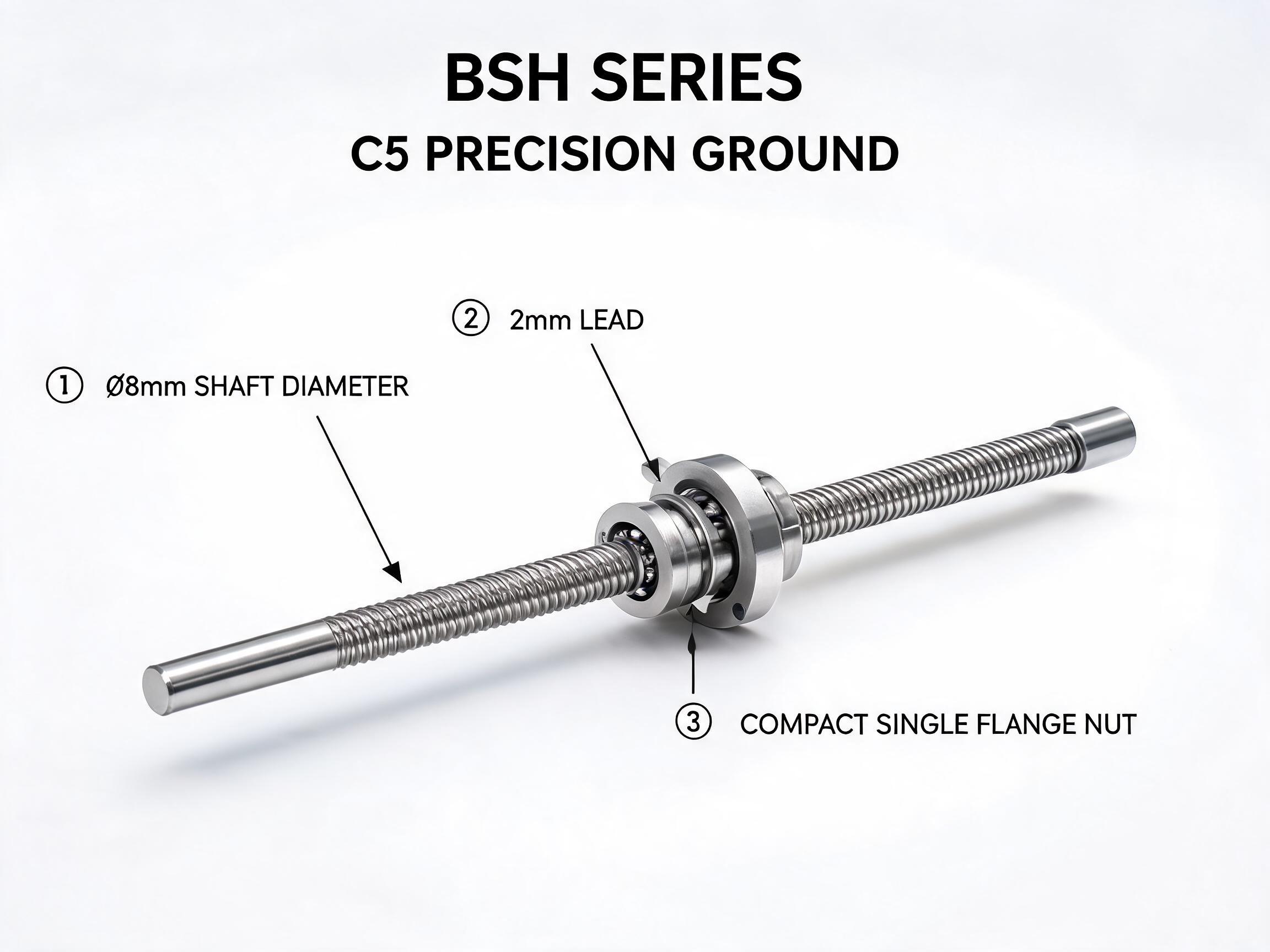
Miniature C5 ground vs rolled C7: a side-by-side view
| Parameter | BSH miniature ground | SFU1605 rolled |
|---|---|---|
| Shaft diameter | 6–12 mm | 16 mm |
| Lead options | 1 / 2 / 2.5 mm | 5 mm |
| Accuracy grade | C5 (ISO 3408) | C7 |
| Lead accuracy | ±0.008 mm/300 mm | ±0.05 mm/300 mm |
| Dynamic load (example) | 2.1 kN (BSH0802) | 6.8 kN |
| Static load (example) | 3.5 kN (BSH0802) | — |
| Nut envelope | 20 mm (BSH08) to 28 mm (BSH12) | — |
| Standard lengths | 100–600 mm | — |
| Material | GCr15 HRC 60–64; 9Cr18Mo stainless HRC 54–58 option | — |
The two columns are not competing for the same job. The BSH series is a precision component for instruments and small axes. The SFU1605 is a cost-effective rolled assembly for larger desktop machines where C7 lead accuracy and 6.8 kN dynamic load are appropriate. Buying a C5 ground miniature screw for a desktop engraver adds cost without improving the finished part. Buying a rolled C7 screw for a 20 mm-envelope optical axis creates a precision problem the axis cannot solve.
Application boundary: when the miniature ground screw is necessary
The decision comes down to three checks, in this order:
- Envelope. Does the nut have to fit inside a housing smaller than about 30 mm? If yes, a 20 mm or 28 mm nut envelope is a hard requirement, and a 16 mm rolled screw with a larger nut is not a candidate.
- Lead accuracy. What is the total error budget over the stroke? If the budget is tighter than roughly 0.05 mm per 300 mm, a C7 rolled screw will consume it. A C5 ground screw at ±0.008 mm/300 mm is the realistic starting point.
- Load. Is the moving mass low? Miniature axes in lab automation, medical devices, and optical instruments typically move small loads, so the lower dynamic rating of a miniature screw is not a constraint. If the axis needs several kilonewtons of dynamic load, the 16 mm rolled screw is the better fit.
If all three point to a small envelope, tight lead accuracy, and low load, the BSH miniature ground ball screw is the appropriate series. If the application is a desktop CNC or engraver with a larger structure and a looser error budget, the SFU series rolled ball screw assembly is the more economical choice.
Practical selection notes
Lead choice interacts with the rest of the drive system. A 1 mm lead gives finer positioning per motor revolution but requires higher input speed for the same linear speed. A 2 mm lead is a common middle ground for miniature axes. A 2.5 mm lead trades some resolution for faster travel. The BSH series offers all three so the screw can be matched to the motor and controller rather than the other way around.
Length matters for more than reach. A longer, thinner screw is more prone to whip and is more sensitive to temperature during grinding and measurement. Standard lengths run from 100 mm to 600 mm. If the application needs a length outside that range, confirm with the supplier before designing the axis around it.
Material selection follows the environment. GCr15 at HRC 60–64 is the standard choice for general instrument use. The 9Cr18Mo stainless option at HRC 54–58 is relevant where corrosion resistance is required. The stainless hardness range is lower, which is a normal trade-off for that material class and should be considered alongside the load and life expectations of the axis.
FAQ
Can a C7 rolled screw be used in a miniature axis?
It can be used if the axis error budget is loose enough to accept ±0.05 mm/300 mm lead error and there is room for the nut. In many miniature axes, the envelope and the error budget are the reasons the rolled screw is not selected.
Is C5 the only option below 16 mm?
The BSH series is specified at C5 grade per ISO 3408. Other grades or sizes are a supplier question; the specification should be confirmed for the exact shaft diameter and length being considered.
Does the smaller nut envelope affect load capacity?
Yes. The BSH0802 is rated at 2.1 kN dynamic and 3.5 kN static, which is lower than a 16 mm rolled screw at 6.8 kN dynamic. For low-mass instrument axes this is normally acceptable, but the load case should be checked for each axis design.
For miniature ground ball screws in the 6–12 mm shaft range, see the BSH series miniature ground ball screw. For desktop CNC and engraver applications where C7 lead accuracy is sufficient, the SFU series rolled ball screw assembly is the matching option.