
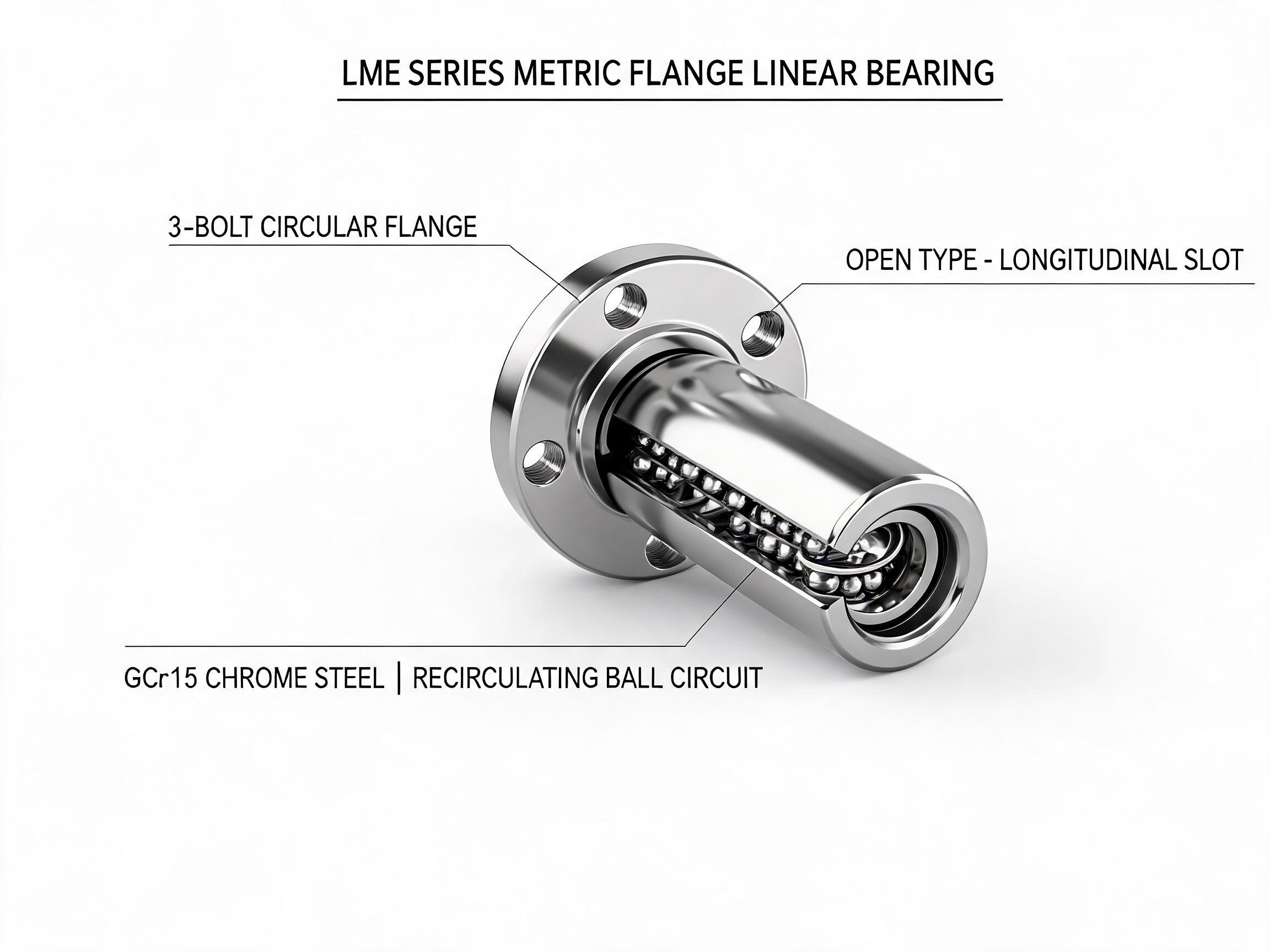
Small-bore linear ball bearings fail for reasons that have little to do with the bore itself. This article sets out the selection rules that matter when shaft sizes get small: budgeting load against a bearing-only rating, controlling shaft hardness and tolerance, treating seal choice as a load decision rather than an accessory, and designing the mount so the small bearing carries the load it was rated for.
Miniature Linear Bearings: Selection Rules for Small Bores
A small-bore linear ball bearing is not a scaled-down copy of a large one. At small bores the published ratings are low in absolute terms — a standard LM16UU, for example, carries a 980 N dynamic rating — the shaft becomes less forgiving of tolerance and hardness variation, and the mounting interface stops being a detail and starts being the dominant factor in whether the axis runs reliably. The rules below apply across the standard series rather than to any single model, so they can be used whether the design lands on a 6 mm bore or a larger one.
- Budget the load against a bearing-only rating, not against any figure borrowed from another configuration.
- Specify shaft hardness and tolerance explicitly, because small bores leave less margin for error.
- Treat the seal as part of the load envelope and mounting decision, not as an afterthought.
- Design the housing so the small bearing is loaded through its full length, not on an edge.
Why small bores change the selection problem
In a compact gantry, a lab instrument carriage, or a small automation axis, the bearing is usually the cheapest precision element in the assembly and the one that is hardest to replace once the machine is built. That asymmetry is what makes the selection rules worth following. A bearing that is oversized is a nuisance; a bearing that is under-loaded at the design stage may work in the prototype and then deflect, bind, or wear the shaft in the field, where the fix costs far more than the part.
The standard LM series covers shaft sizes from 6 mm to 60 mm, with hardened raceways at HRC 60–64 and both sealed (UU) and open (OP) types offered in the same envelope. Those facts matter to a compact design in a specific way: the sealed and open versions share mounting dimensions, so the seal decision does not force a housing redesign. The series references JIS B 1185 and ISO 10285, and a standard order runs at a MOQ of 100 pieces. For LM8 through LM40, an optional H5 shaft tolerance is available when the design calls for a tighter shaft fit.
Rule 1: Budget the load against a bearing-only rating
The single most common error in small-bore selection is mixing load figures from different bases. A bearing-only dynamic rating, a sealed extended-length rating, and a pillow-block unit rating are three separate numbers describing three different assemblies. They cannot be compared directly or substituted for one another.
| Configuration | Dynamic load | Static load | Basis |
|---|---|---|---|
| LM16UU, standard series | 980 N | Not provided in the record — take from the datasheet for this size | Bearing only |
| LM16UU, sealed extended LMUU variant | 1,580 N | 2,450 N | Bearing only — higher because the extended sleeve carries 40% more balls |
| KH16 pillow block | 980 N | Not provided in the record — take from the datasheet for this size | Complete unit, including ADC12 aluminum housing |
Read the table as three separate records, not a ranking. The 980 N of a standard LM16UU and the 1,580 N of the sealed extended variant are not the same component measured twice; the extended sleeve carries 40% more balls, which is why the figure is higher. And the 980 N of the KH16 is a complete-unit figure that includes the housing, so it must not be applied to a bare bearing of any type.
The practical rule: take the rating for the exact configuration you intend to buy, state the basis in your design notes, and divide by a service factor that reflects your duty — shock, vibration and continuous running raise it — and agree the actual value with the supplier or the datasheet rather than assuming one. At small bores the rated loads are low in absolute terms — 980 N dynamic for a standard LM16UU — so the margin between the rated load and the real load is tight, and a borrowed or mislabelled figure does more damage than it would on a large axis. Where a rating for a specific small bore does not appear in the published records, the exact rating has to be taken from the datasheet for that size — it should not be inferred by extrapolating from a neighbouring size.
Rule 2: Shaft quality dominates at small diameters
At a small bore, the shaft is the raceway. The bearing's hardened raceway handles the rolling contact, but the shaft sets the geometry the balls run on, and any deviation in hardness or roundness is concentrated over a shorter length of contact. Two specifications deserve explicit attention:
- Hardness. The listed raceway hardness is HRC 60–64. The mating shaft should be specified to match the bearing's duty, not left to the general-tolerance block on the drawing.
- Tolerance. For LM8 through LM40, an H5 shaft tolerance is available as an option. If the design depends on a tight fit or on low clearance in a compact carriage, that option should be written into the shaft drawing rather than assumed.
Small bores also punish shaft deflection. A shaft that is adequate in diameter for the load can still flex enough over an unsupported span to misalign the bearing along its length. Supporting the shaft at closer intervals, or specifying a stiffer shaft section, is usually a more effective fix than going up one bearing size — and it keeps the compact envelope the design was built around.
Rule 3: Seal choice is a load decision
Seals are often treated as an environmental accessory chosen after the bearing is picked. On a small axis that order is backwards. The sealed and open types share the same envelope in the standard LM series, so sealing does not cost you mounting space, but it does change what the bearing is:
- Sealed versions protect the rolling contact from dust and chips in a compact machine where the bearing sits close to the work.
- The sealed extended LMUU variant uses double-lip NBR seals with a labyrinth groove, and its higher rating comes from the extended sleeve carrying 40% more balls — a load consequence, not just a sealing one.
- Open versions suit clean, well-enclosed environments where the priority is lower running resistance.
The selection rule is to decide the contamination environment first, then choose the seal, then confirm the load rating of the configuration you have chosen. Choosing the seal last and keeping a rating from a different configuration is how a compact axis ends up under-specified.
Rule 4: The mounting method decides whether the bearing survives
A small bearing has a short sleeve relative to its bore. That makes it sensitive to edge loading and to any misalignment that forces the carriage to run at an angle to the shaft. Two approaches handle this:
Direct bore mounting. When the bearing is pressed into a housing bore, the bore must be machined to hold the sleeve over its full length, with the shoulder square to the bore axis. A housing that grips only part of the sleeve concentrates the load on one end and is a common cause of premature wear on small axes.
Pillow block mounting. The KH series covers shaft sizes from 8 mm to 50 mm with an ADC12 aluminum housing and self-aligning capability of ±3°. The self-alignment absorbs small frame misalignment that a rigid bore mount would transfer into the bearing. Where the frame is welded, folded sheet, or assembled from several parts, that ±3° is worth designing in. Note again that the KH16 unit rating of 980 N is a complete-unit figure including the housing, and cannot be compared against a bearing-only number.
The mounting rule in one line: the bearing should be supported along its full sleeve length and allowed to align with the shaft, because at small bores there is very little length over which to absorb an error.
A short selection sequence for compact equipment
Applied in order, the rules above form a sequence that fits a small automation or lab-device design cycle:
- Fix the shaft size from the envelope and the required stroke, then support the shaft to limit deflection.
- Calculate the real radial load on the carriage, including any moment from an offset payload, and apply a service factor agreed from the duty conditions (shock, vibration, continuous running) with the supplier or datasheet.
- Take the dynamic rating for the exact configuration — bearing only for an LM bearing, complete unit for a KH block — from the published record for that size.
- Confirm the shaft hardness and tolerance, using the H5 option for LM8–LM40 where a tighter fit is needed.
- Choose sealed or open based on the contamination environment, then re-check the rating of the chosen configuration.
- Design the housing to support the full sleeve length, or use a self-aligning pillow block where the frame cannot be held square.
If any step leaves a figure you cannot find in the records for the specific bore, stop and take it from the datasheet for that size. Extrapolating a rating from a larger bore is the one shortcut that reliably causes trouble on compact axes.
Product references
- LM series linear ball bearing bush — standard series, 6 mm to 60 mm, sealed and open types in the same envelope.
- LMUU series sealed extended-length linear bearing — extended sleeve with more balls, double-lip NBR seals and labyrinth groove.
- KH series pillow block linear bearing housing unit — ADC12 aluminum housing, self-aligning ±3°, 8 mm to 50 mm shaft sizes.