
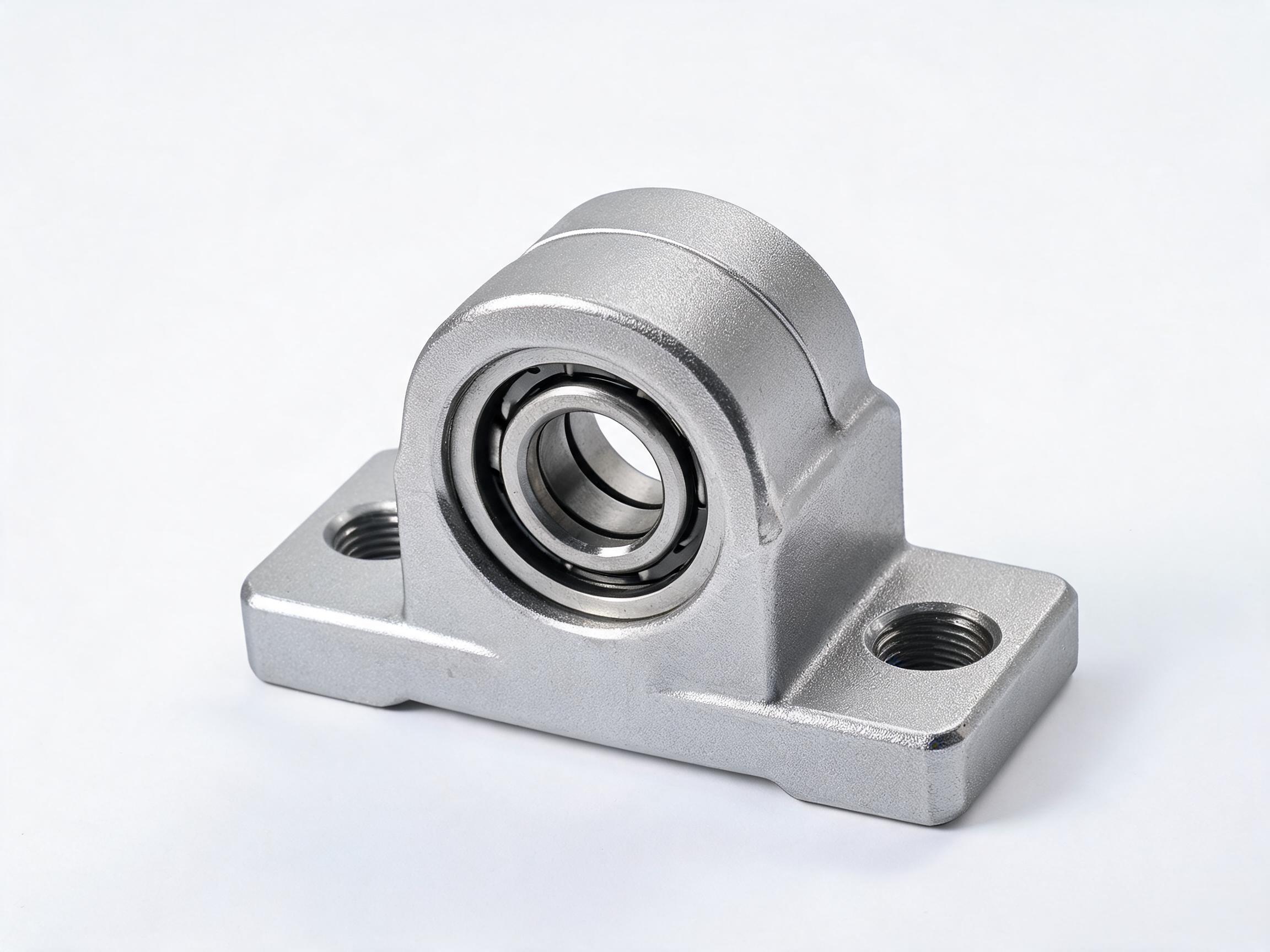
A fit check for pillow block linear bearing housing units: how shaft tolerance, housing bore, and base mounting determine whether you order a complete KH pillow block housing unit or only a replacement bearing.
A pillow block order usually fails on one of two things: the shaft does not sit right in the bearing bore, or the housing does not land on the bolt pattern already drilled into the machine. Both are measurable before the order is placed. The fit check below takes a few minutes and decides whether you buy a complete housing unit or only a replacement bearing.
What decides the order
- Shaft diameter and tolerance fix which KH housing size is correct, from KH 8 through KH 50.
- Housing bore is machined to H7 and carries a clearance fit that lets the bearing tilt up to +/-3 degrees, which absorbs misalignment between two pillow blocks on the same shaft.
- Base bolt size is M5 for KH8 to KH20, M6 for KH25 to KH40, and M8 for KH50. If the existing bolt pattern does not match, the housing is the wrong part.
- Replaceable bearing is the split that matters commercially: if the housing is reusable, a worn bearing is a bearing order, not a housing order.
On this page
Shaft fit: what the bearing bore expects
A pillow block linear bearing housing unit is ordered by shaft size, not by housing size alone. The KH series covers shaft diameters of 8 mm to 50 mm across ten housing sizes: KH 8, KH 10, KH 12, KH 16, KH 20, KH 25, KH 30, KH 35, KH 40 and KH 50. The number in the part name is the shaft diameter in millimetres.
Inside the cast aluminium housing sits a sealed LM..UU linear bearing. The bearing material is chrome steel GCr15, and it is pre-installed at the factory. That matters for the fit check: you are not matching a bare housing bore to a shaft, you are matching an assembled bearing bore to a shaft. The relevant nominal shaft tolerance is the one the LM..UU bearing is designed around, and the shaft surface that runs through it is a wear surface.
Two practical points follow:
- Measure the shaft, not the drawing. Used equipment shafts often carry wear, scoring or a hard chrome or ceramic coating that was added after the original build. A coated shaft can be outside the tolerance the standard bearing accepts.
- Shaft diameter decides the housing size first, then the load rating follows. As an example of how the series scales, KH 16 with an LM16UU installed is rated 980 N dynamic load. Larger KH sizes in the same housing family accept larger shafts and are built for correspondingly higher loads.
Why a clearance fit is the design intent
The housing bore carries a clearance fit rather than a press fit, and this is deliberate. A linear shaft supported by two pillow blocks is rarely perfectly parallel in a real machine. The clearance fit allows the bearing to tilt up to +/-3 degrees in the housing, so the two blocks can follow the shaft instead of fighting each other.
This is the single most common misunderstanding in a reorder. A buyer who expects a press-fit feel may reject the correct part, or may over-torque the retaining cap trying to remove the play. The play is the alignment compensation.
Housing bore and concentricity
The housing is cast from aluminium alloy ADC12 with an anodized surface. The bore is machined to H7, and bore concentricity is verified on a CMM per unit. Running torque is also measured per unit. For a procurement reader, these are process statements rather than marketing claims: they describe what is checked before the unit leaves, not a performance grade.
What to take from H7: the bore tolerance class tells you the housing is made to a controlled fit class, which is why the standard reference for this housing family is JIS B 1185. When you compare a KH pillow block housing unit against an unbranded alternative, the bore class and the per-unit concentricity check are the two items worth asking about directly.
Mounting pattern and base bolts
The pillow block two-bolt base mounts on a flat surface with two bolts, and the bolt size steps with the housing series.
| Housing sizes | Nominal shaft range | Base bolt size |
|---|---|---|
| KH 8, KH 10, KH 12, KH 16, KH 20 | 8 mm to 20 mm | M5 |
| KH 25, KH 30, KH 35, KH 40 | 25 mm to 40 mm | M6 |
| KH 50 | 50 mm | M8 |
Before ordering, confirm three things about the mounting surface and not just the bolt size: the bolt spacing of the existing holes, the height of the shaft centreline above that surface, and whether the surface is flat enough over the full base footprint. A housing that fits the shaft but sits on an uneven pad will pull the shaft out of alignment when the bolts are tightened, and the +/-3 degree tilt allowance cannot correct a mounting pad that flexes.
On multi-block assemblies, note the sequence: realign the shaft after replacing or re-bolting any single block, because the clearance fit that compensates misalignment also means each block's position is only as good as its mounting.
Complete unit or replacement bearing only
This is where the fit check pays for itself. The retaining cap on a KH housing unit can be unscrewed to release the bearing. The bearing can then be replaced in the housing without removing the shaft from the assembly and without disassembling adjacent components. The operation takes about 5 minutes, and the housing is reusable.
So the decision rule is straightforward:
- Order a complete housing unit when the housing is new to the machine, when an existing housing is damaged or cracked, when the base bolt pattern has changed, or when you are specifying the assembly for the first time.
- Order only a replacement bearing when the housing is intact and correctly mounted, the shaft is unchanged, and the wear is in the bearing. This is the cheaper and faster path, and it also reduces assembly time compared with press-fit housing designs that require the bearing to be pressed in.
For a maintenance planner, the second case is the one worth writing into the spare parts list. Because the housing survives the bearing, the stocked item is the LM..UU bearing, not the full pillow block. The related product, the KH series pillow block linear bearing housing unit, is where the housing sizes, bore class and base bolt data sit if you need the full specification set.
Fit-check checklist before ordering
- Shaft diameter measured at the bearing seat, at the position where the bearing will actually run, not at the shaft end.
- Shaft condition checked for wear steps, corrosion and any aftermarket coating that changes the effective diameter.
- Housing size selected to match that diameter across the KH 8 to KH 50 range.
- Base bolt size confirmed against the M5, M6 or M8 groups above.
- Bolt spacing and centreline height measured on the existing frame.
- Second block on the same shaft identified, since alignment between the two is what the +/-3 degree tilt allowance is for.
- Temperature and wash-down checked against the -20 C to +80 C NBR seal range, and against the stainless steel 304 variant if the area is washed down.
- Decision made: complete unit or replacement bearing, based on housing condition, not on habit.
One commercial note for planning purposes: minimum order quantity is 100 pieces per size. If your existing assembly runs two sizes in the same frame, plan the order as two line items rather than assuming a mixed quantity clears the minimum.
FAQ
What does a pillow block bearing do in a linear motion assembly?
It supports and guides a linear shaft while holding the bearing in a housing that bolts to the machine frame. The two-bolt base transfers load to the frame, and the clearance fit in the bore lets the bearing tilt up to +/-3 degrees so multiple blocks on one shaft can compensate for misalignment instead of binding.
Can I replace just the bearing instead of the whole housing?
Yes, if the housing is intact. Unscrew the retaining cap, release the bearing, fit the new one, and retighten. The shaft does not need to be removed and adjacent components do not need to be disassembled. The housing is reusable, and the operation takes about 5 minutes.
Why does the bearing tilt in the housing if the fit is correct?
Because the housing bore uses a clearance fit by design. The movement is the misalignment compensation, not play caused by wear. It is a useful way to distinguish a healthy assembly from a worn one: tilt in a clean, correctly seated unit is normal, whereas radial looseness that lets the shaft move up and down within the bore is not.
Where to buy pillow block bearings that match an existing KH housing?
Match on three values before requesting a quotation: shaft diameter, housing size in the KH series, and base bolt size. If the housing is being reused, the bearing part number in the LM..UU range that corresponds to the shaft size is the item you need. Suppliers can confirm the current configuration from those three values.
Is a stainless steel housing available for wash-down areas?
Yes. A stainless steel 304 housing variant is available for food-grade and wash-down applications, alongside the standard ADC12 aluminium alloy housing with anodized surface. Note that the standard seal is NBR, rated -20 C to +80 C, so any cleaning regime outside that band should be discussed with the supplier before ordering.
Ready to confirm a fit? Send the measured shaft diameter, the required housing size from the KH 8 to KH 50 range, and the base bolt size on the existing frame. That is enough to confirm whether the requirement is a complete KH pillow block housing unit or a replacement bearing, and the full specification for the KH series pillow block linear bearing housing unit is available for cross-checking bore class, mounting and seal data.