A pillow block bearing carries a shaft and lets it turn. But the same housing name is also used for linear motion units that carry a shaft moving back and forth. This article separates the two families, explains the plummer block naming convention, and answers the three questions buyers ask most, including which lubricant specification to request.
Linear Motion Explained
A pillow block bearing holds a shaft and lets it turn. That is the short answer. The longer answer matters more at the specification stage, because the same words describe two different pieces of hardware that behave in opposite ways: one carries a rotating shaft, the other carries a shaft moving back and forth. Buyers who mix them up order the wrong housing, and the drawing review happens too late.
Key points
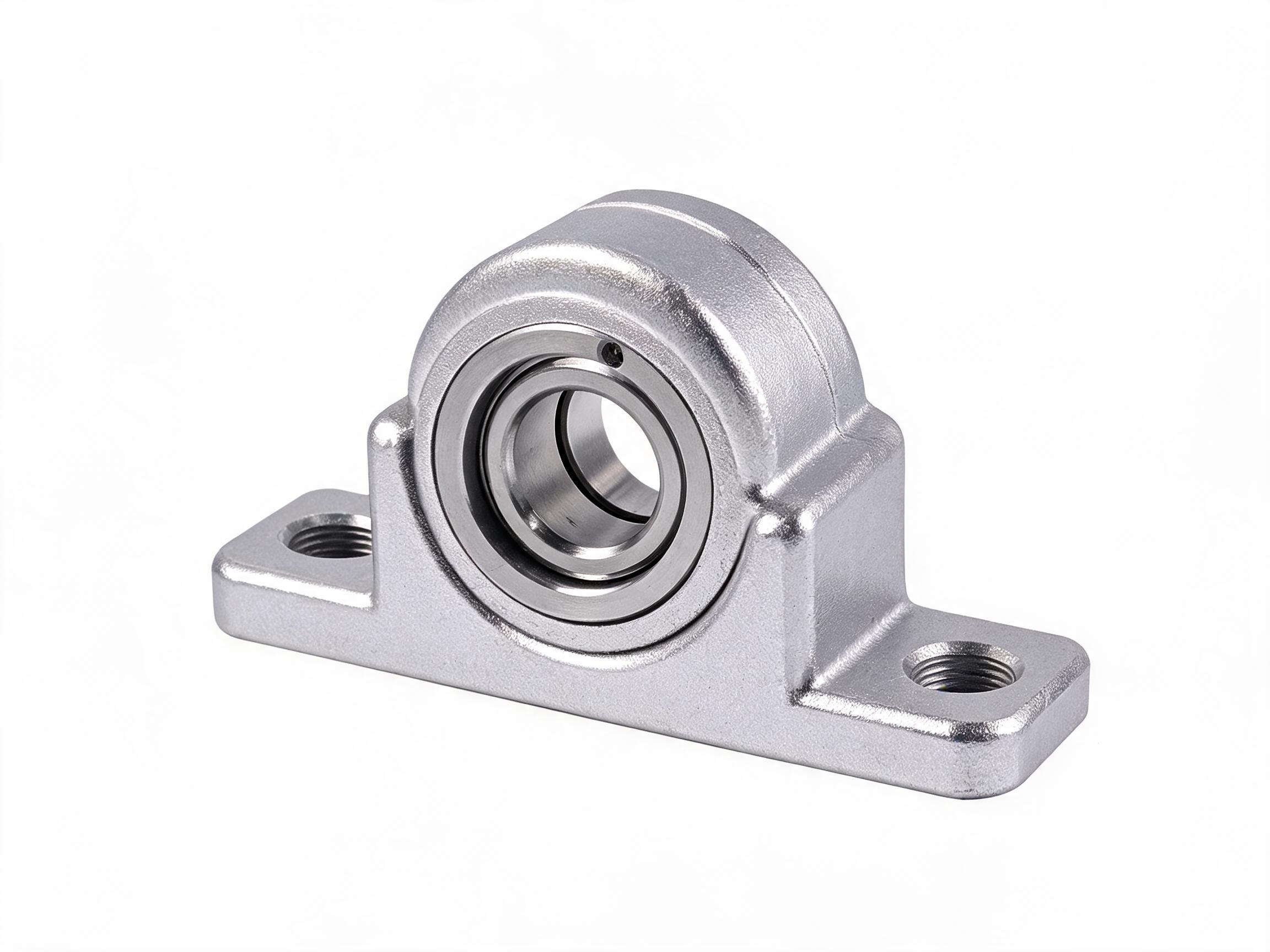
- A pillow block bearing is a mounted unit: a bearing inside a housing, bolted to a frame, supporting a shaft.
- “Plummer block” and “pillow block” name the same housing family. The difference is regional usage, not design.
- One branch carries a rotating shaft. The other carries a reciprocating shaft through a linear bearing.
- Lubricant is a specification you request from the supplier, not a grade you guess from a forum post.
- Catalogue load ratings are test figures, not what your axis will see.
What a pillow block bearing does
A pillow block bearing is a bearing already installed in a housing. The housing bolts to a machine frame, and its bore accepts a shaft. The unit does three jobs at once:
- It carries the shaft. Radial load passes from the shaft through the bearing into the housing and into the frame.
- It locates the shaft. The bore position sets the shaft centreline relative to the machine base, which is why the mounting height and bolt-hole spacing on the drawing matter.
- It absorbs small misalignment. A self-aligning seat lets the bearing follow slight shaft deflection or frame inaccuracy instead of loading one edge of the rolling elements.
The reason the housing exists at all is practical. A bare bearing needs a machined seat, a shoulder, and a way to keep contamination out. A pillow block arrives as a single bolted unit, so a fitter can mount it without machining the frame. That is also why the housing material and the seat design are specification items, not cosmetic details.
Pillow block vs plummer block: the same family
The two names describe the same housing family. “Plummer block” follows British usage; “pillow block” is the common term in North America and in most English-language catalogue and drawing systems. When a US buyer searches for a plummer block bearing, the part they usually need is listed in a catalogue as a pillow block unit.
The practical consequence is small but worth stating: when a drawing or a purchase list uses one term and the supplier catalogue uses the other, that is not a discrepancy, and it does not require a different part number. What does require attention is the mounting configuration and the bore size, which are separate specification fields.
The rotating-shaft branch
In the conventional mounted bearing unit, the shaft turns continuously and the bearing carries that rotation. Typical forms are a two-bolt or four-bolt housing with a bore for the shaft, the housing bolted down along an axis. The bearing is often a self-aligning type, because a long shaft between two supports deflects and the supports are never perfectly co-planar.
This branch is what most people picture when they hear “pillow block”. It is also where the term is used loosely, covering several housing shapes that share the mounting concept but differ in bolt pattern, sealing, and whether the unit locates the shaft axially or lets it float.
The linear branch: a pillow block housing for a reciprocating shaft
There is a second use of the same housing form that buyers often do not expect. In a linear axis, the shaft does not rotate. It moves back and forth, and the housing travels along it. The housing here is a linear pillow block housing, and the bearing inside it is a linear motion bearing, not a rotating-shaft bearing.
Xiamen Dongfeng Bearing Mechanical & Electrical Co., Ltd. has manufactured linear motion bearings and linear guideways since 2014. Its KH Series Pillow Block Linear Bearing Housing Unit is an example of this branch: a two-bolt pillow block housing with a pre-installed sealed linear bearing, made for a shaft that reciprocates.
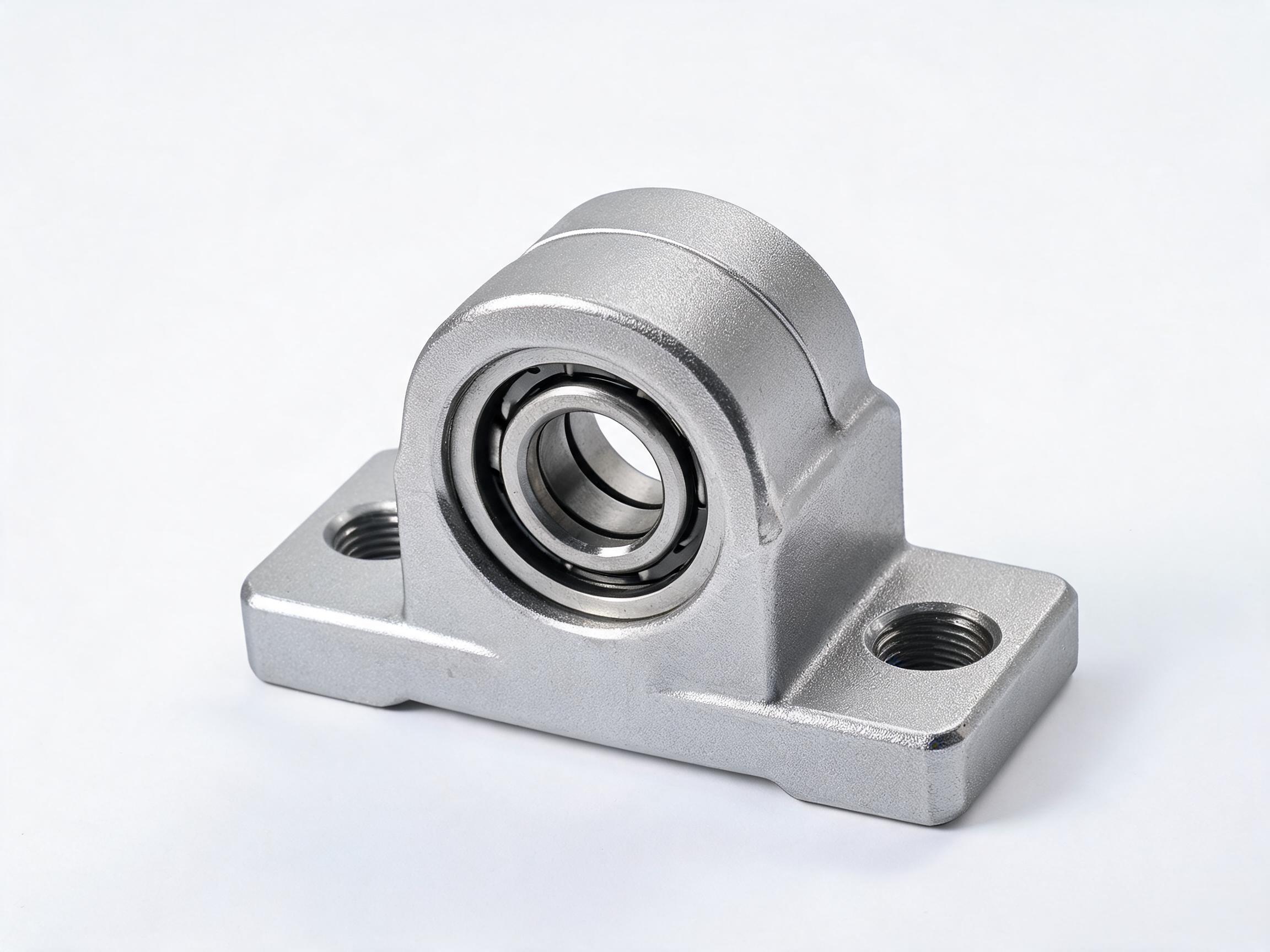
Key specifications of this unit:
| Item | Specification |
|---|---|
| Housing type | Two-bolt pillow block |
| Housing material | Anodized ADC12 die-cast aluminium |
| Bearing | Pre-installed sealed linear bearing, GCr15 steel |
| Self-aligning seat | ± 3 degrees |
| Shaft diameter range | 8 to 50 mm |
| Housing dimensioning | JIS B 1185 |
| Operating temperature | −20 to +80 °C |
| Bearing replacement | About 5 minutes, without dismantling the shaft |
| KH16 dynamic load | 980 N |
| Minimum order | 100 pieces |
The serviceable point is the bearing replacement path. Because the bearing can be swapped in about 5 minutes without pulling the shaft, a maintenance team can restore an axis without a full teardown. That matters on machines where the shaft also carries other components that would otherwise need re-alignment.
If your application is the rotating-shaft type, this housing is not the right family. State that on the enquiry and the supplier should point you to the correct product group rather than match a similar-looking bore size.
Catalogue load rating vs the load your axis sees
The KH16 dynamic load figure is 980 N. That number comes from a test condition. A real axis rarely reproduces it, and a buyer who sizes from the catalogue number alone will end up with a unit that behaves differently on the machine. The gap comes from conditions the test does not carry:
- Load direction. A radial rating assumes the load acts in a defined direction relative to the bearing. Off-axis components change the effective load.
- Stroke and speed profile. Acceleration at the ends of travel, not the average speed, sets the peak force.
- Moment load. A housing mounted on a single bolt line sees a moment when the load is offset from the bearing centre, which a pure radial rating does not capture.
- Environment. Contamination, washdown, and temperature outside the stated −20 to +80 °C range change both friction and clearance.
- Parallelism between shafts. On a two-rail axis, non-parallel shafts preload the bearings before any external load is applied.
For an axis under development, the useful approach is to send the supplier the stroke, the moving mass, the acceleration, the mounting orientation, and the expected moment. With those inputs the bearing selection can be checked against the geometry rather than against a single rating number.
Grease for pillow block bearings: a specification check
“What grease for pillow block bearings” is one of the most common questions buyers ask, and it is best treated as a specification enquiry rather than a lookup. There is no single correct grease grade across the category. The right lubricant depends on the bearing type inside the housing, the operating temperature, the speed, and the environment.
For the KH Series unit, the bearing is supplied pre-installed and sealed. The lubricant question therefore becomes: what specification does the pre-installed bearing carry, and what does the application require? Two items to put to the housing supplier in writing:
- The base oil and thickener of the factory-fill lubricant, so the site team knows what is already in the bearing.
- Compatibility with the application. If the axis runs near the upper end of the −20 to +80 °C range, or in a washdown area, that should be stated when ordering, not resolved after installation.
Do not mix lubricants on the basis of a forum recommendation. If a re-lubrication point is planned, ask the supplier for the correct procedure and interval for the specific installed bearing. The housing supplier is the right party to answer that, because the answer belongs to the bearing inside the housing, not to the housing casting.
FAQ
What does a pillow block bearing do?
It supports a shaft, holds its position relative to the machine frame, and allows rotation or linear travel depending on the bearing inside. The housing bolts down, so the mounting surface does not need to be precision-machined to accept a bare bearing. In a linear pillow block housing, the same form carries a reciprocating shaft through a linear bearing.
What is a pillow block bearing used for?
Common uses include driven shafts on conveyors and fans in the rotating branch, and reciprocating axes on automation equipment in the linear branch. The deciding factor is whether the shaft rotates in place or travels along its own axis. The KH Series, for example, is used where a linear bearing needs a bolted housing that can be serviced without removing the shaft.
What grease for pillow block bearings?
There is no universal grade. Request the lubricant specification from the housing supplier for the exact bearing supplied, and state the operating temperature and environment. For the KH Series unit the bearing is pre-installed and sealed, so the correct question is what the factory fill is and whether it suits the application conditions.
Is a plummer block bearing the same as a pillow block bearing?
Yes. The two names refer to the same housing family under different regional conventions. When comparing a drawing against a catalogue, treat the terms as equivalent and check the mounting configuration and bore size instead.
Can a pillow block housing be used with a linear bearing?
Yes, and this is a distinct product family. The KH Series Pillow Block Linear Bearing Housing Unit is a two-bolt housing in anodized ADC12 die-cast aluminium with a pre-installed sealed linear bearing in GCr15 steel, a self-aligning seat of ± 3 degrees, and shaft diameters from 8 to 50 mm. It is dimensioned to JIS B 1185.
Confirming the family before you order
Two questions settle most enquiries. Does the shaft rotate in place, or does it travel along its own axis? And if it travels, what is the bore size, the stroke, and the mounting orientation? Answer those and the choice between the rotating-shaft family and the linear pillow block housing becomes a specification decision rather than a guess.
For linear applications, the KH Series product page lists the housing dimensions, the shaft range, and the ordering quantity. Send the shaft diameter, stroke, load direction, and operating temperature with your enquiry so the unit can be checked against the axis rather than matched on bore size alone.