A selection guide for buyers comparing plastic linear bearings with recirculating ball bushings. It explains the two product families sold under the term, the ball-bushing failure modes that plain bushings solve, the friction and speed trade-offs, and which datasheet values to check before specifying.
Plastic Linear Bearings: When a Polymer Bushing Beats Balls
- Buyers searching “plastic linear bearing” are usually comparing plain bushings against recirculating ball bushings, not shopping for a single material.
- Solid polymer bushings and polymer-lined metal composite bushings are different products with different ratings.
- Plain bushings solve corrosion, dust, edge loading and washdown problems; they trade away stiffness, speed capability and smoothness.
- Check the datasheet before specifying either family for dry running, high temperature or low-speed axes.
The term “plastic linear bearing” does not describe one product. In purchasing enquiries it covers two distinct families: solid polymer bushings machined from engineering plastics, and metal-backed composite bushings with a polymer sliding layer. They share the same job — supporting a shaft in linear motion without rolling elements — and they are close in price and appearance. Their ratings are not interchangeable. A buyer specifying one while the datasheet describes the other can end up with a bushing that runs hot, wears quickly or fails under load.
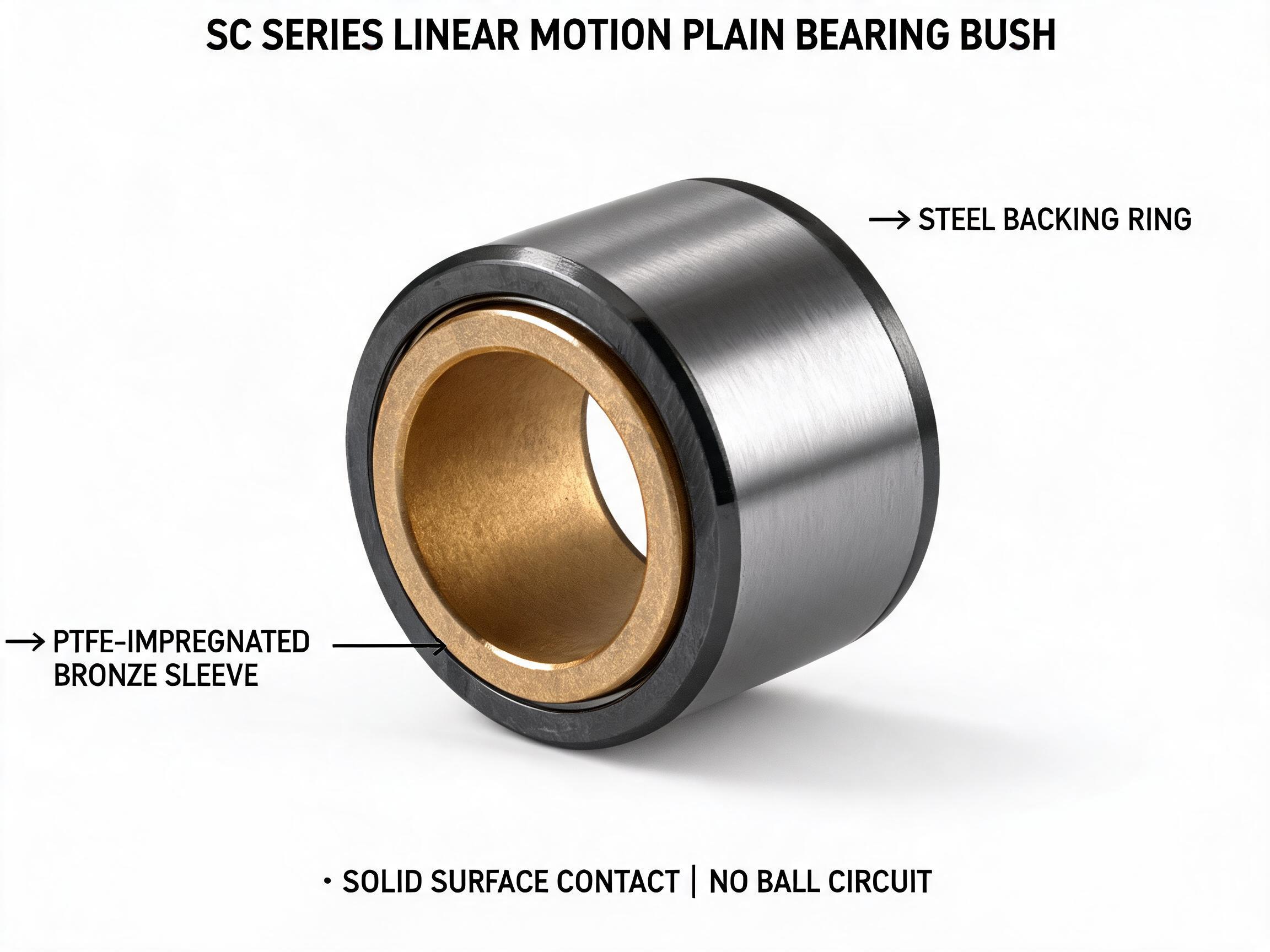
This guide explains what each family is, which failures of recirculating ball bushings plain bushings are chosen to avoid, and the trade-offs a buyer accepts in return. The reference product is our SC Series linear motion plain bearing. It is a PTFE-impregnated bronze composite bushing of the DU type — a metal backing with a filled bronze layer and a PTFE sliding surface. It is not a solid plastic bushing. Solid-polymer bushings carry different load, speed and temperature ratings; confirm their values with the manufacturer's datasheet, not with the SC figure below.
Two families sold under the same keyword
Solid polymer bushings
These are plain cylinders machined or moulded from materials such as UHMW-PE, POM, PEEK or filled PTFE. There is no metal backing. They suit light loads, clean or wet environments and applications where the bushing itself must be electrically or chemically inert. Their load capacity and operating temperature depend entirely on the polymer chosen, so a single generic figure does not apply across the family. Confirm with the datasheet.
Polymer-lined metal composite bushings
These combine a steel or bronze backing with a porous bronze interlayer impregnated with PTFE and other fillers. The composite supports far higher loads than most solid polymers because the backing carries the pressure, while the sliding layer provides low friction without grease. The SC Series belongs here.
| Property (SC Series) | Listed value |
|---|---|
| Construction | PTFE-impregnated bronze composite on metal backing (DU type) |
| Friction coefficient, dry | 0.08–0.12 |
| Friction coefficient, greased | 0.04–0.06 |
| Max static load, SC20 | 12 kN |
| Max PV rating, dry | 2.8 MPa·m/s |
| Max PV rating, greased | 5.0 MPa·m/s |
| Operating temperature | -50°C to +200°C |
| Shaft diameter range | 6 mm to 60 mm |
| Sizes | SC6, SC8, SC10, SC12, SC16, SC20, SC25, SC30, SC40, SC50, SC60 (11 sizes) |
| Bore tolerance | H7 |
| Types | SC closed sleeve, SCF flanged |
Note that the load rating quoted above is for the SC20 size. Load capacity scales with bushing length and projected area, so a SC8 and a SC50 do not share the same figure. Check the size-specific value in the catalogue before sizing an axis.
Failure modes plain bushings are chosen to avoid
Recirculating ball bushings, such as our LM Series linear ball bearing bush, offer low friction and high stiffness. Those advantages depend on conditions the bushing cannot control. Five common failure modes make buyers look for a plain alternative:
- Dust and debris. Balls and their recirculation channels are sensitive to grit, scale and wood dust. Contamination can raise friction or block the return path, and sealing adds drag and cost. A plain bushing wipes the shaft rather than rolling over it and tolerates many dusty environments better, provided the shaft itself is protected or hardened — and note that highly abrasive grit can still wear the PTFE sliding layer, so severe dust duty needs a shaft protection check.
- Dry running and washdown. Ball bushings normally need lubrication to keep balls and races apart. In food, packaging and washdown equipment, lubricant is unwanted or washed out. A PTFE-lined composite can run dry; the friction figures above apply to unlubricated operation.
- Shock and edge loads. When a load is applied over a short stroke, the balls near the bushing edge carry most of the load and can indent the raceway. A plain bushing spreads a compressive load across the sliding surface rather than through point contacts.
- Temperature. Standard ball bushings are generally limited by seals, lubricant and bearing steel hardening. The SC Series is listed for -50°C to +200°C. Whether the surrounding hardware and seals survive that range is a separate question; confirm with the datasheet for each component in the assembly.
- Low-speed axes on a budget. Where stroke speeds are low and precision requirements are modest, a plain bushing removes the ball recirculation parts, the seals and the lubricant system from the bill of materials.
The trade-offs you accept
A plain bushing is not a drop-in upgrade. It is a different set of compromises, and the buyer should confirm that the application can live with them.
Friction and stick-slip
Even the listed dry-running friction coefficient of 0.08–0.12 is higher than a lubricated ball bushing's. At very low speeds, PTFE composites can show stick-slip; greasing lowers friction to 0.04–0.06 and generally improves motion smoothness. If the axis must move in fine increments or hold position precisely, test the chosen combination on the actual shaft finish.
Speed and PV limit
The PV rating is the product of contact pressure and sliding speed. The SC Series is listed at 2.8 MPa·m/s dry and 5.0 MPa·m/s greased. A high-speed, lightly loaded axis and a low-speed, heavily loaded axis can both sit inside that limit, but the combination of the two must be checked. Recirculating ball bushings are generally the better choice when continuous high speed at low friction is the dominant requirement.
Precision and stiffness
The SC Series is specified with an H7 bore tolerance. Plain bushings generally offer lower stiffness and less precise running than preloaded ball bushings, and clearance depends on shaft tolerance and fit. For positioning axes where repeatability matters, confirm the shaft tolerance and the resulting clearance with the datasheet.
Environmental limits
Abrasive particles can wear the PTFE sliding layer, and the bronze layer can corrode if the fluid is chemically aggressive to bronze. Shaft hardness and surface finish also matter more than with ball bushings, because the whole sliding surface bears on the shaft. Confirm the shaft specification against the bushing datasheet before ordering.
How to specify the right part
A short requirement statement narrows the choice quickly:
- Shaft size and bore fit. SC covers 6 mm to 60 mm in 11 sizes — SC6, SC8, SC10, SC12, SC16, SC20, SC25, SC30, SC40, SC50, SC60 — with an H7 bore. State the shaft tolerance, not only the nominal diameter.
- Mounting type. Closed sleeve (SC) or flanged (SCF). Flanged types simplify axial location in a housing.
- Load per size. Give the actual radial load and stroke. Do not assume the SC20 load figure applies to your chosen size.
- Speed and duty cycle. State maximum speed, stroke and whether the motion is continuous or intermittent, so the PV check can be made.
- Lubrication. Say whether the axis must run dry or can be greased. The friction and PV figures differ between the two cases.
- Environment. Temperature, dust, washdown, chemicals and shaft material.
If the application needs a solid polymer bushing rather than a composite, treat the SC figures as irrelevant and request the polymer supplier's ratings for the specific grade. The two families are not substitutes by default.
Next step: once your shaft diameter, load, speed and environment are written down, compare them against the SC Series product page and its datasheet — and against the LM Series ball bushing if your axis is clean, lubricated and speed-sensitive.
Frequently asked
Is the SC Series a plastic bearing?
No. It is a PTFE-impregnated bronze composite plain bushing on a metal backing, often called a DU-type bushing. The sliding surface contains polymer, but the load-bearing structure is metal. Solid polymer bushings have different ratings and should be checked separately.
Can I run a plastic linear bearing without grease?
The SC Series is listed for dry running at a friction coefficient of 0.08–0.12 and a PV limit of 2.8 MPa·m/s. Greasing lowers friction to 0.04–0.06 and raises the PV limit to 5.0 MPa·m/s. Whether dry running is acceptable for your load and speed needs to be checked against the PV limit for your size.
When should I still choose a ball bushing?
When the axis needs high speed at low friction, high stiffness, or very smooth, precise motion, and the environment is clean and lubricated. The LM Series recirculating ball bush is the conventional choice for those conditions. For dusty, washdown, shock-loaded or high-temperature axes at low speed, a plain bushing can be considered first — with the shaft protection and wear checks described above.