An honest drive-choice comparison for automation axes: where pneumatic slides win on simple end-to-end strokes, cycle speed, harsh environments and first cost, and where ball-screw electric slides win on programmable positioning, ±0.01 mm repeatability, intermediate stops, holding under power-off with a brake, and force control. Grounded in SKF20 and XY200 catalog specifications; pneumatic side kept qualitative.
Pneumatic Linear Slides vs Ball Screw Slides: How to Choose
Two technologies answer two different automation questions. A pneumatic cylinder or slide table is built for fast, repeated movement between fixed mechanical ends. A ball-screw electric slide is built for positions you set in software. The right choice follows from what your axis actually has to do.
Key takeaways
- Pneumatic wins on simple end-to-end strokes, short cycle times, harsh or washdown environments, and the lowest first cost.
- Ball-screw electric slides win on programmable position, repeatability, intermediate stops, holding under power-off conditions when a brake is fitted, and controlled force.
- Repeatability is the sharpest test: pneumatic cylinders do not natively give ±0.01 mm; you need sensors or servo-pneumatic control to approach it.
- Our catalog covers ball-screw electric solutions, not pneumatic products, so the pneumatic side of this comparison is kept qualitative.
What each drive actually controls
A pneumatic slide is normally triggered: air enters, the tool moves to the end of its stroke, air reverses, and the tool moves back. Position is set by hardware — cylinder stroke, end stops, or the size of the slide table — not by the controller. Cycle time is driven by airflow, pressure and the mechanical load.
A ball-screw electric slide turns a motor into linear travel through a screw and a carriage on rails. Every position within the stroke is a number the control system can command. That changes the role of the axis: it can move to position A, stop, move to position B, dwell, and return, all without changing hardware.
Neither is universally better. The sections below separate the conditions where each drive fits.
Where pneumatic slides lead
Simple end-to-end strokes
If the axis only ever lives at two ends — extend and retract, clamp and release, push and reset — the pneumatic slide does the job with hardware and a valve. There is no position to program and no tuning to maintain. For a pick-and-place that only needs to reach a stop, this is a clean match.
High cycle speed
Pneumatic actuation moves the slide as soon as the valve switches. Cycle speed depends on air supply, valve flow and the mass being moved. For repetitive short strokes, the drive does not spend time counting encoder counts per move, and the end position is defined mechanically.
Harsh or washdown environments
Pneumatic components are widely used in environments with dust, coolant or washdown, because the actuator is not a motor and screw assembly exposed to those conditions in the same way. The pneumatic side of this comparison is qualitative here: our catalog covers electric ball-screw solutions, so pneumatic ratings and environmental specifications must come from the pneumatic supplier.
Low first cost
The pneumatic slide itself, a valve and a simple control are commonly less expensive up front than a motor, drive and screw assembly for the same nominal stroke. That advantage is concentrated in applications that only need two positions. Once you need variable position, the comparison changes.
Where ball-screw electric slides lead
Programmable positioning and repeatability
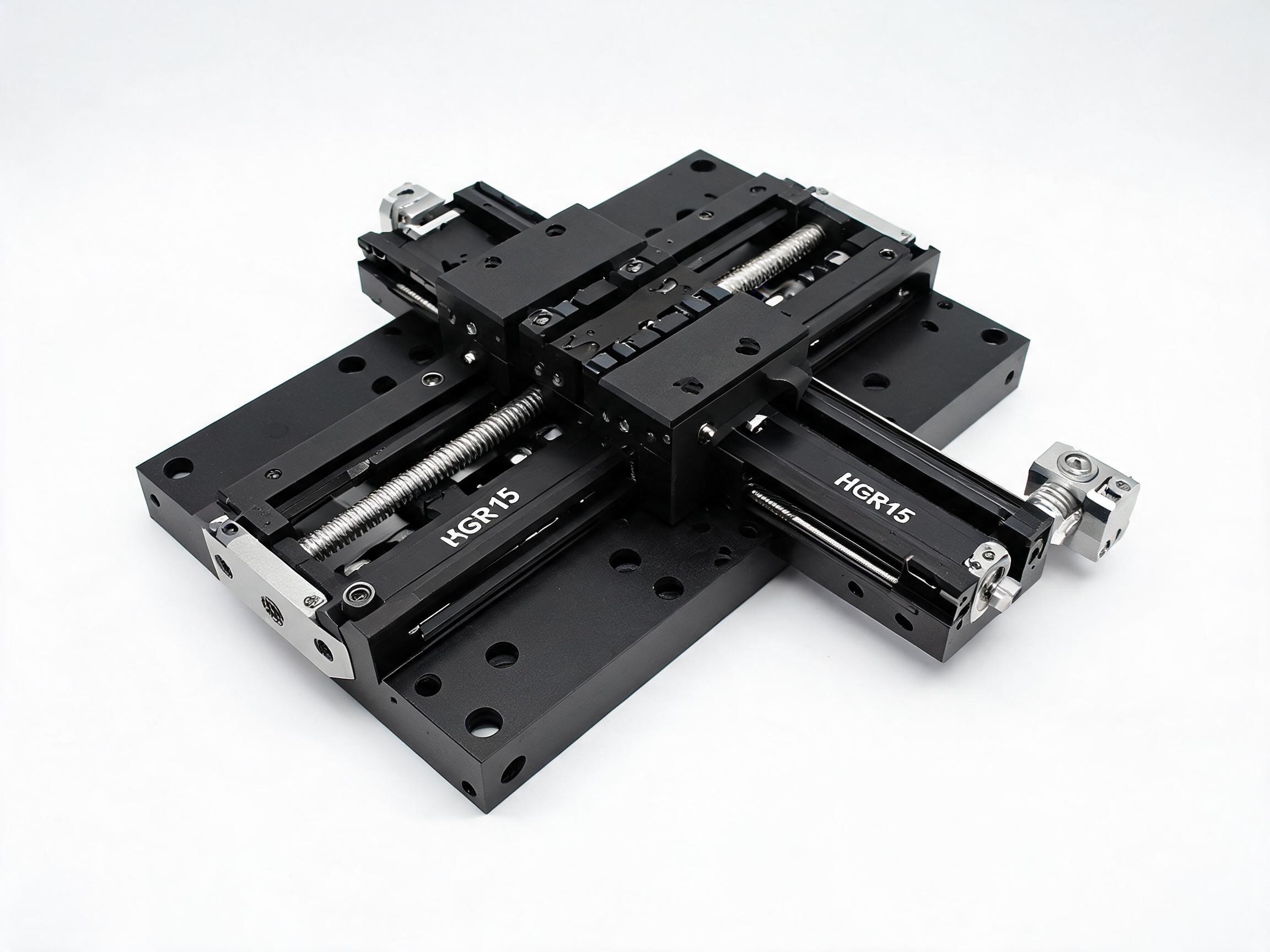
This is the decisive difference. Consider the SKF20 aluminum profile slide module. It uses an HGR15 rail with an HGH15CA carriage and an SFU1605 ball screw (C7 grade, 5 mm lead). The catalog lists 11.2 kN dynamic load, 17.5 kN static load, and travel from 100 to 500 mm standard, custom to 1000 mm. It mounts a NEMA 17 or 23 motor on a 2020 T-slot base and weighs 2.8 kg at 500 mm travel.
A 5 mm screw lead gives a clear relationship between motor revolutions and carriage movement: one turn is one 5 mm move. Position is commanded, checked and changed without touching the mechanics. On an axis where the tool must sit at different distances from the part, that capability separates the two drives.
Intermediate stops
A pneumatic slide stops where its stops are mounted. A ball-screw slide stops wherever the controller says. If your process has three or more fixed positions in one stroke, or needs different positions between batches, the electric slide removes the need for multiple cylinders or several sensors.
Holding position when power is off
A ball-screw slide with a vertically loaded axis can hold its position with power removed only if a brake is fitted. That condition matters in the comparison: the brake is a component to specify, not a default property of the screw. Horizontal axes with low load may not need it; vertical axes usually do.
Repeatability as the decision example
This is the clearest dividing line. Pneumatic cylinders do not natively give ±0.01 mm repeatability. They can be instrumented with sensors, or controlled with servo-pneumatic valves, and such systems can measure their position — but that is extra hardware and extra control. A ball-screw slide's repeatability comes from the screw and the servo loop. The XY200 cross slide table is listed with ±0.01 mm positioning repeatability per axis, 200 mm travel per axis, 11.2 kN per axis, and CMM-verified 90° ±0.02° orthogonality with base flatness ≤0.01 mm.
Those numbers are listed catalog values, not independent test results. But the distinction is valid for choosing: if your requirement is ±0.01 mm, a pneumatic slide needs a sensor-based solution, while a ball-screw slide meets it as a specification.
Force and control
An electric slide can control force through the motor: you can define a move profile, limit torque, and monitor current. A pneumatic slide controls force through pressure and cylinder area, which is simpler in many clamp applications but limited when force must vary within a stroke. For mixed load or delicate parts, electric force control is the more flexible option.
Side-by-side comparison
| Decision factor | Pneumatic slide (qualitative) | Ball-screw electric slide (catalog example) |
|---|---|---|
| Position control | Set by stroke, stops and sensors | Set in software; any position in travel |
| Repeatability | Not natively ±0.01 mm; needs sensors or servo-pneumatics | ±0.01 mm listed per axis (XY200) |
| Intermediate stops | Needs extra hardware per position | Programmed stops; no added mechanics |
| Cycle speed | Valve-triggered; fast for short strokes | Limited by motor, screw lead and load |
| Stroke flexibility | Fixed by cylinder | 100–500 mm standard, 1000 mm custom (SKF20) |
| Load capacity | Depends on cylinder bore and pressure | 11.2 kN dynamic, 17.5 kN static (SKF20) |
| Power-off holding | Holds as configured by valve state | Only with a brake fitted |
| Force control | Pressure × area | Motor torque and current control |
| First cost | Lower for two-position axes | Higher: motor, drive, screw, control |
| Harsh/washdown | Widely used; check supplier data | Check sealing and protection per application |
Pneumatic specifications are qualitative because our catalog does not list pneumatic products. Electric values are listed in the SKF20 and XY200 product pages and are not independent test results.
Turning the comparison into a request
The choice is not a vote for one drive. State the axis requirement first, then let the drive follow. A practical list to write down before requesting a solution:
- How many distinct positions does the axis need — two, or more?
- What repeatability does the process tolerate? If it is ±0.01 mm, specify it explicitly.
- Does the axis hold position with power removed? If so, does that require a brake?
- Is the motion horizontal or vertical, and what is the moving mass?
- What is the cycle time, and how much of it is travel versus dwell?
- What environment: dust, coolant, washdown, temperature?
When the answers include intermediate positions, ±0.01 mm repeatability, or variable force, the electric side becomes the natural starting point. Our catalog covers ball-screw electric solutions in that range: the SKF20 module for a single programmable axis, the XY200 cross slide for two-axis work, and SFU series rolled ball screw assemblies for builders who integrate their own stage. For a two-position, high-cycle, washdown application, the pneumatic route remains valid — specify it with a pneumatic supplier who can provide the environmental and load data.
FAQ
Can a pneumatic slide be made to repeat to ±0.01 mm?
Not with a standard cylinder and end stops. A pneumatic axis can report and control position with sensors or servo-pneumatic valves, but that is additional hardware and control. If ±0.01 mm is the requirement, state it and compare the instrumented pneumatic solution against a ball-screw slide as a specification.
Can a ball-screw slide hold position when power is off?
Only if a brake is fitted. The screw alone does not hold a vertically loaded axis when the motor is unpowered. Specify the brake where power-off holding is required, and confirm the axis orientation and load.
Which is faster for a short stroke?
Pneumatic actuation can switch quickly on short strokes, with speed governed by air flow, pressure and mass. A ball-screw slide's speed depends on motor, screw lead and load. If cycle time is the primary constraint, define stroke, mass and required cycle and compare both on those numbers rather than on general claims.
Where should the first cost comparison stop?
For a two-position axis, the pneumatic slide is commonly the lower first cost. For an axis requiring several positions, controlled force, or ±0.01 mm repeatability, the cost of sensors, valves or multiple cylinders changes the comparison. Include the control hardware on both sides of the estimate.