
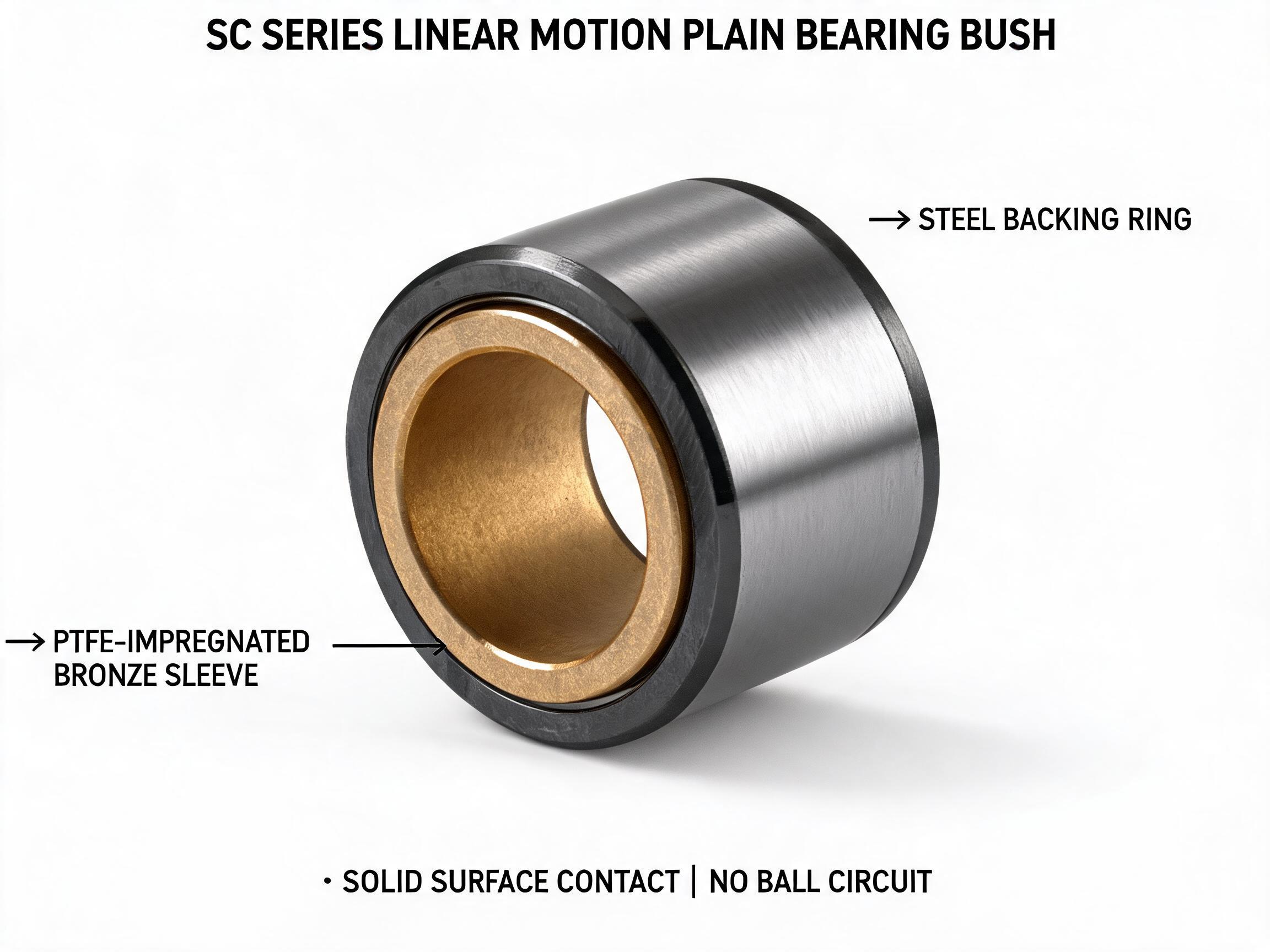
Two quotes for the same 20 mm bore rarely match, because they may describe three different products. This article breaks down how a linear bushing quote is built across the SC, LM and LME routes at the same shaft diameter, which quotation lines move when the route changes, and what an industrial buyer should get in writing before releasing a purchase order.
Two quotes land in your inbox for the same 20 mm shaft, and the prices do not match. One is roughly a third of the other. Nothing on either sheet is wrong. What usually happened is that the two suppliers quoted two different products, or quoted the same product with different commercial terms attached.
How much a linear bushing costs depends far less on the bore size than on which of the three common product routes you are buying, and on how much inspection and paperwork travels with the parts. At the same 20 mm bore, a PTFE-lined plain sleeve, a recirculating ball bush and a metric flanged ball bush are three separate assemblies with different materials, load behaviour, lead times and packing. The bore dimension is the only thing they share. That is why the same keyword search returns prices that look impossible to compare, and why the useful question is not "what does a bushing cost" but "what exactly is this quote describing."
The three routes at the same bore diameter
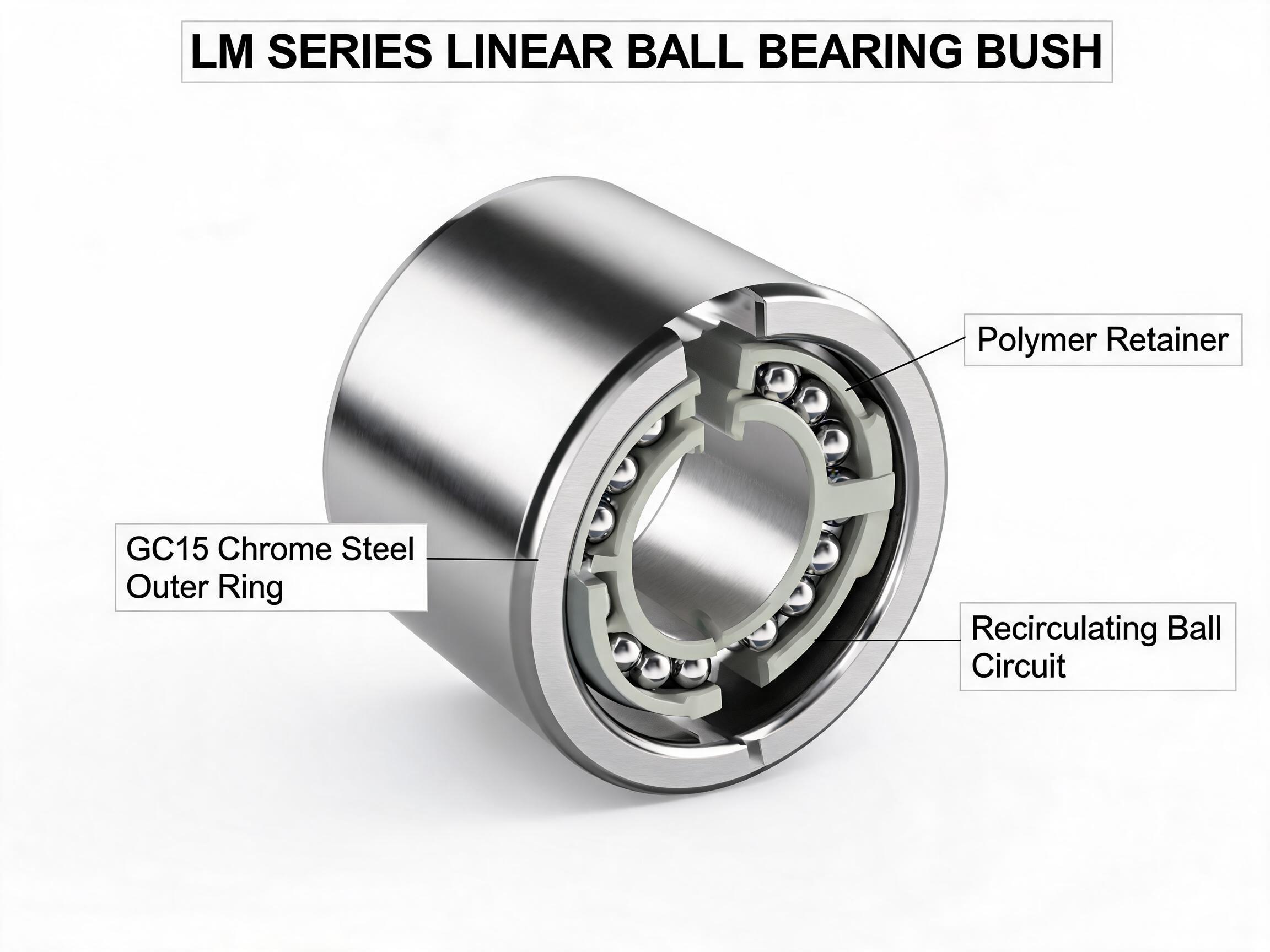
The table below compares the three routes the way a quotation would present them, at the same nominal shaft size range. Read it as a specification map rather than a price list: the lines that differ here are the lines that drive the price difference in your inbox.
| Quotation line | SC series plain sleeve bush | LM series linear ball bush | LME series metric flange linear bearing |
|---|---|---|---|
| Shaft range | 6–60 mm | 6–60 mm | 8–60 mm |
| Construction | PTFE-impregnated bronze DU-type composite with steel backing ring, press-fit | GCr15 chrome steel, PA66-GF retainer | GCr15 chrome steel, three-bolt circular flange |
| Hardness | Not applicable (composite sliding layer) | HRC 60–64 | HRC 60–64 |
| Bore and fitting | H7 bore, press-fit outer diameter | Standard metric bore, slip fit in housing | Standard metric bore with bolt-on flange housing |
| Load data quoted | Static load, e.g. SC20 max static 12 kN | Dynamic load, e.g. LM16UU 980 N | Dynamic load per DIN ISO 10285 LME |
| Friction / PV | 0.08–0.12 dry, 0.04–0.06 greased; max PV 2.8 MPa·m/s dry, 5.0 greased | Rolling contact, not quoted as PV | Rolling contact, not quoted as PV |
| Temperature | −50 °C to +200 °C | Dependent on retainer and seal selection | Dependent on retainer and seal selection |
| Variants | SC closed, SCF flanged | UU sealed, OP open | Three-bolt circular flange |
| Standard reference | Composite sleeve practice, H7/press-fit | JIS B 1185 / ISO 10285 | DIN ISO 10285 LME |
| Interchangeability | Not interchangeable with ball types | Dimensionally within its own series | Interchangeable with SKF LMEF / INA KGNOZ after dimension check |
| MOQ | 100 per size | 100 per size | 100 per size |
Notice that the SC route is quoted on static load, while the LM and LME routes are quoted on dynamic load. Those are not the same number wearing different labels. A 12 kN static figure and a 980 N dynamic figure describe different failure conditions, and a buyer comparing them side by side will reach the wrong conclusion about which part is "stronger." Always check that the two quotes you are comparing are stating the same load type.
Which quotation lines actually change
When a supplier switches your 20 mm line from LM to LME, the price movement usually comes from the flange housing: a three-bolt circular flange is a machined addition to the same ball bush, and it changes both the raw material weight and the machining time. When the switch goes from LM to SC, almost every line changes, because you have moved from a rolling element to a composite sliding layer. The bore stays 20 mm; the rest of the sheet does not.
Material and technology route sits at the top of the list for a reason. The SC sleeve carries a PTFE-impregnated bronze layer on a steel backing ring, and the outer diameter is specified for press-fit, so the housing bore tolerance is part of the product definition. The LM and LME bushes are through-hardened GCr15 at HRC 60–64 with a PA66-GF retainer, and they expect a different housing fit because the balls need running clearance. If you send an SC drawing to a supplier who quotes LM, or the reverse, the quote will be priced on the wrong process and the parts will not install the way you expect.
Fit and tolerance class is the second line that moves. The SC route specifies an H7 bore and a press-fit outer diameter, which means the customer's housing bore has to hold H7 to make the interference work. The LM and LME routes tolerate a wider housing range, but they are sensitive to shaft hardness and surface finish, because the balls run directly on the shaft. Two quotes can both say "20 mm" and still be priced against two different assumptions about your shaft and housing.
Duty conditions change the answer in a different way. If the application runs dry, the SC route offers a friction coefficient of 0.08–0.12 and a maximum PV of 2.8 MPa·m/s. Greased, those figures improve to 0.04–0.06 and 5.0 MPa·m/s. A supplier who knows the lubrication state can quote the right sleeve variant; a supplier who does not will quote the default and hope it holds. Temperature range also pushes selection: the SC composite covers −50 °C to +200 °C, while the ball routes depend on which retainer and seal you choose.
Inspection documentation is the line most often left off the first quote and added to the second. A quote that includes a material report, a dimensional record or third-party verification is not quoting the same deliverable as one that ships parts and a packing list. This is not padding. It is a different scope of work, and it should appear as a separate line so you can see what you are buying.
MOQ and packing close the gap. MOQ for all three routes is 100 pieces per size, so MOQ rarely explains a large price gap at this bore. Packing does move the landed number: SC6–SC20 ship at 50 pieces per carton, and carton counts change the freight calculation on a DAP or DDP quote more than most buyers expect. Samples of 10–20 pieces are available, and sample pricing should be read separately from production pricing because the setup cost is spread over far fewer pieces.
The one line that flips a comparison: static load versus dynamic load. If your two quotes disagree on which one they printed, ask both suppliers for the same load type before you compare anything else.
What to confirm in writing before you place the order
Verbal clarity does not survive a container. Put the following on the purchase order or in the supplier's written confirmation, because each one maps to a line that changes price.
- Series and variant code. SC closed or SCF flanged, LM with UU seals or OP open, LME with its three-bolt circular flange. A one-letter difference changes the part.
- Bore, outer diameter tolerance and housing fit. For SC, confirm that your housing is prepared for H7 bore and press-fit outer diameter. For LM and LME, confirm shaft hardness and surface finish expectations.
- Load type and value quoted. Static for SC, dynamic for LM and LME, with the specific figure written next to the part number.
- Lubrication and temperature. Dry or greased determines which PV figure applies; operating temperature confirms the SC composite range or the correct retainer and seal for the ball routes.
- Documentation scope. State which reports you need and whether they are a line item. Do not assume they are included.
- Quantity, packing and lead time. Confirm MOQ of 100 per size, carton quantity, and the lead time band. For SC, SC6–SC25 typically ship in 7–10 business days and SC30–SC60 in 15–20 business days.
- Incoterm and origin. EXW, FOB, DAP and DDP are all available from Xiamen, and the choice changes the number you compare against another supplier.
- Interchangeability check. If you are replacing an SKF LMEF or INA KGNOZ part with an LME equivalent, confirm the dimensional check was done against your drawing, not against the catalogue only.
Xiamen Dongfeng Bearing Mechanical & Electrical Co., Ltd. has manufactured these three routes since 2014, with ISO 9001:2015 and CE certification, a 5,000 square metre plant and 12 production lines, and an SGS material report at 58–62 HRC for the hardened steel routes. If you want a quote that is line-by-line comparable with the one you already have, send the drawing, the housing fit, the lubrication state and the documentation scope, and ask for the corresponding lines by name. You can reach the application team through the contact page.
Frequently asked questions from buyers
How much do bushings cost for a 20 mm shaft?
There is no single answer, because a 20 mm bore describes three different products. The price depends on whether the quote is for an SC composite sleeve, an LM ball bush or an LME flanged bearing, and on whether inspection documents are included. Ask for the series code, the load type and the documentation scope on the quotation, then compare like for like. Any supplier who gives you one number without those details is quoting a default, not your application.
Why are two quotes for the same bore so far apart?
Usually one of three things. The suppliers may be quoting different series, the load figure may be static in one case and dynamic in the other, or one quote may include inspection documentation and the other may not. Occasionally the difference is the flange housing, which adds material and machining. Ask each supplier to break the quote into route, fit, documentation, MOQ and packing lines, and the gap usually explains itself.
Where to buy bushings that match an SKF or INA part number?
For flanged metric bearings, the LME series is dimensionally interchangeable with SKF LMEF and INA KGNOZ after a dimension check against your drawing. Confirm the check in writing rather than relying on the catalogue designation alone. For plain sleeves and standard LM bushes, there is no cross-series interchange, so supply the drawing and the housing fit instead of a competitor part number.
Can the SC sleeve run without lubrication?
Yes, the PTFE-impregnated composite is designed to run dry, with a friction coefficient of 0.08–0.12 and a maximum PV of 2.8 MPa·m/s. If you grease it, friction drops to 0.04–0.06 and maximum PV rises to 5.0 MPa·m/s. The correct figure for your quote depends on which state you specify, so state it.
What is the minimum order and how fast do samples ship?
MOQ is 100 pieces per size across the three routes. Samples of 10–20 pieces are available for evaluation. Production lead time for SC parts runs 7–10 business days for SC6–SC25 and 15–20 business days for SC30–SC60, shipped FOB Xiamen. Confirm the current band when you request the quote, since it applies per size and per order.