A practical pre-purchase checklist for maintenance and engineering teams converting sliding ways to profile rail guidance — load and moment assessment, mounting surface condition, rail size selection, straightness expectations, carriage interchangeability, and the questions to put to a supplier before you order.
Retrofit Checklist
Converting a machine from sliding ways to profile rail guidance is usually cheaper than replacing it — but the decision is made before the first bolt is loosened. These are the checks that determine whether a rail retrofit is straightforward or expensive.
Key takeaways
- Measure load and moment at the carriage first; rail size follows from that, not from the old way width.
- Machined mounting surfaces and a reference shoulder edge do more for final accuracy than a higher rail grade.
- Interchangeability depends on bolt hole pitch and cross-section profile matching the existing rail, not on nominal size alone.
- Straightness is a property of the assembled machine, so expect to measure and adjust on site.
- Tell the supplier the old rail's dimensions and the application, so grade, preload, length and splices can be quoted correctly.
Load and moment assessment
Sliding ways and profile rails carry load in different ways. A box way resists moment through the length of its bearing surface; a recirculating carriage resists it through the internal ball rows and the rail's stiffness. When you swap one for the other, the loads have not changed, but the way they are transmitted has.
Work out, for each axis being converted:
- The static and dynamic load carried by the carriage — tool weight, workpiece weight, fixture weight, and any cutting or pressing force that passes through the block.
- Where the load acts relative to the rail centre line. Offset loads create a moment, and moment capacity, not pure radial load, usually decides the rail size.
- The number of carriages per rail. Two blocks spaced apart share a moment far better than one, and can let you use a smaller section than a single-block design would allow.
- Acceleration and deceleration levels, including emergency stops. These add inertial loads that a static calculation misses.
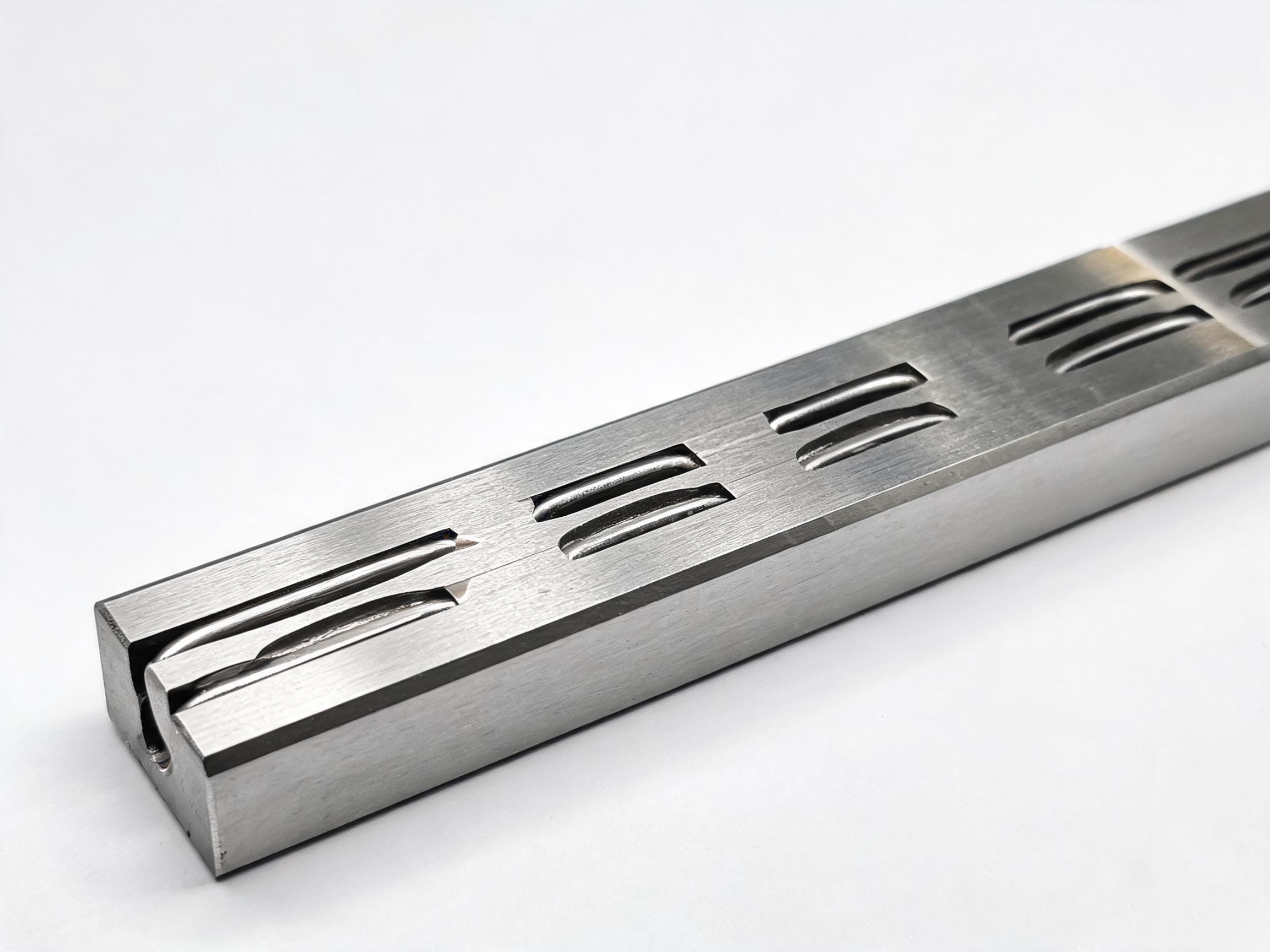
For a heavy-duty profile, the HGR Series heavy-duty linear guideway rail covers sizes HGR15, HGR20, HGR25, HGR30, HGR35 and HGR45, made from 55# high-carbon steel, induction hardened to 58–62 HRC on the raceway surface. That range is broad enough that most retrofits land somewhere inside it, but the choice within the range still has to come from your load case.
Mounting surface condition
This is where most retrofits succeed or fail. A profile rail is only as straight and as parallel as the surface it is bolted to.
Check the machine bed or column before ordering anything:
- Flatness and straightness of the mounting face. If the original ways were hand-scraped or fitted, the surface may be neither flat nor parallel to the axis of travel. Measure it rather than assuming.
- Reference shoulder. Profile rails are normally located against a machined shoulder on one side. If the old design has no shoulder, you will need to create one, or plan on a different alignment method during installation.
- Bolt hole position. Existing holes rarely line up with a standard rail's hole pattern. Re-drilling and tapping, or using an adapter plate, is often part of the job.
- Height difference. Replacing a low sliding way with a taller rail assembly changes the working height of the carriage. Check whether the drive, tooling or workpiece support can absorb that change.
- Contamination risk. Old way-lubrication systems, chips and coolant paths may need re-routing before a precision rail is installed in the same place.
If the surfaces need re-machining, that work has to be planned into the schedule. It is normally the longest single item in a rail retrofit.
Rail size selection logic
Rail size is set by load capacity first, and by envelope second. The old way width is not a reliable guide — a sliding way and a profile rail of similar width can have very different load and stiffness characteristics.
| Step | What you are deciding | What it depends on |
|---|---|---|
| 1 | Required load and moment capacity | Carriage load, offset, number of blocks, acceleration |
| 2 | Rail section size | Capacity curves for the candidate sizes; available mounting space |
| 3 | Grade | Accuracy the machine can actually hold after installation |
| 4 | Preload | Required stiffness versus acceptable running friction and heat |
| 5 | Length and joints | Stroke, mounting layout, transport and handling limits |
On size: moving up one frame size increases capacity meaningfully, but it also increases rail height and bolt size, which may not fit the existing bed. It is usually better to add a second carriage or stiffen the mounting structure than to force a larger rail into a space that cannot take it.
On grade: ground rails such as the H (P5) grade and rolled rails such as the N (P7) grade are both stocked for the HGR series. Ground rail gives a tighter running accuracy and is the usual choice for machine tools; rolled rail covers longer lengths and general automation. If the mounting surface itself is not precise, buying the tighter grade does not recover the difference.
Straightness tolerance expectations
Rail straightness as supplied is one thing; straightness of the installed rail on your machine is another. The second number is what affects the finished part.
Two rails running in parallel on a machine share a common axis. Errors that matter are:
- Straightness of each rail in the vertical and horizontal planes.
- Parallelism between the two rails over the full stroke.
- Height difference between the two rails, which twists the carriage assembly.
Expect to measure these after bolting down, not just to trust the rail's own accuracy class. A common sequence is to locate and lightly clamp one rail against its reference shoulder, indicate it along its length, tighten progressively from the centre outward, then align the second rail to the first using the carriage as the gauge.
If your measuring equipment on site is limited, say so when discussing the job with the supplier. That is a real constraint and it changes what installation method makes sense.
Interchangeability with existing carriages
If only the rail is worn and the carriages are still serviceable, you may want a replacement rail that the existing blocks will run on. That is decided by two things:
- Bolt hole pitch. The centre-to-centre distance of the mounting holes along the rail, and the hole pattern at the ends, must match the machine's mounting arrangement.
- Cross-section profile. The raceway geometry and overall section have to match the carriage's ball tracks. Nominal size alone — "25 mm" — does not guarantee this across different manufacturers.
For the HGR series, the bolt hole pitch and cross-section follow the standard Taiwanese HGR profile, which is what makes direct substitution practical on machines already built around that profile. Where a rail has been cut to a non-standard length or has a splice, supply the original drawing or measure the rail directly; do not rely on the model number alone.
If the carriages are also being replaced, the constraint loosens and you can consider the rail and block as a pair.
Questions to put to the supplier
Most retrofit delays come from missing information rather than from the rail itself. A short, specific enquiry gets a usable answer:
- Grade: is the rail ground or rolled, and what accuracy class does that correspond to?
- Preload: what preload classes are available for the carriage, and how does each affect running friction?
- Length: what is the standard maximum length, and can the rail be cut to a required length? For the HGR series, maximum standard length is 4000 mm, with custom lengths and splice joints available on request.
- Splices: if the stroke exceeds the available length, how are splice joints specified and what does that mean for mounting?
- Interchangeability: will the rail's bolt hole pitch and profile match the existing rail's model and drawing?
- Lubrication interface: how is the carriage lubricated — for HGR, via the oil groove and grease nipple interface — and does that suit the machine's existing lubrication system?
- Lead time and MOQ: the standard MOQ for the HGR series is 50 pieces per size, and in-stock HGR20, HGR25 and HGR30 sizes ship in 7–10 business days. Ask for the current position on the size and length you need.
Send the old rail's dimensions, the machine type, the load case and the mounting surface condition together. It is faster than a back-and-forth about model numbers.
FAQ
Can I replace sliding ways with linear rails without re-machining the bed?
Sometimes. It depends on whether the existing mounting face is flat enough and whether a reference shoulder can be established. If the old ways were fitted by scraping, the surface often needs work before a profile rail can be aligned to it. Measure the surface first, then decide.
Do I need ground rail for a retrofit?
Not automatically. Ground rail gives tighter running accuracy, but if the machine's mounting surfaces are not precise, that accuracy cannot be realised in the assembled machine. Rolled rail is often sufficient for automation and general positioning retrofits, and covers longer lengths.
How do I know whether a replacement rail will fit my existing carriages?
Compare bolt hole pitch and cross-section profile against the original rail, ideally with a drawing or direct measurement. Matching nominal size is not enough. Suppliers who work in the standard Taiwanese HGR profile can usually confirm substitution from the original model number plus a drawing.
What is the longest rail available in one piece?
For the HGR series, the maximum standard length is 4000 mm. Longer travel is normally handled with splice joints, which are available on request. Transport and handling of long rails is also a practical limit worth discussing early.
What access does a rail need on the machine for lubrication?
The carriage has to be reachable for grease replenishment. HGR carriages use an oil groove and grease nipple interface, so check that the retrofit layout leaves clearance for that access before finalising the mounting position.
Next step
Xiamen Dongfeng Bearing has supplied replacement rails to machine builders and maintenance teams since 2014. If you are planning a retrofit, send the existing rail dimensions, the machine and load details, and the condition of the mounting surfaces. That is enough to start a specific answer on size, grade, preload and lead time.