
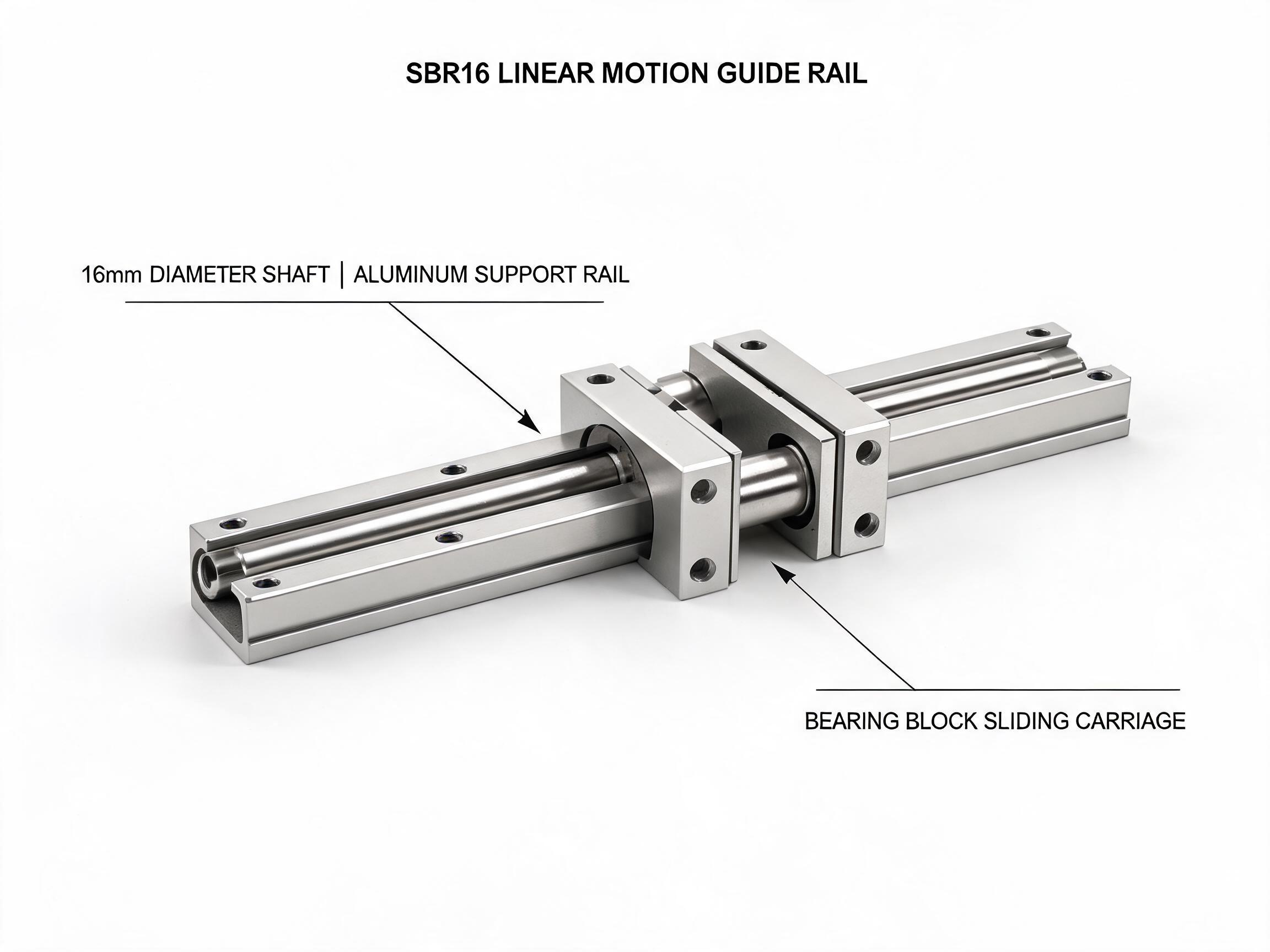
A buyer-level map of the SBR round-shaft linear rail system: how the five sizes (12, 16, 20, 25, 30 mm) differ in construction, load rating, standard and custom length, packaging and MOQ — plus an honest boundary showing where a supported round shaft makes sense and where a profile rail is the better fit.
The SBR linear rail is a supported round-shaft linear guide: a hardened steel shaft mounted on an aluminum support rail, running inside a double-row ball bearing block. It is sold as a system across five shaft sizes from 12 to 30 mm, and buyers usually need to see the whole range at once before picking a size. This page lays out the series as one system — construction, per-size load points, length options, packaging and MOQ — and then draws the boundary where a profile rail becomes the better choice.
The short version
- Five shaft sizes cover the range: 12, 16, 20, 25 and 30 mm, all in the same construction family.
- The shaft is GCr15 bearing steel, HRC 58-62; the support rail is 6063-T5 aluminum.
- Load capability rises with size. SBR16 lists 7.8 kN dynamic / 12.0 kN static; SBR20 lists 11.2 kN dynamic / 17.5 kN static per block, giving 22.4 kN dynamic on a dual-block axis.
- Standard lengths reach 2000 mm for SBR16 and 3000 mm for SBR20, with custom lengths up to 4000 mm.
- Rails 2000 mm and longer ship in wooden crates; MOQ is 50 sets for SBR16 and 30 sets for SBR20.
What the SBR system is made of
Every SBR size uses the same three-part build, so the layout is consistent across the range even though the dimensions and load numbers change. The shaft is a round, case-hardened bearing steel — GCr15, held at HRC 58-62 — which is the surface that carries the rolling load. That shaft is supported continuously along its length by a 6063-T5 aluminum rail. The aluminum support is what makes this a “supported” design: the shaft is not left spanning freely between two end mounts, it is backed along its run.
The block is a double-row ball bearing block. Because the shaft is round, the block locates on the diameter, and the aluminum support rail carries the mounting pattern. That is the practical difference buyers notice first: the rail sits on the machine and the block rides over the shaft, so the rail takes the fastening and the shaft does the guiding.
For SBR16, the standard mounting hole spacing is 50 mm. Hole pitch is set by the rail, not by the block, so this matters for anyone preparing a mounting plate or drawing a bracket. Confirm pitch and hole size against the size you are specifying rather than assuming the series is interchangeable between sizes.
Size-by-size load points
The five sizes exist because the load the axis carries changes with diameter. Rather than publish a single “load capacity,” the honest way to read the series is to read each size. The product pages state two load ratings for the two sizes with published figures, and the pattern shows how the series scales.
| Size | Dynamic rating | Static rating | Notes |
|---|---|---|---|
| SBR12 | — | — | Entry size in the range |
| SBR16 | 7.8 kN | 12.0 kN | Unit rating as stated on the product page |
| SBR20 | 11.2 kN per block | 17.5 kN per block | Dual-block axis: 22.4 kN dynamic |
| SBR25 | — | — | Between SBR20 and SBR30 |
| SBR30 | — | — | Largest shaft size in the range |
Two points are worth making about these numbers. First, the SBR20 figure is expressed per block, and a dual-block axis doubles the dynamic rating to 22.4 kN — because the load is shared across two blocks. If your design uses one block, use the per-block figure; if it uses two, the axis rating is the relevant one. Second, the SBR16 figure is the stated unit rating on the product page. Read each rating in the form it is published rather than splitting or recombining it.
Load ratings are one input to sizing, not the whole calculation. Shaft length, support spacing along the run, mounting rigidity and the direction of the load all affect what a given axis can carry. Use the published rating as a starting point and confirm the final configuration against your actual layout.
Length, packaging and MOQ
Length is the second major decision after size. The series is stocked and produced in standard lengths, with custom lengths to 4000 mm. The two sizes with published length and MOQ data show how the terms change across the range.
| Item | SBR16 | SBR20 |
|---|---|---|
| Standard length | Up to 2000 mm | Up to 3000 mm |
| Custom length | Up to 4000 mm | Up to 4000 mm |
| MOQ | 50 sets | 30 sets |
Two practical notes follow from the table. Rails 2000 mm and longer ship in wooden crates, which affects packing weight, container loading and how you plan unloading and storage. Shorter rails do not need that treatment. The MOQ difference also matters for first orders and spares planning: an order that mixes SBR16 and SBR20 is subject to both thresholds, so it is worth deciding sizes before you commit quantities.
Standard lengths are not the same as custom lengths. If your design can use a standard length, you avoid the custom-length lead time and the crate requirement that long rails bring. If the layout fixes a specific length, confirm the exact cut length, hole pattern and end treatment when you request the quote.
Where the SBR system fits, and where it does not
The SBR series is a supported round-shaft guide. That places it in a specific spot among linear motion options, and buyers who understand the boundary avoid specifying the wrong family.
SBR makes sense when the axis is simple and the load is moderate relative to size: general linear movement, adjustment axes, sliding doors, packaging and handling equipment, and machines where the rail needs to be supported along its length rather than cantilevered at the ends. The round shaft is straightforward to mount, the aluminum support carries the rail to the machine, and the double-row block handles radial and some moments. The 12–30 mm range gives you a step-up path within one family as load grows.
A profile rail becomes the better choice when the application needs a different geometry: where the block must be rigid in multiple directions, where the rail profile itself is the locating datum, or where the load and moment combination exceeds what a supported round shaft at that size can carry. Profile rails have a different construction and a different mounting logic, and they are not interchangeable with SBR on the same machine drawing. The decision is not “SBR is worse” — it is that each family is built for different conditions. The honest boundary is set by your load, moment, rigidity and mounting requirements, not by brand preference.
If you are already inside a machine where an SBR rail is mounted, size selection is largely fixed by the existing shaft diameter and hole pattern. If you are designing from scratch, choose the smallest size whose published rating covers your load with a margin, and check length and support before you fix the block count.
Choosing a size and getting a quote
A clean request for an SBR linear rail quote contains four things: the shaft size, the rail length, the number of blocks per axis, and the mounting hole pattern if it differs from the standard pitch for your size. That is enough for a supplier to price a set and to tell you whether the length is standard, custom, or long enough to need a wooden crate.
If you are comparing a single-block and a dual-block axis, state which one you are designing and use the published rating in that form — the SBR20 page lists both per-block and dual-block figures. If you are stepping up or down a size, use the published ratings for each candidate rather than scaling from one size. And if the load conditions are near the rating, say so: the supplier can then tell you what to check before the order is placed.
For the two sizes with the most complete published terms:
- SBR16 linear motion guide rail unit with bearing block — 7.8 kN dynamic / 12.0 kN static, standard length to 2000 mm, custom to 4000 mm, MOQ 50 sets.
- SBR20 heavy-duty linear motion guide unit with dual bearing blocks — 11.2 kN dynamic / 17.5 kN static per block, 22.4 kN dynamic on a dual-block axis, standard length to 3000 mm, custom to 4000 mm, MOQ 30 sets.
The 18-month warranty applies across the series. Beyond that, the practical thing to confirm in the quote is length and whether a wooden crate is required, because those two items change packing and delivery more than any other variable in the order.
Questions buyers ask about the SBR series
Is SBR available in sizes beyond 12–30 mm?
The published range is 12, 16, 20, 25 and 30 mm shafts. If your application falls outside that range, the size question becomes a different product family question, not a custom SBR size.
How do I compare SBR16 and SBR20 load ratings?
Use the published form for each. SBR16 is listed as 7.8 kN dynamic / 12.0 kN static for the unit. SBR20 is listed per block at 11.2 kN dynamic / 17.5 kN static, and a dual-block axis is 22.4 kN dynamic. A single-block SBR20 axis and a dual-block SBR20 axis are not the same number, so state your block count.
What decides whether a rail ships in a wooden crate?
Rails 2000 mm and longer ship in wooden crates. That includes standard lengths at 2000 mm and 3000 mm, and custom lengths up to 4000 mm. Plan packing weight and container loading accordingly.
Can I mix sizes in one order?
Yes, but the MOQ applies per size: 50 sets for SBR16 and 30 sets for SBR20. Mixed orders are subject to both thresholds, so settle the size plan before quantities are fixed.
Need a set priced?
Send the shaft size, rail length, blocks per axis and hole pattern. We will confirm standard versus custom length, whether the rail ships in a wooden crate, and the MOQ for your mix. Every SBR set carries an 18-month warranty.