
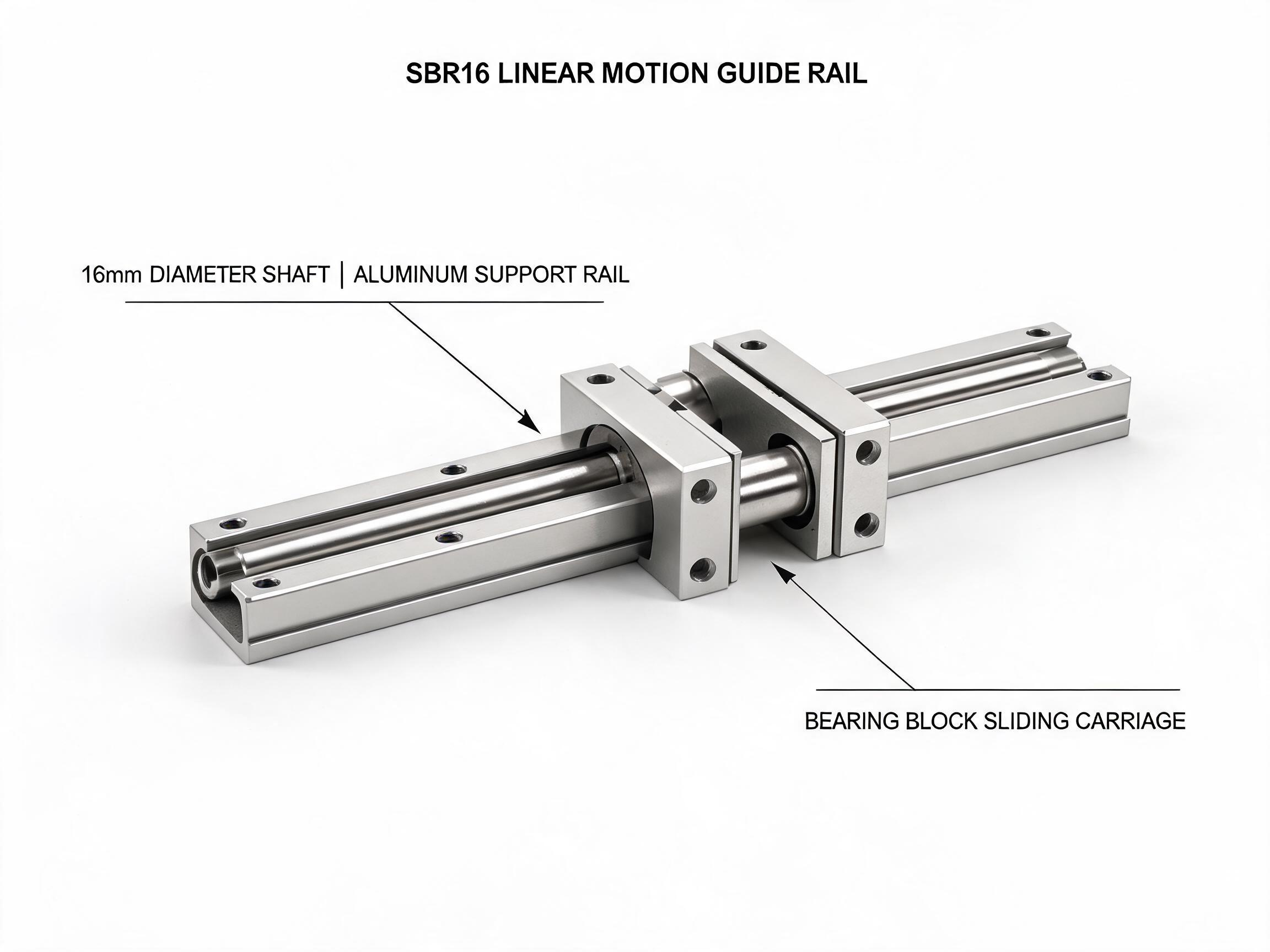
A buyer-focused look at the SBR16 round-shaft linear guide unit: how the shaft, support rail and bearing block are assembled, the 7.8 kN dynamic load rating, where 16 mm units fit, the ordering details buyers most often get wrong, and when an SBR20 or profile guideway is the better choice.
If you are searching for sbr16, sbr16 linear rail or sbr 16, you are usually looking at a small machine build and asking one practical question: will a 16 mm round-shaft guide carry my moving load over the length I need? This article answers that with the specification this unit actually carries, then covers the ordering details that most often cause problems after delivery.
What this article covers
- What the SBR16 unit is, and how it arrives
- What it carries: the 7.8 kN dynamic load figure
- Where a 16 mm round-shaft unit fits
- The ordering checks buyers most often miss
- When to step up to SBR20 or a profile guideway
What an SBR16 unit actually is
An SBR16 is not a bare shaft or a bag of loose parts. It is an integrated assembly, supplied pre-assembled and ready to bolt onto a machine frame. Three components make up the finished unit:
- A hardened GCr15 round shaft, 16 mm in nominal diameter, which forms the running surface.
- An aluminium support rail that runs the full length of the shaft and gives it a continuous backing along the mounting face.
- A double-row bearing block that rides on the shaft, with rolling elements arranged on two rows.
The distinction matters for buyers comparing an SBR 16 against a plain unsupported shaft with separate bushings. On a supported unit, the rail carries part of the load and stiffens the shaft along its whole span. The full description of this configuration is on the SBR16 linear motion guide rail unit product page, including the interface dimensions you will need for your mounting plate.
The double-row arrangement is what gives the block its capacity in the directions that matter on a light machine: downward load, plus the off-axis and moment loads that appear when a cutter or a tooling head hangs off the side of the carriage. The block is bored to the shaft diameter, so the fit between shaft and block comes as part of the assembly rather than something you match yourself.
What the unit carries: 7.8 kN dynamic load
The dynamic load rating is 7.8 kN at the 16 mm shaft diameter. Dynamic rating describes the load the bearing block is rated to carry while the carriage is moving, which is the condition that governs most machine builds. Static capacity, on the other hand, describes a stationary or near-stationary load, and the two are not interchangeable when you are checking a design. Use the dynamic figure when the block is in motion under load.
Buyers often ask whether 7.8 kN is "enough." That depends entirely on how the load is distributed and how many blocks share it. A single block on a single rail is one case; two blocks carrying one carriage, or two parallel rails with a block on each, is a different case and divides the load differently. Before you compare 7.8 kN against your estimated carriage weight, decide the rail and block layout, because the rating applies per block, not per machine.
Where a 16 mm round-shaft unit fits
The SBR16 sits in the light-to-medium band of linear motion. It is a good match for machines where the moving mass is modest, the travel is a few hundred millimetres to a couple of metres, and the build is being put together from standard plates and extrusions rather than a machined casting.
DIY CNC routers
Hobby and small-format routers are the most common home for a 16 mm linear guide rail. A gantry that moves a compact spindle or a trim router, with the rail mounted on an aluminium extrusion, is the classic use. The pre-assembled format shortens build time because the rail and block are already matched, and the block bolts directly to a carriage plate.
Desktop engravers and marking machines
Desktop engravers, laser marking frames, and small plotting or dispensing heads use the same format. Here the loads are lower than on a router, so the 7.8 kN rating is rarely the limiting factor; the constraints are more often travel length, mounting flatness, and how many blocks the carriage needs to keep a tool head stable.
Educational and lab automation builds
Teaching rigs, laboratory positioning stages, and small automation demonstrators benefit from the fact that the unit arrives assembled. Students and lab technicians can mount it without pressing bearings or matching a shaft to a housing. The visible, bolt-on construction also makes the assembly easy to explain and easy to reconfigure.
Ordering checks that buyers most often miss
Most problems with an SBR16 order are not about the load rating. They are about the details a buyer leaves out of the enquiry, which then have to be clarified or corrected after the order is placed. The following four are the ones worth settling before you request a quotation.
Supported span and shaft deflection
A supported rail is stiffer than an unsupported shaft, but it still has a span between mounting points. The longer the unsupported or lightly supported span, and the heavier the carriage, the more the shaft will deflect under load. On a router, that shows up as chatter or a cut that is deeper in the middle of the travel than at the ends. Specify your rail length and your mounting point spacing, and ask how the rail is supported along that length.
Number of blocks per rail
The load rating is per block. A single rail carrying a wide carriage with one block will behave differently from the same rail with two blocks spaced apart, because two blocks resist tipping and spread the load. State how many blocks you need per rail, and whether the two rails in a pair are each single-block or double-block. This changes both capacity and price.
Shaft end support
The ends of the rail have to be supported by the machine structure, not left overhanging. End supports also define how the rail is located and whether the block can run to the end of travel. Tell the supplier how the ends will be mounted so the rail end configuration matches your frame.
Total length and end machining
The overall length is not the same as the travel. Travel is shorter than the rail length because the block itself occupies space at each end, and because the carriage plate usually needs clearance. Buyers frequently quote travel when they mean length. Send the overall rail length you need plus your required stroke, and let the rail end machining be confirmed against the datasheet for your order. Length and end-machining options are confirmed per order rather than assumed as a fixed catalogue maximum.
SBR16 versus SBR20 versus a profile guideway
When a 16 mm unit is marginal, the usual next step is the SBR20 range, which uses a larger shaft and, in the dual-block version, two bearing blocks on the same rail. The SBR20 heavy-duty linear motion guide unit with dual bearing blocks is rated at 11.2 kN per block. Two blocks on one rail therefore give you substantially more capacity than a single 16 mm block, and the wider shaft also resists bending over a given span.
| Option | Dynamic load | What changes for the build |
|---|---|---|
| SBR16, 16 mm shaft | 7.8 kN per block | Light gantries, desktop engravers, teaching rigs; smallest mounting footprint in the SBR range |
| SBR20 with dual bearing blocks, 20 mm shaft | 11.2 kN per block | Higher capacity and greater shaft stiffness; larger block and rail, so carriage plate and frame dimensions change |
| Profile guideway | Depends on the specific profile size and carriage | Different mounting geometry, typically recirculating profile rail and carriage rather than a round shaft; requires a reworked mounting interface |
Moving from SBR16 to SBR20 is not just a capacity change. The block is larger, so the carriage plate height and bolt pattern change, and the rail cross-section is bigger, so the frame clearance and the extrusion slot may need attention. Moving to a profile guideway is a larger redesign: the mounting surface, bolt spacing, and height reference are all different. Buyers should treat these as interface changes, not as drop-in substitutions.
What to send with your enquiry
An SBR16 quotation is only as precise as the information in the request. The details that remove most of the back-and-forth are:
- Required overall rail length and required travel length, stated separately.
- Number of rails and number of blocks per rail.
- How the shaft ends will be supported on your frame.
- The load on the carriage and how many blocks will share it.
- Whether you need a matched pair of rails for a gantry.
Xiamen Dongfeng Bearing Mechanical & Electrical Co., Ltd. is a manufacturer of linear motion bearings and linear guideways, founded in 2014 and based in Xiamen, Fujian, China. The company holds ISO 9001:2015 certification and CE marking, and can provide SGS material test reports. SBR16 linear guide units are covered by a 24-month warranty. For enquiries, send the details above and confirm rail length and end machining against the datasheet for your order.
Frequently asked questions
Is an SBR16 supplied assembled?
Yes. The unit is supplied as a pre-assembled set of hardened GCr15 shaft, aluminium support rail and double-row bearing block, ready to bolt onto the machine.
What is the dynamic load rating of the SBR16?
7.8 kN at the 16 mm shaft diameter, as published on the product page. The rating applies per bearing block.
Can I get a longer rail than the standard listing?
Length and end-machining options are confirmed per order against the datasheet. State your overall length and travel so the correct option can be confirmed for your build.
When should I move up to SBR20?
When the single-block SBR16 rating or shaft stiffness is marginal for your carriage, or when a wider carriage needs two blocks to resist tipping. SBR20 with dual bearing blocks is rated at 11.2 kN per block, but the mounting interface changes.