A technical look at what self-lubricating linear bearings are made of — PTFE-impregnated bronze composite on a steel backing — and the three operating conditions where plain linear bushings hold up better than recirculating ball bearings, plus the limits buyers should weigh before specifying.
Linear Motion Components
If a linear axis runs in dust, takes impact, or has to survive without grease, the bearing that fails first is often the one with the most rolling elements. Self-lubricating plain bushings solve those three problems by removing the ball circuit entirely — and they pay for it in friction and speed ceiling.
What a Self-Lubricating Linear Bearing Actually Is
The term covers several constructions, so it is worth being specific before comparing anything. A self-lubricating linear bearing is a sliding (plain) bearing that carries its own lubricant inside the bearing material, so no external grease line or oil reservoir is required for the bearing to run. The lubricant is not a coating added afterwards; it is part of the composite.
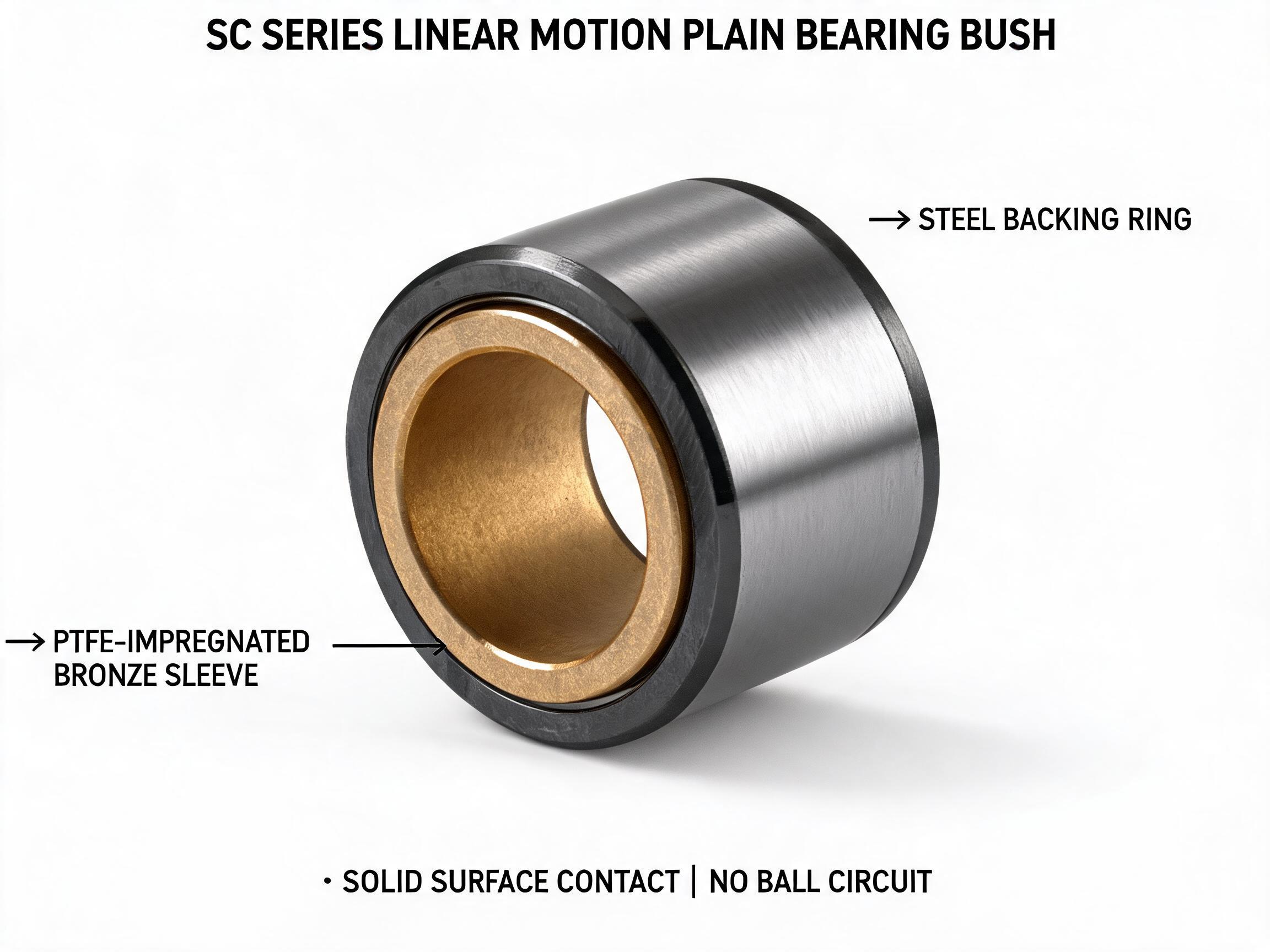
In the SC Series plain bearing bush, the structure is a three-layer composite sometimes called DU-type material. A bronze layer is sintered onto a steel backing ring, and the bronze is impregnated with a PTFE-and-filler mixture that forms the actual sliding surface. The steel backing provides the structural stiffness and the press-fit interference; the bronze carries load and conducts heat away from the sliding face; the PTFE mixture transfers a thin film to the shaft during running, which is what keeps friction low without a grease gun in the picture.
That construction is why a plain linear bearing bush can quote a dry friction coefficient of 0.08–0.12 and a greased figure of 0.04–0.06. The dry number is the one that matters in most of the applications discussed below, because the dry number is what you get when nobody can reach the bearing to relubricate it.
The Numbers on the SC Series
Before going further into where plain bushings win, here is what the product record actually states. Everything in the table below is from the SC Series specification; nothing is extrapolated.
| Property | Value |
|---|---|
| Material construction | PTFE-impregnated bronze (DU-type) on steel backing ring |
| Friction coefficient, dry | 0.08 – 0.12 |
| Friction coefficient, greased | 0.04 – 0.06 |
| Max. static load | 12 kN at SC20 |
| PV value, dry | 2.8 MPa·m/s |
| PV value, greased | 5.0 MPa·m/s |
| Operating temperature | −50 °C to +200 °C |
| Shaft diameter range | 6 – 60 mm |
| Configurations | SC sleeve type, SCF flanged type |
| Housing bore | H7 |
Two entries in that table do more work than the others. The PV value is the product of contact pressure and sliding velocity, and it is the real limit on whether a given application is feasible — not load alone, and not speed alone. The −50 to +200 °C range is what opens up the high-temperature cases where grease has already given up.
Condition 1: Dust, Chips, and Abrasive Contamination
Recirculating ball bearings depend on a closed loop. Balls roll from the loaded zone into a return channel, around, and back into the load zone. That return channel is a narrow passage, and its job is to keep the balls separated and moving in an orderly line.
Introduce fine chips, foundry sand, or grinding dust and the failure mode is predictable. Debris enters the circuit, packs into the return channel, and eventually the balls skid instead of roll, or the cage and end seals are damaged. Seals slow this down but do not eliminate it, and in many machines the seals themselves are the first thing to wear out.
A plain bushing has no circuit to clog. The sliding surface is continuous, and the PTFE film tends to push small particles aside rather than trap them in a passage. This is the single most common reason a maintenance team switches a dirty-environment axis from ball bushings to a plain linear bearing: not because the plain bearing is more precise, but because it does not have an internal mechanism that contamination can destroy.
Condition 2: Shock Loads and Brinelling
Ball bearings carry load through very small contact areas — theoretically a point, in practice a small ellipse. That concentrates stress. Under a steady, gentle load this is efficient. Under impact, it is a problem.
When a shock load exceeds the elastic limit of the raceway material, the balls leave permanent indentations in the race. This is brinelling, and it is not reversible. Once it happens, the bearing runs rough, generates vibration, and the damage progresses. The same applies to static overload while a machine is parked or during a press-fit operation.
A plain bushing spreads the same load over a full contact patch — the projected area of the sleeve, not a point. Peak contact stress is far lower, so a shock that would brinell a ball raceway is more likely to be absorbed. The SC Series figure of 12 kN maximum static load at SC20 is quoted for the plain bushing, and static load is exactly the case where the area-based load path matters.
This does not mean plain bushings are indestructible. Sustained overload still deforms the bronze layer, and once the PTFE film is worn through, friction rises and the shaft begins to wear. The advantage is in peak events, not in continuous abuse.
Condition 3: No Grease Available, or Too Hot for Grease
Two separate situations land in the same place.
The first is the application where relubrication is simply not practical — a bearing buried inside an assembly, a mechanism in a cleanroom or food-adjacent environment where grease is unwelcome, or an axis in a remote location where nobody is going to service it. Here the dry numbers apply: friction 0.08–0.12, PV 2.8 MPa·m/s.
The second is temperature. Grease is a base oil held in a thickener, and both components have limits. Above a certain point the oil separates and migrates out, and the bearing runs dry whether or not you wanted it to. The SC Series is rated to +200 °C, and PTFE does not depend on a petroleum base oil to function. At the cold end, −50 °C is also outside the comfortable range of many greases, which stiffen and stop feeding the contact.
It is worth noting that the same bushing can be run greased, and the specification improves when it is: friction drops to 0.04–0.06 and PV rises to 5.0 MPa·m/s. So where lubrication is available, use it. Self-lubricating does not mean lubrication-averse.
The Honest Limits
Plain bushings are not a universal upgrade, and specifying them where they do not belong creates its own set of problems.
- Friction is higher than rolling. Even at 0.04–0.06 greased, a sliding contact costs more drive torque than a ball circuit. On a long axis with many bearings, that adds up at the motor.
- Speed ceiling is lower. The PV limit of 2.8 MPa·m/s dry is the binding constraint. High speed and high load cannot both be taken at once; you trade one against the other.
- Heat has nowhere to go. Rolling elements generate less heat and pass it through point contacts. A sliding surface generates more, and the steel backing has to conduct it out. Continuous operation near the PV limit needs the heat path considered.
- No preload adjustment by ball selection. Ball bushings can be matched to a shaft for a specific fit; a plain bushing relies on the H7 housing bore and the shaft tolerance.
- Wear is progressive, not sudden. A ball bearing often announces failure with noise and vibration. A plain bushing wears gradually, which is quieter but can go unnoticed until clearance is out of specification.
Quick Selection Check
- Dust, chips, or washdown present → plain bushing is worth evaluating first.
- Impact or shock in the duty cycle → check static load against the 12 kN (SC20) figure and the contact-area argument.
- No relubrication possible, or operating temperature beyond grease limits → compare against the −50 to +200 °C range.
- High speed with moderate load → ball bushing is usually still the right answer; calculate PV before assuming otherwise.
What to Confirm Before Ordering
Three items decide whether a plain bushing is the right call, and none of them can be settled from a catalog page alone.
First, calculate PV for the actual duty cycle. Take the real contact pressure and the real sliding velocity, not the nameplate maximums. This is where a supplier's pre-sales engineering support earns its keep — DFLinear offers PV calculation support before order precisely because the answer determines feasibility. If the calculated PV sits close to 2.8 MPa·m/s dry, the decision between dry and greased operation becomes the whole design.
Second, check the shaft. The SC Series covers shaft diameters from 6 mm to 60 mm and requires an H7 housing bore. Shaft hardness and surface finish matter to sliding wear in a way they matter less to a ball circuit, so confirm what the shaft actually is rather than what the drawing says.
Third, decide between the sleeve and flanged form. Both are available in the SC Series — the SCF flanged type handles axial location without a separate shoulder in the housing.
For buyers comparing the two technologies directly, the LM Series linear ball bearing bush covers the recirculating-ball side of the same product range, which makes a side-by-side specification comparison straightforward.
Practical Notes on Procurement
DFLinear has been manufacturing linear motion components since 2014 and holds ISO 9001:2015 certification, with CE and SGS documentation as part of its company-level credentials. Minimum order quantity for the SC Series is 100 pieces per size, which is worth factoring in if a trial is being planned across several shaft diameters — consolidating to fewer sizes usually makes more sense for a first order than spreading the same quantity across the full range.
The bushings are sized in millimetres across the 6–60 mm range, so imperial shafting will need an equivalent metric selection rather than a direct match.
Frequently Asked Questions
What are self-lubricating bearings made of?
In this construction, a bronze layer is sintered onto a steel backing ring and impregnated with a PTFE-based mixture. The steel provides structural support, the bronze carries load and conducts heat, and the PTFE mixture supplies the low-friction sliding film. There is no separate lubricant reservoir or grease nipple.
Do self-lubricating bushings need any lubrication at all?
No — they are designed to run dry, and the dry specification (friction 0.08–0.12, PV 2.8 MPa·m/s) is what applies. However, lubricating them improves performance measurably: friction drops to 0.04–0.06 and PV rises to 5.0 MPa·m/s. If grease is available, use it.
Can a plain bushing replace a ball bushing in the same housing?
Only if the housing bore and shaft diameter match. The SC Series requires an H7 housing bore and covers shaft diameters from 6 to 60 mm. Housing dimensions and load capacity need to be checked against the original specification, not assumed equivalent.
What is the PV value and why does it matter?
PV is contact pressure multiplied by sliding velocity. It is the limiting parameter for a plain bearing because load and speed cannot both be maximised at once. For the SC Series the dry limit is 2.8 MPa·m/s and the greased limit is 5.0 MPa·m/s. A duty cycle above these figures is not suitable for this bushing regardless of how the individual load and speed numbers look.
Next Step
If the application involves contamination, shock, or a temperature range that grease cannot survive, send the shaft diameter, housing bore, load, and sliding speed. A PV calculation against the SC Series limits will show quickly whether a plain bushing is feasible — and if it is not, the ball bearing option is the better answer to give.
Specifications quoted above are from the published SC Series product record. Actual performance depends on shaft hardness and finish, housing fit, duty cycle, and contamination level in service.