
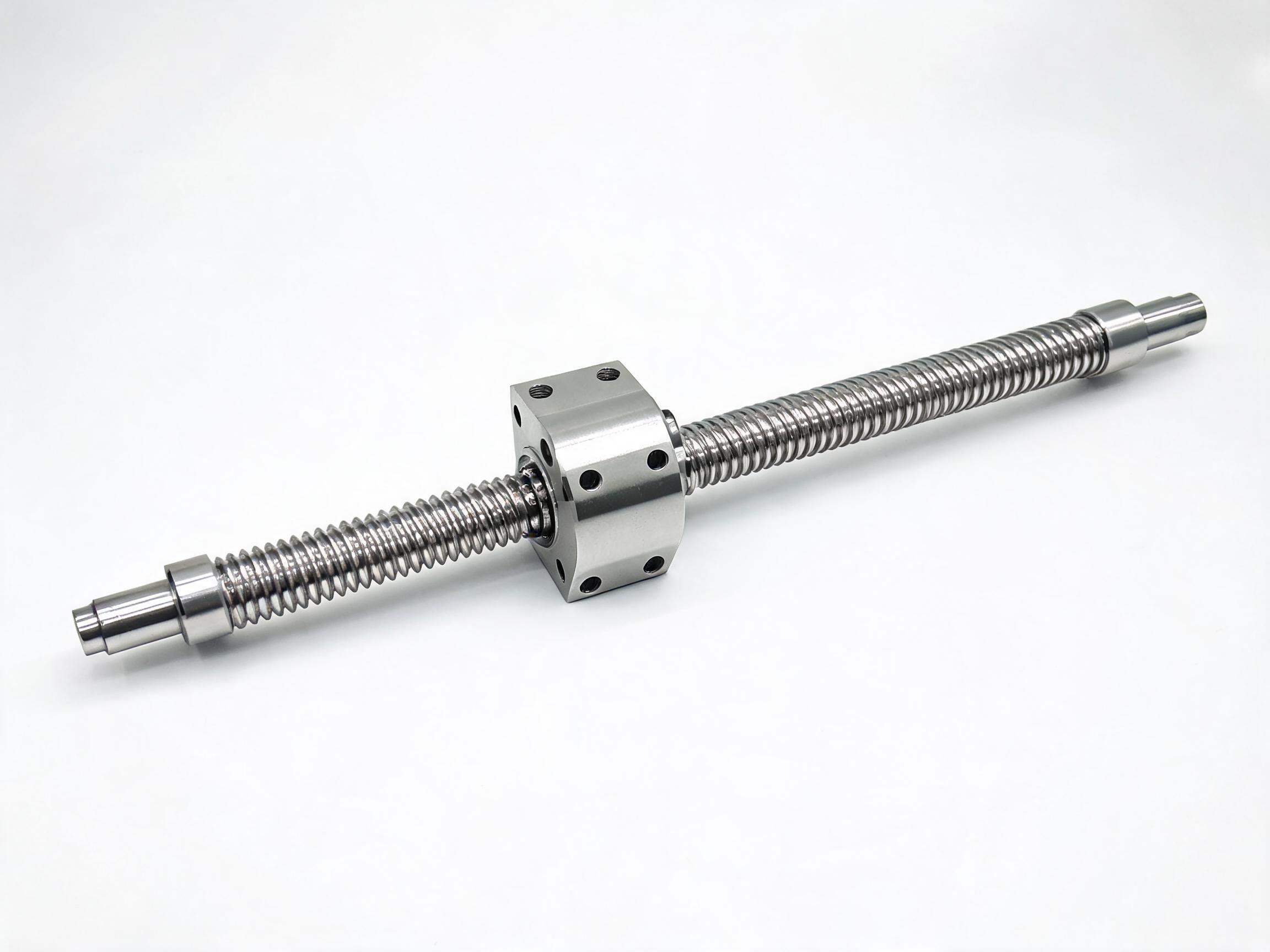
SFU1204 and SFU1605 are adjacent rolled ball screw sizes with different diameter-to-lead ratios. This guide decodes the model code, compares compactness against lead and load, and uses verified SFU1605 data as the reference point for choosing between them.
Ball Screw Selection Guide
The SFU1204 and the SFU1605 differ in two numbers, and those two numbers decide how the screw fits your machine. The first pair tells you the shaft diameter, the second pair the lead per revolution. Everything else — stiffness, travel per turn, nut size, how much space the assembly consumes — follows from that ratio. This guide decodes the model code so you can read any SFU designation correctly, then compares the 12 mm / 4 mm and 16 mm / 5 mm configurations on the points that change a build: compactness, speed, thrust demand, and mounting.
Key takeaways
- The SFU code reads diameter first, lead second: SFU1204 = 12 mm diameter, 4 mm lead; SFU1605 = 16 mm diameter, 5 mm lead.
- A larger-diameter shaft resists bending and whip at longer unsupported lengths; a larger lead moves further per revolution but lowers the torque-to-thrust ratio.
- Verified SFU1605 data gives a concrete anchor: 16 mm diameter, 5 mm lead, 6.8 kN dynamic load (single nut), C7 precision per ISO 3408, lead accuracy ±0.05 mm/300 mm.
- For any SFU1204 spec beyond diameter and lead, treat the datasheet as the source — confirm exact specs and load ratings against it before you finalise a design.
In this article
How to read the SFU model code
SFU designations are not arbitrary. The series prefix is followed by a four-digit block in which the first two digits are the nominal shaft diameter in millimetres and the last two are the lead — the axial distance the nut travels in one full revolution of the screw. SFU1204 therefore reads as a 12 mm diameter screw with a 4 mm lead, and SFU1605 as a 16 mm diameter screw with a 5 mm lead. Those readings come from the naming convention itself; for a specific SKU, the diameter and lead should still be confirmed on the datasheet, because the model code is a designation and not a dimensional inspection report.
Two consequences follow directly from the naming rule. First, a screw with a 4 mm lead needs four turns to travel 16 mm, while a 5 mm lead screw needs roughly three and a bit. Second, the diameter sets the screw's second moment of area and thus its resistance to bending under axial load and to lateral vibration at speed. A 16 mm shaft is not simply "a bigger 12 mm shaft"; it changes the stiffness and critical-speed behaviour of the whole axis.
The SFU family is a rolled ball screw series. Rolled screws are formed by rolling the ball track rather than grinding it, which is why they are the common choice for general automation axes. For buyers comparing adjacent sizes, the practical question is not whether rolled or ground is better, but whether the 12 mm / 4 mm or 16 mm / 5 mm geometry matches the load, stroke, and speed envelope of the axis.
The trade-off: compactness versus lead and load
Every ball screw selection is a compromise between three things that pull against each other: how much space the assembly takes, how far each revolution moves the load, and how much axial force the screw can reliably transmit.
Diameter and compactness
A 12 mm screw is smaller in every dimension that matters for packaging an axis: shaft diameter, nut envelope, and the bearing block bore that supports it. On a desktop CNC router, a laser engraver, or a 3D printer Z or X axis, that reduction in envelope can be the difference between a compact gantry and a crowded one. Smaller diameter also means less rotating mass, which matters on axes that reverse direction frequently.
The cost of that compactness is bending stiffness. A longer unsupported span amplifies the difference: the same axial load causes more deflection on a thinner shaft, and a thin shaft reaches its critical whipping speed sooner. If your design has a long stroke with bearing support only at the ends, the 16 mm option gives you more headroom before whip becomes the limiting factor.
Lead and speed versus thrust
Lead is the number that converts motor torque into linear force and motor speed into linear speed. A 5 mm lead moves the nut 5 mm per revolution; a 4 mm lead moves it 4 mm. For a given motor speed, the larger lead produces a faster axis. For a given motor torque, the larger lead produces less axial thrust, because torque is converted to force over a longer lever arm.
That is the core trade: the SFU1605 is the faster, longer-travel-per-turn choice, and it asks more of the motor, the coupling, and the bearing support when the application needs high thrust. The SFU1204 is the finer-resolution choice — more turns per millimetre, better suited to axes where small, repeatable increments matter more than top speed — and it is easier to drive to a given thrust because each turn produces less travel. Whether that finer resolution is actually advantageous depends on the resolution of your motor and encoder and on the mechanical stiffness of the rest of the axis, not on the screw alone.
What doesn't change between them
Both sizes belong to the same SFU rolled series. SFU Series Rolled Ball Screw Assemblies share the same construction: GCr15 chrome steel (equivalent to 52100), an induction-hardened ball track at HRC 58-62, C7 precision grade per ISO 3408 with ±0.05 mm/300 mm lead accuracy on the rolled version, a single pre-loaded flange nut, and end-machined shafts supplied in standard lengths from 300 mm to 1500 mm. The series is stocked at a minimum order quantity of 50 pieces. If your project needs tighter accuracy than C7 rolled, the ground variant (C5) is the alternative for semiconductor or medical stages — that is a different manufacturing route, not a different lead.
SFU1605 verified data as the reference point
The SFU1605 has published, verified figures, which makes it a useful concrete anchor when comparing the two sizes. Its 6.8 kN dynamic load rating for a single nut is the number to hold in mind when you estimate what an axis must carry. That rating is for the nut and ball track under the stated conditions; the real capacity of your axis also depends on how the screw is supported, how it is aligned, and how the load is applied.
Use the 6.8 kN figure as a benchmark rather than a promise. If your calculated axial load sits well below that, both sizes warrant a closer look at stiffness and speed rather than at strength. If your load approaches the SFU1605's rating, the smaller SFU1204 is the wrong direction to move in, and the design should be reviewed with the datasheet in hand.
Note on the SFU1204: the 12 mm diameter and 4 mm lead are read from the model code. This article does not publish a load rating, accuracy figure, or length range for the SFU1204 — confirm exact specs and load ratings against the datasheet before sizing an axis around it.
Which one fits your build
Work through these questions in order. The first two usually settle the choice; the rest confirm it.
Start with the load the axis must move
Calculate the axial force your application requires, including friction, cutting or process forces, and the inertial force from acceleration. Compare that figure with the verified dynamic load of the SFU1605 (6.8 kN on a single nut) and with the datasheet figure for whichever SFU1204 variant you are considering. A large margin on the 16 mm screw is a signal that the 12 mm screw may be viable on load grounds — but not the only signal.
Then check stroke length and support
Short, well-supported strokes favour the smaller screw. Long strokes with end support only favour the larger diameter, because bending stiffness and critical speed scale with the shaft's geometry. If your stroke approaches the upper end of the 300-1500 mm standard length range and the screw is unsupported in the middle, the 16 mm option is the safer starting point.
Then match lead to your motion profile
Decide whether you are optimising for speed or for fine increment size. A 5 mm lead gives more travel per motor revolution and suits axes that need to move quickly between positions. A 4 mm lead gives more resolution per revolution and suits axes where small, controlled steps are the priority. Neither is superior in the abstract; both are geometric consequences of the lead you choose.
Then check the mounting envelope
Measure the space available for the nut, the bearing blocks, and the coupling. A 12 mm screw needs smaller bearing bores and a smaller nut envelope, which can free up room on a compact gantry. If the frame already accommodates 16 mm bearing blocks, the envelope argument for the smaller screw weakens.
Comparison table
| Attribute | SFU1204 | SFU1605 |
|---|---|---|
| Nominal shaft diameter | 12 mm (from model code) | 16 mm (verified) |
| Lead per revolution | 4 mm (from model code) | 5 mm (verified) |
| Dynamic load, single nut | Confirm on datasheet | 6.8 kN (verified) |
| Precision grade | Series standard, confirm on datasheet | C7 per ISO 3408 |
| Lead accuracy | Confirm on datasheet | ±0.05 mm/300 mm (C7 rolled) |
| Ball track hardness | Series standard, confirm on datasheet | HRC 58-62 |
| Material | Series standard, confirm on datasheet | GCr15 chrome steel (equiv. 52100) |
| Standard lengths | Confirm on datasheet | 300-1500 mm |
| MOQ | Series MOQ, confirm | 50 pieces |
| Typical fit | Compact axes, finer increment per revolution | Faster travel per revolution, longer unsupported spans |
FAQ
Does SFU1204 mean a 12 mm screw with a 4 mm lead?
Yes — that is how the model code is read: 12 mm nominal diameter, 4 mm lead. Confirm the exact figures on the datasheet for the specific variant you order, because the code is a designation rather than a measured value.
Is the SFU1605 stronger than the SFU1204?
The SFU1605 has a verified 6.8 kN dynamic load rating on a single nut and a larger shaft diameter. The SFU1204's own load rating must come from its datasheet; this article does not publish one. Compare the two datasheet figures directly, taking into account how each screw is supported in your axis.
Which lead gives finer resolution?
The 4 mm lead moves 4 mm per revolution; the 5 mm lead moves 5 mm. For the same motor step angle, the 4 mm lead produces a smaller linear increment per step. Whether that translates into better usable resolution depends on the rest of the drive train.
Can I get either size in a longer length?
The SFU series is supplied in standard lengths from 300 mm to 1500 mm. For a specific size, confirm the available length against the datasheet or by enquiry before committing a design.
What if I need tighter accuracy than C7 rolled?
The ground variant (C5) is the tighter-accuracy option in this family, used for semiconductor or medical stages. It is a separate manufacturing route from the rolled SFU series.
What is the minimum order quantity?
The SFU series carries a minimum order quantity of 50 pieces.
Next step
If your load, stroke, and lead requirements now point to one size but you still need the load rating, accuracy figure, or available length for the SFU1204 variant, that is the point to ask for the datasheet rather than estimate. Tell the supplier your required load, stroke length, target speed, and mounting envelope, and ask them to confirm which of the two sizes meets the specification — including the SFU1204's actual dynamic load rating. For an overview of the series, see the SFU Series Rolled Ball Screw Assembly range.