
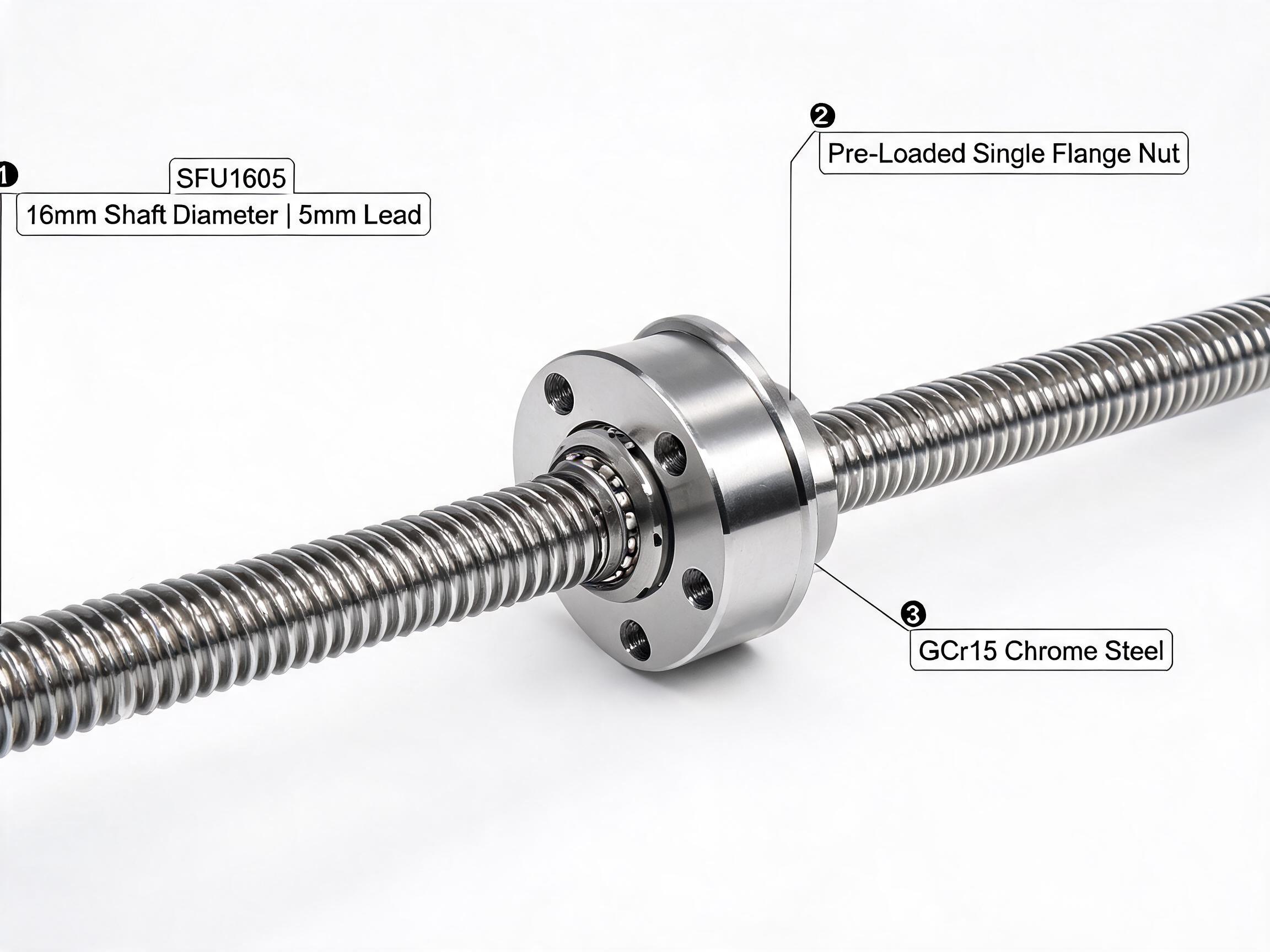
The SFU1605 code is a parts designation, not a marketing name: 16 mm nominal shaft diameter, 5 mm lead per revolution. This article decodes the designation, describes the SFU1605 rolled assembly we manufacture at C7 grade with a pre-loaded single nut, explains which light gantry axes it suits, and sets out when a buyer should move up to SFU2510 and what to confirm before ordering a matched set.
Buyers searching for an SFU1605 ball screw are usually holding a drawing or a BOM line and want two things confirmed: that the designation matches the dimensions they need, and that the part they receive will bolt onto their axis without rework. The first is a naming convention. The second is an ordering question, and it is where most trouble starts.
This article decodes the 1605 designation, describes the SFU1605 assembly we build at Xiamen Dongfeng Bearing Mechanical & Electrical Co., Ltd., and sets out the point at which a light gantry axis needs a larger screw.
The short answer
- 16 = nominal shaft diameter, in millimetres. 05 = lead, the axial travel per full revolution, also in millimetres.
- Our SFU1605 is a rolled ball screw assembly at C7 precision grade with a pre-loaded single nut, positioning tolerance plus or minus 0.05 mm per 300 mm.
- It fits light moving masses: 3D printers, laser engravers, small CNC gantry axes.
- For mid-size router X and Y axes up to 3 m travel, step up to SFU2510: 25 mm shaft, 10 mm lead, 17.2 kN dynamic load.
- The screw, nut and end machining must be ordered as one matched set. Length and end configuration are made to your drawing.
What the code SFU1605 actually means
SFU1605 is a parts designation. The letters identify the series and nut type, and the first four digits carry the geometry a mechanical designer needs.
The 16: nominal shaft diameter
16 refers to the nominal diameter of the screw shaft in millimetres. It is a nominal figure, not a measured one. The actual outside diameter of a rolled screw sits within the tolerance band defined by the standard the screw is made to, and the ball track is ground or rolled into the shaft below that diameter. When you check fit, use the drawing dimensions and the measured value, not the two-digit label.
Diameter is the governing number for stiffness and load. A 16 mm shaft is a light-duty shaft. It suits an axis where the moving mass is modest and the screw is supported reasonably close to the nut.
The 05: lead per revolution
05 is the lead: the axial distance the nut travels in one complete revolution of the screw. Five millimetres of travel per turn. On a stepper-driven axis, the lead is the number that converts motor steps into linear movement, which is why it appears in the controller configuration rather than on the mechanical drawing.
The lead also fixes the relationship between torque and thrust. A 5 mm lead is a relatively fine pitch for a 16 mm screw, which favours resolution and holding force over fast traverse. That is exactly the trade a small printer or engraver makes when it accepts an SFU1605.
What the letters add
The SFU designation indicates the series and the flange-type single nut configuration. Two screws with the same 16 mm diameter and 5 mm lead can differ in nut body, flange pattern and end machining, so the code alone does not describe a finished, mountable part. The drawing does.
What our SFU1605 assembly is
Our SFU1605 rolled ball screw assembly is a rolled, not ground, ball screw assembly. Rolling is the process that makes C7 rolled screws economical at volume; ground screws are used where tighter grades are specified.
| Attribute | Value |
|---|---|
| Type | Rolled ball screw assembly |
| Nominal shaft diameter | 16 mm |
| Lead | 5 mm per revolution |
| Precision grade | C7 |
| Nut | Pre-loaded single nut |
| Positioning tolerance | Plus or minus 0.05 mm per 300 mm |
Values as stated on the product page. Other figures, including dynamic load rating and nut rigidity, should be confirmed on the datasheet for the exact configuration you are ordering.
The pre-loaded single nut is worth explaining, because it affects how the part behaves on a reversing axis. Pre-load removes the internal clearance between ball and track, so the nut does not float through a dead band when the axis changes direction. On a printer or engraver that reverses constantly, that clearance would show up as lost motion in the finished part.
The precision statement is the one buyers should read most carefully. Plus or minus 0.05 mm per 300 mm is a positional tolerance over a defined length, not a promise about the accuracy of your finished machine. Frame stiffness, bearing support, motor tuning and the workpiece all sit between the screw and the cut. If your drawing calls for a tighter grade, say so at inquiry; do not assume the standard part will be selected to it.
Where an SFU1605 belongs
The right home for a 16 mm screw with a 5 mm lead is an axis that moves a light load, at moderate speed, and needs repeatable positioning more than raw thrust.
- 3D printers. The bed or the print head on a desktop-format machine is the classic case: low moving mass, frequent short reversals, and a controller that expects a defined travel per revolution.
- Laser engravers. Light gantries, modest traverse, and a need for clean small movements rather than heavy cutting force.
- Light CNC gantry axes. Small routers and engraving tables working soft materials, where the cutting force stays low and the frame is stiff enough to support the screw properly.
In each of these, the limits are the same two: shaft diameter and support spacing. A 16 mm screw is sensitive to long unsupported spans and to side loads, so the axis design should keep the nut close to a support and keep the load on the rail, not on the screw.
When the buyer must step up to SFU2510
The decision point is not a rule of thumb about screw diameter; it is the load and the span on your axis. For mid-size router X and Y axes with travel up to 3 m, a 16 mm screw is the wrong starting point. The SFU2510 rolled ball screw assembly with flange nut is the part for that job: 25 mm shaft, 10 mm lead, and a 17.2 kN dynamic load rating.
Three things change at once, and each matters:
- Diameter, 16 to 25 mm. A stiffer shaft over a longer span, which is what a 3 m traverse demands.
- Lead, 5 to 10 mm. Doubling the travel per revolution suits a router that needs to move between features quickly, at the cost of positional resolution per motor step.
- Dynamic load, 17.2 kN. A published rating for the SFU2510, against no published comparable figure for our SFU1605. That asymmetry is the practical answer to the sizing question: if your axis needs a rating at that level, the choice has already been made.
A buyer who is unsure which side of that line an axis falls on should send the travel length, the moving mass including fixture and workpiece, and the expected cutting or process force. Those three inputs settle the shaft diameter faster than any general discussion of screw sizing.
Ordering checks before you place the PO
A ball screw assembly is not a catalogue part you pick off a shelf in a fixed length. Four items decide whether the part that arrives can be installed.
Overall length
State the total screw length and identify which end carries the motor. If you also give the nut travel range and the two end-support positions, the factory can check that the nut never runs off the usable thread. Length is made to your drawing, not chosen from a list, so an ambiguous figure becomes a rework.
End machining
The journal diameter, length, thread, keyway or flat, and the bearing seat on each end are all machined to order. Send the drawing with tolerances. A screw delivered with a plain shaft is not usable in a machine designed around a supported end, and end machining is not something a buyer can add later without losing the screw.
Nut housing and support blocks
Confirm the nut flange pattern against your carriage, and confirm the end support blocks against your frame. The flange hole spacing on a single nut is a fixed geometry; if your bracket was designed around a different nut body, the mismatch appears at assembly. Support block selection also determines how the screw is held axially, which is part of the positioning result.
Order the assembly as one matched set
This is the point that repays attention. The screw, the nut with its pre-load, and the end machining are produced and checked as a set. A nut bought separately and fitted to an existing screw loses the factory pre-load relationship and the matching between ball set and track. The positioning tolerance we publish applies to the assembly as supplied, so ordering the assembly as a matched set is what makes that number meaningful to you.
Include on the inquiry: overall length, end machining drawing, nut flange requirement, support block requirement, quantity, and the machine or axis the screw goes into. That last item lets us flag a mismatch before the drawing is released.
About the manufacturer
Xiamen Dongfeng Bearing Mechanical & Electrical Co., Ltd. was founded in 2014 and is based in Xiamen, Fujian, China. We manufacture linear motion bearings, guideways and ball screws. The company holds ISO 9001:2015 certification and CE marking, and we can provide an SGS material test report. Products carry a 24-month warranty.
Where a specification is not stated on the product page for a given configuration, ask for the datasheet rather than inferring the value. Lead time, pricing and any project-specific documentation are quoted per order.
Next step. If you are sizing a light gantry axis, send the drawing and the travel length for the SFU1605 assembly. If the axis is a mid-size router X or Y up to 3 m, send it against the SFU2510 instead. We will confirm the configuration against your drawing before quoting.
Product pages: SFU1605 rolled ball screw assembly and SFU2510 rolled ball screw assembly with flange nut.