
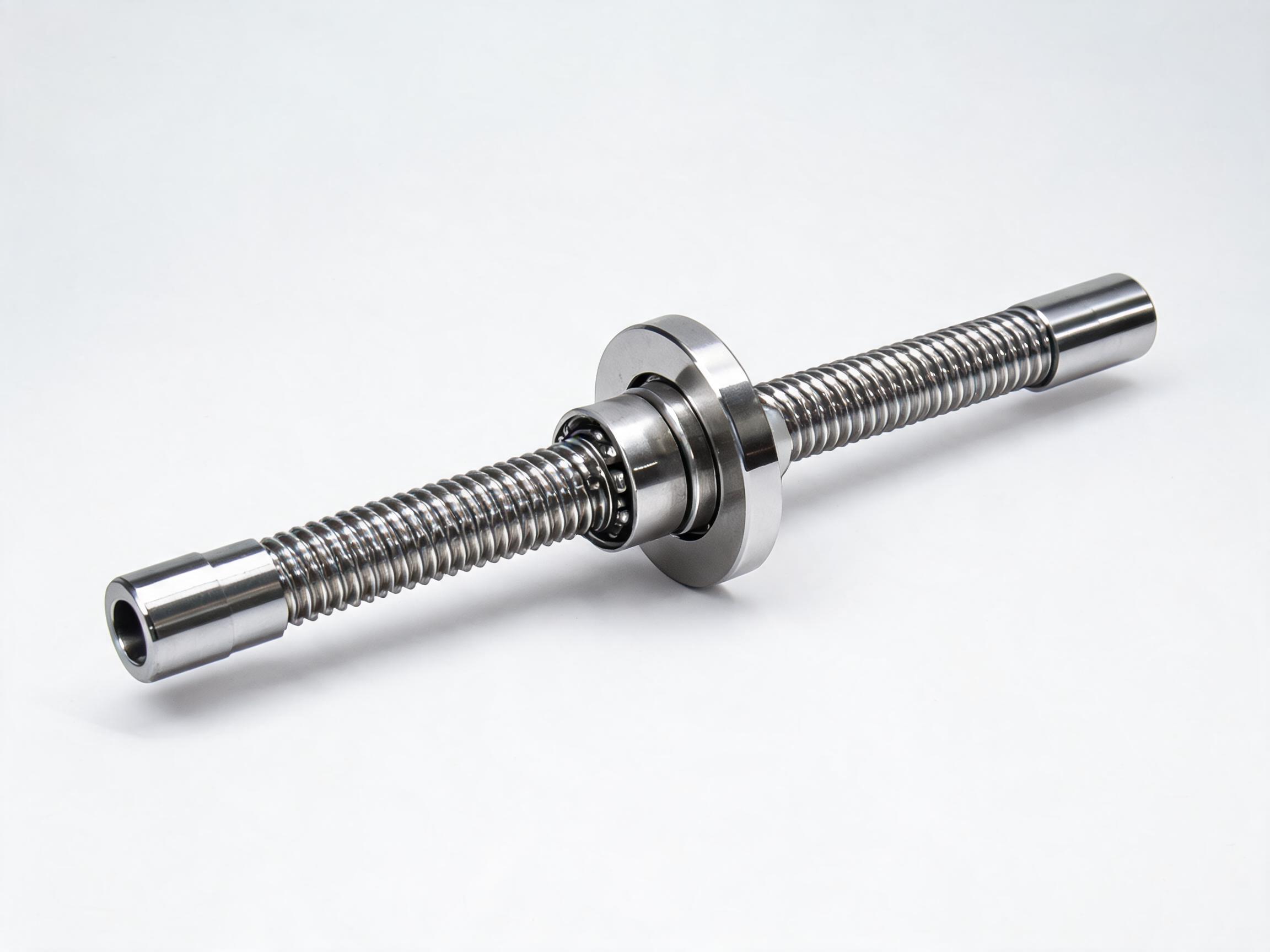
SFU2005 decodes to an SFU-series rolled ball screw with a 20 mm nominal shaft and a 5 mm lead. This article explains each part of the code, compares the recorded SFU1605 and SFU2510 5 mm and 10 mm lead references, and sets out what to confirm by inquiry before you buy.
Model code explained
If you arrived here from a search for sfu2005, you are probably holding a drawing, a replacement part list or a competitor quotation and trying to work out what the code actually describes. The short answer: SFU2005 is a naming convention that reads as an SFU-series rolled ball screw with a 20 mm nominal shaft diameter and a 5 mm lead. That decoding comes from how the recorded SFU codes on this site are constructed, not from a published SFU2005 datasheet.
This article does two things. First it breaks the code into its parts and shows which ones you can rely on when checking a machine. Second it helps you decide whether a 5 mm lead makes sense for your application, by comparing it with a recorded 10 mm lead and with a ground-screw alternative in the same 20 mm diameter class.
Important: A dedicated SFU2005 product page with its own load, precision and length data is not published on this site. SFU2005 load capacity, precision grade and standard lengths are to be CONFIRMED VIA INQUIRY. Every numeric load figure in this article belongs to a sibling product, and is labelled as such.
On this page
- What each part of SFU2005 means
- When a 5 mm lead is the right choice
- When a 10 mm lead is the right choice
- How load capacity scales with size (recorded figures)
- Rolled versus ground in the 20 mm class
- What to put in your inquiry
What each part of SFU2005 means
Ball screw model codes in this family are built from three pieces of information: series, nominal shaft diameter and lead. The recorded codes on this site follow that pattern consistently — SFU1605, SFU2510 and SFU3205 all read the same way — which is why the decoding below is a reasonable naming interpretation.
| Code segment | Reading | What it controls in your machine |
|---|---|---|
| SFU | SFU series, rolled ball screw assembly | Manufacturing route and, by extension, the grade class you should expect to specify |
| 20 | 20 mm nominal shaft diameter | Shaft stiffness and the size of nut, bearing and mounting hardware that will fit |
| 05 | 5 mm lead | Linear travel per shaft revolution, and therefore resolution versus speed |
Two cautions follow from this. "Nominal" diameter is a designation — the shaft is made to a tolerance band, so the bearing journal and any end machining on your drawing are what actually govern fit. And because the site does not publish an SFU2005 product record, the load, precision grade and standard length options for that specific code are to be confirmed via inquiry rather than read off this page.
When a 5 mm lead is the right choice
Lead is the distance the nut travels along the shaft for one full revolution. At 5 mm, one motor revolution produces 5 mm of linear motion. Compared with a 10 mm lead, that means half the travel per revolution for the same motor rotation.
A 5 mm lead is the natural starting point when the machine needs fine positional increment rather than fast traverse — applications where the controller commands small steps and the axis does not need to sprint from one end of its stroke to the other. It is also the geometry that pairs naturally with a gearbox or a high-resolution motor, because the reduction is already built into the screw.
The trade-off is speed. To move an axis at a given linear rate, a 5 mm lead screw must turn twice as fast as a 10 mm lead screw. That raises shaft rotational speed, which brings its own consequences for critical speed on long, slender screws. This is the single most important reason not to choose a lead on resolution alone: a fine lead on a long stroke can force the shaft into a speed range you do not want. Check the critical speed and the nut's speed rating for your actual stroke length before committing.
When a 10 mm lead is the right choice
A 10 mm lead delivers twice the linear travel per revolution. For a given axis speed, the motor turns half as fast relative to the 5 mm case, and for a given motor speed, the axis moves twice as far.
Choose 10 mm when throughput matters more than fine increment — longer strokes, faster rapids, or a motor and controller combination that does not need the extra mechanical reduction. The recorded 10 mm reference on this site also shows what a larger shaft brings with it: the SFU2510 rolled ball screw assembly with flange nut is a 25 mm shaft, 10 mm lead, grade C7 (ISO 3408) unit, with lengths from 300 to 3000 mm and a recorded dynamic load of 17.2 kN on a single nut.
Note that this comparison carries two changes at once — lead and shaft diameter. If you need to isolate the effect of lead alone, compare screws of the same nominal diameter and confirm the resulting figures with the supplier, because the site does not record a same-diameter 5 mm versus 10 mm pair.
How load capacity scales with size (recorded figures)
The figures below are the recorded values for sibling products. They are here so you can see the direction and rough magnitude of scaling. None of them is an SFU2005 rating.
| Recorded product | Shaft | Lead | Grade | Dynamic load (recorded) |
|---|---|---|---|---|
| SFU1605 rolled assembly | 16 mm | 5 mm | C7 (ISO 3408) | 6.8 kN (single nut) |
| SFU2510 rolled assembly, flange nut | 25 mm | 10 mm | C7 (ISO 3408) | 17.2 kN (single nut) |
| SFE2005 ground assembly | 20 mm | 5 mm | C5 (ISO 3408) | 12.7 kN (double nut) |
The SFU2510 figure is recorded as 2.5 times the SFU1605 figure, which illustrates the practical point: in these two recorded samples, the larger shaft and its nut carry the higher dynamic load. Because lead and shaft diameter change together between the two samples, the records cannot isolate how much of that difference comes from the lead itself, and the ratio must not be treated as a general scaling law. A 20 mm shaft sits between the two by size, but load does not scale linearly with diameter, so you cannot interpolate a rating and treat it as a specification. The actual SFU2005 load capacity has to come from the supplier, on a real quotation, for the nut configuration you intend to use.
Key takeaways
- SFU2005 reads as: SFU rolled series, 20 mm nominal shaft, 5 mm lead. This is a naming interpretation, not a published spec sheet.
- SFU2005 load capacity, precision grade and standard lengths are to be confirmed via inquiry.
- A 5 mm lead gives finer increment per revolution; a 10 mm lead gives faster travel per revolution.
- Recorded load figures rise with shaft size: 6.8 kN at 16 mm versus 17.2 kN at 25 mm in the same rolled C7 family.
- Do not pick a fine lead for a long stroke without checking critical speed.
Rolled versus ground in the 20 mm class
Within the 20 mm diameter class, the site does publish a 5 mm lead reference — but it is a ground screw, not a rolled one. The SFE series ground ball screw assembly records the SFE2005 as: 20 mm shaft, 5 mm lead, grade C5 (ISO 3408), accuracy ±0.008 mm/300 mm, axial clearance below 0.005 mm on a preloaded double nut, dynamic load 12.7 kN on the double nut, axial rigidity up to 280 N/µm, lengths 200–1200 mm, and an MOQ of 10.
This is a useful reference point for two reasons. It shows what a 20 mm / 5 mm geometry looks like when it is specified to a ground C5 standard, and the C5 accuracy and preload figures tell you what a tighter grade actually buys: a much smaller error over 300 mm than the C7 rolled references, plus very low axial clearance. Whether the rolled SFU2005 reaches anything like that depends on its grade and nut configuration, which are to be confirmed via inquiry.
If your application is driven by positional accuracy rather than by cost per unit, the ground reference is the comparison to make. If it is driven by cost and speed of supply, the rolled route is the usual starting point — and the SFU series rolled ball screw assembly page is where the family-level rolled specifications, including the C7 grade, ±0.05 mm/300 mm accuracy and HRC 58-62 shaft hardness, are recorded.
If your machine turns out to need more capacity than the 20 mm class can offer, a heavier 32 mm option exists in the same rolled family: see the SFU3205 heavy-duty rolled ball screw for CNC machining centers.
What to put in your inquiry
Because the SFU2005 record is not published here, the quality of your answer depends on the quality of your question. Lead with the machine and the duty, not just the code:
- Geometry: required stroke and overall screw length, plus your drawing for end machining if you have one.
- Duty: the axial load the axis actually sees, and whether it is continuous or intermittent.
- Accuracy: the positional error budget over your stroke, so the grade can be matched rather than guessed.
- Nut configuration: single nut or preloaded double nut, since the recorded load figures differ between the two.
- Speed: maximum linear speed, so critical speed on your stroke can be checked against the lead you propose.
- Quantity and end machining: the MOQ recorded for the rolled C7 family is 50 (the ground SFE2005 record, a different series, lists 10), and the SFU2510 record notes custom end machining at 30 pcs per drawing — the SFU2005 terms are to be confirmed.
Ask specifically for the dynamic load rating, static load rating, accuracy grade and standard length range for SFU2005 in the nut configuration you need, and ask which of these are standard versus custom. Treat any load figure you receive as valid for the quoted nut and configuration only.
FAQ
Is SFU2005 a 20 mm screw with a 5 mm lead?
Yes — that is the standard reading of the code, consistent with the recorded SFU1605, SFU2510 and SFU3205 codes on this site. It is a naming interpretation, not a published specification for SFU2005.
What is the load capacity of SFU2005?
It is not published here. SFU2005 load capacity is to be confirmed via inquiry. The recorded figures of 6.8 kN (SFU1605, 16 mm) and 17.2 kN (SFU2510, 25 mm) show the direction of scaling but are not SFU2005 ratings.
Should I use a 5 mm or a 10 mm lead?
Use 5 mm when fine increment per revolution matters and your stroke is short enough that shaft speed stays acceptable. Use 10 mm when faster travel per revolution matters more. Check critical speed for your actual stroke before deciding.
Is there a ground version in 20 mm / 5 mm?
Yes — the SFE2005 ground assembly is recorded at 20 mm shaft, 5 mm lead, C5 grade, with ±0.008 mm/300 mm accuracy and a 12.7 kN dynamic load on a preloaded double nut.