A same-conditions comparison of sliding-contact and rolling-contact linear bushings: how each carries load, where each wins, what lubrication and contamination demand each places on your machine, and the duty-cycle details a supplier needs to make a recommendation.
Linear Motion Guide Comparison
If you are specifying a shaft-guided axis and the load path has come down to a choice between a slide bushing and a ball bushing, the tie-breaker is rarely the catalog load rating. It is how the two bearings make contact with the shaft, and what that contact costs you in friction, noise, lubrication, and contamination tolerance over the life of the machine.
- Slide bushing: sliding contact; simple, quiet, tolerant of dirty or marginal lubrication conditions; higher friction.
- Ball bushing: rolling contact; lower friction, better precision and repeatability at speed; more sensitive to contamination and to shaft hardness.
- Load rating alone does not decide the choice. Duty cycle, speed, lubrication access, and environment do.
- Both types are made by Xiamen Dongfeng Bearing, which has produced linear ball bearings and linear plain bearing bushes since 2014.
What a slide bushing actually is
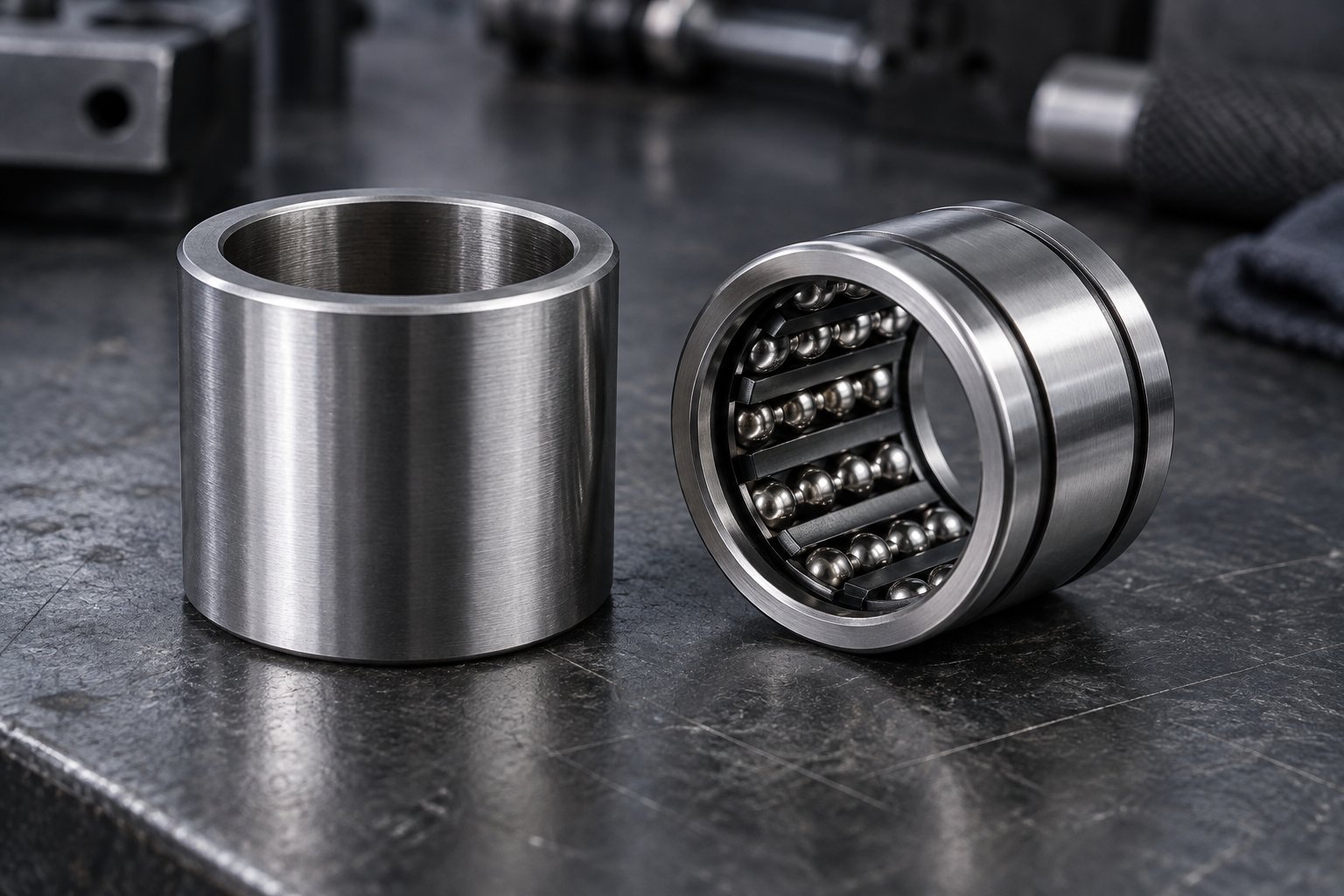
This is the question most buyers start with: what is a slide bushing? A slide bushing, also called a plain bearing or linear plain bearing bush, is a sleeved bearing with a bore sized for a shaft. The bushing and the shaft touch directly, usually across a polymer or composite liner, or across a bronze body. Motion comes from one surface sliding over the other, with a film of lubricant or a self-lubricating liner separating them. There are no rolling elements, no recirculation channel, and no cage.
A ball bushing works on the opposite principle. Balls run between the shaft and a hardened outer sleeve, and a return channel recirculates them as the bushing strokes. Contact is rolling rather than sliding. That single difference cascades into friction, stiffness, noise, lubrication demand, and contamination tolerance.
How each type carries load
A slide bushing spreads load across the full contact area of the liner or bushing bore. Because the load is distributed over a large, continuous face, the bushing is relatively forgiving of edge loading, misalignment, and moderate shaft finish variation. The trade-off is friction: sliding contact generally produces more resistance to motion than rolling contact, and the friction number is not constant. It rises as the load rises and as the lubrication film thins.
A ball bushing carries load through a discrete set of balls. The load path is concentrated at the ball–shaft and ball–sleeve contacts, which is why ball bushings expect a shaft of adequate surface hardness. The Xiamen Dongfeng Bearing process hardens shaft-relevant components to 58–62 HRC as part of the material verification approach, and the site holds ISO 9001:2015 certification plus CE and SGS material verification for this class of product.
The practical consequence: for a given envelope, a ball bushing usually delivers lower running friction and lower breakaway force, which matters for fine positioning and for drives that must move at speed. A slide bushing typically tolerates a wider range of shaft condition and less careful lubrication without immediate damage.
Same-conditions comparison
The table below compares the two types under the same axis conditions, which is the only fair basis for a decision.
| Condition on the same axis | Slide bushing (plain) | Ball bushing (recirculating) |
|---|---|---|
| Contact principle | Sliding, continuous face contact | Rolling, discrete ball contact |
| Friction and breakaway force | Higher; rises with load and thin lubrication | Lower; more consistent at low and high speed |
| Best fit | Smooth, quiet, low-load motion; short strokes; intermittent duty | Lower friction at higher speed; higher precision and repeatability |
| Running noise | Quieter; no ball recirculation | Ball return channel generates audible noise as speed rises |
| Shaft hardness sensitivity | Less critical; liner or bronze accommodates softer shafts | More critical; hardened, ground shaft expected |
| Contamination tolerance | Higher; debris does not block a recirculation path | Lower; particles in the ball channel cause jamming or wear |
| Lubrication expectation | Self-lubricating liners reduce but do not remove the need for maintenance | Regular lubrication is part of normal operation |
| Temperature range (sealed NBR variants) | -30 to +110 °C | -30 to +110 °C |
| Backlash and stiffness | Clearance is set by bushing-to-shaft fit | Preload can be tuned for stiffness and lower backlash |
Where each type wins
Choose a slide bushing when
- The axis runs at low speed and moderate load, and smooth, quiet motion matters more than friction number.
- The environment is dusty, wet, or difficult to seal, and you cannot guarantee a clean ball channel.
- Shaft hardness or surface finish is not well controlled, or the axis is long and misalignment is possible.
- Lubrication access is limited and you want a self-lubricating liner working in your favor.
Choose a ball bushing when
- You need low breakaway force and consistent motion at higher speed.
- Positioning accuracy and repeatability are primary requirements, and preload can be used.
- The shaft is hardened and ground, and the environment can be sealed with an NBR wiper or equivalent.
- Duty is continuous and predictable, making planned lubrication practical.
Maintenance and lubrication: what changes
Slide bushings shift the maintenance burden toward inspection rather than routine re-greasing. A self-lubricating liner carries a reservoir of lubricant in the material itself, which reduces the frequency of lubrication but does not eliminate it in high-load or high-temperature service. A plain bushing is also more tolerant of a missed lubrication interval, because sliding surfaces wear gradually instead of failing abruptly.
Ball bushings expect lubricant to be part of the design, not an afterthought. Rolling contact depends on a film at each ball; lose it, and friction rises and the raceway wears quickly. On the other hand, a properly lubricated and sealed ball bushing holds its positioning accuracy far more consistently over a long stroke.
Contamination sensitivity in real machines
This is often the deciding factor in woodworking, packaging, and general automation. A ball bushing needs its recirculation channel clear. Sawdust, chips, and coolant mist enter through open ends and either obstruct the balls or abrade them. That is why sealed NBR variants, rated from -30 to +110 °C, are common on ball bushings in these settings.
A slide bushing has no channel to block. Contaminants embed in or ride across the liner, and the bushing keeps moving. In dirty environments a slide bushing often lives longer than a poorly sealed ball bushing, even though its friction is higher from day one.
A short decision list
- Is the environment clean and can it be sealed? If not, a slide bushing is the safer default.
- Is friction or breakaway force the limiting factor? If yes, move toward a ball bushing.
- Is precision and repeatability the primary requirement? Preloaded ball bushing.
- Is noise or smoothness at low speed the priority? Slide bushing.
- Can lubrication be scheduled? If not, prefer a self-lubricating slide bushing.
- Is the shaft hardened and controlled? If not, a slide bushing tolerates it better.
What to send a supplier for a recommendation
To recommend between a slide and ball bushing, a supplier needs the axis facts, not just a bore size. Share the following:
- Load per bushing, direction of load (radial, moment, or both), and whether the load is constant or intermittent.
- Stroke length, strokes per minute, and expected duty cycle per day.
- Maximum and minimum speed of the axis.
- Shaft diameter, material, hardness, and surface finish.
- Ambient and operating temperature; note that sealed NBR variants are rated -30 to +110 °C.
- Contaminants present: dust, chips, coolant, washdown, or humidity.
- Required positioning accuracy and allowable backlash.
- Lubrication access and whether maintenance intervals can be scheduled.
- Mounting arrangement and available envelope for the bushing and seals.
With those inputs, a supplier can map the axis to a plain bush or a recirculating ball bearing and confirm the seal, clearance, and lubrication package. Xiamen Dongfeng Bearing has been manufacturing linear ball bearings and linear plain bearing bushes since 2014 and works with OEM and ODM requirements. The company's quality system is ISO 9001:2015, with CE and SGS material verification covering the 58–62 HRC hardening used on relevant components, and a 24-month warranty. Because the bushing and the shaft behave as a pair, include shaft details in the first enquiry rather than after the bearing has been selected.
Slide bushing vs ball bushing is rarely a matter of one being better. It is a question of which contact behavior your axis can support over its actual duty cycle. Send the load, speed, environment, and shaft details above, and the recommendation will follow from the motion need.