
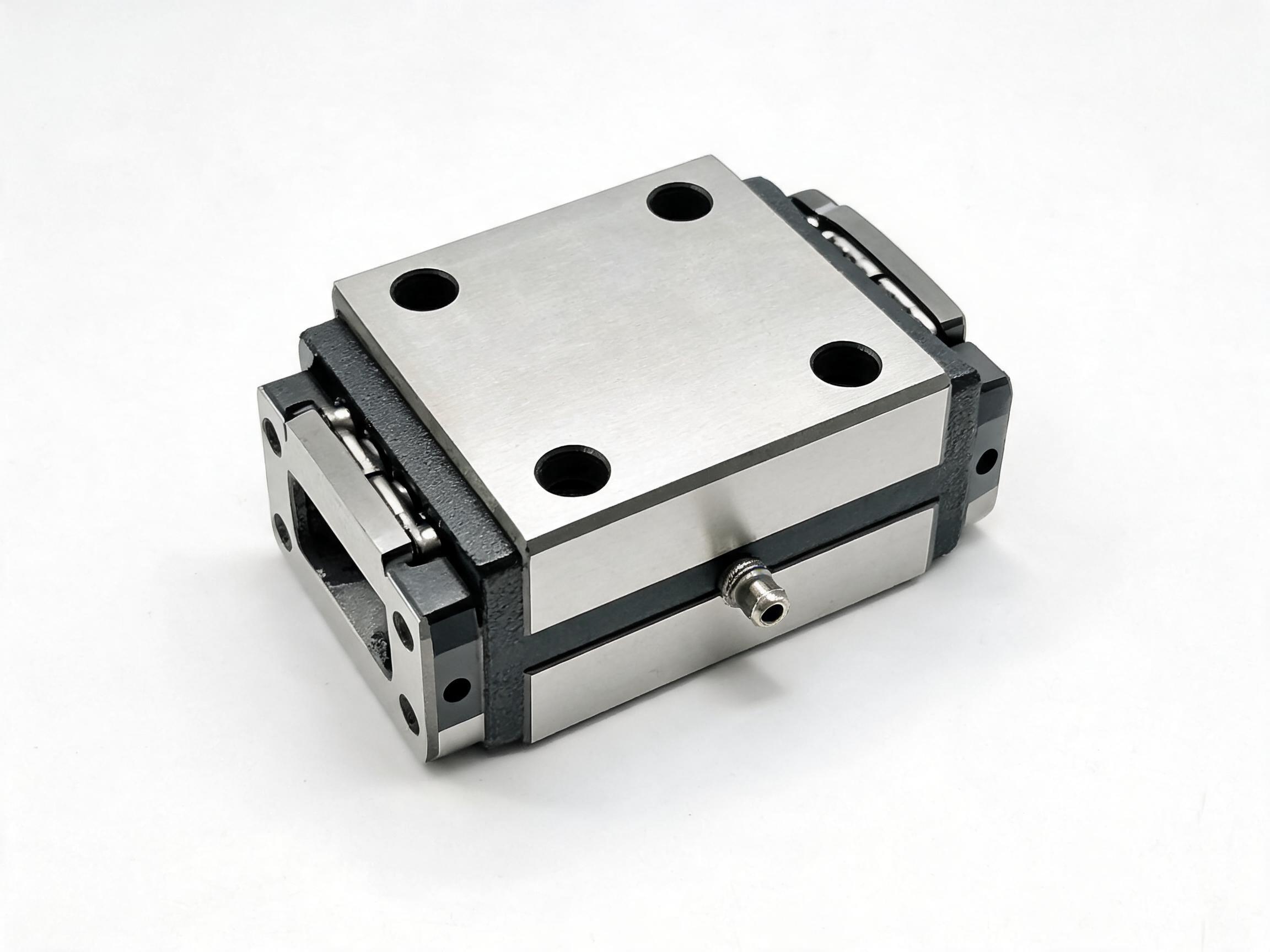
A spring inside a linear slide does one of three jobs: counterbalance a vertical load, apply a constant pressing force, or pull the carriage back to a home position. This article explains each mechanism, the limits of a spring that is fixed once built, and how driven slides and ball-screw axes take over those jobs on production machines.
Spring-Loaded Linear Slides: How They Work and When to Use
A spring-loaded linear slide contains a spring that acts on the carriage. The spring may be compressed during travel and want to push the carriage back, or tensioned so it pulls the carriage toward a stop. Whatever the arrangement, the spring does not produce a smooth, controllable force of its own the way a motor or a screw does; it stores energy and releases it on a curve that depends on how far the carriage has moved.
That single characteristic explains both why these slides are useful on simple fixtures and why they are rarely the right choice on an axis that has to hold a load, press with a set force, or return to a known position every cycle without variation. This article separates the three jobs a spring is asked to do inside a slide, then looks at each limit and how a standard driven axis or counterbalance handles the same job. To be clear about scope up front: our catalog does not list spring-loaded slides. What we supply are driven linear modules and ball-screw assemblies, which are the usual engineering replacement once the spring stops being adequate.
Key takeaways
- A spring in a slide serves three distinct purposes: counterbalancing a vertical load, applying a roughly constant pressing or clamping force, or returning the carriage to a home position.
- The spring's force is fixed at build time and varies with carriage position; it cannot be adjusted to follow a process requirement.
- Springs fatigue over cycles, and the changing spring force adds a variable load that affects positioning stability.
- Where the spring is only doing one of these jobs, a driven axis, a screw drive, or a counterweight usually gives the machine a more controllable result.
On this page
- The three jobs a spring does inside a slide
- Where each job breaks down
- Replacing the spring with standard linear-motion components
- How to decide which way to go
- FAQ
The three jobs a spring does inside a slide
Buyers searching for a spring-loaded linear slide usually have one of three motions in mind. They are physically different, and so are the answers.
Gravity counterbalance on a vertical axis
On a vertical Z axis, the carriage and whatever is mounted on it has weight. A spring can be arranged so that it takes up part of that weight, which reduces the force a motor or a hand crank has to provide to move the load up, and limits how fast the axis falls when power is removed. In a manual or lightly assisted vertical slide, this is the common reason a spring is included: the operator is not lifting the full mass of the tooling.
The limitation is that the counterbalance force is a spring force, not a constant. Over the stroke, the force changes as the spring extends or compresses. It is sized for one load, so a heavier tool or a fixture change alters the balance. It does not provide a positive hold on its own; if the axis must stay put with power off, the spring alone is not a holding arrangement.
Constant-force pressing or clamping motion
In a press-and-hold action, a spring can push a pad or a clamp against a workpiece so the force is set by spring deflection rather than by how hard a motor drives. The operator or the machine moves the carriage until the spring is compressed, and the reaction force is then defined by the spring rate and the amount of compression. This is a common arrangement in light assembly fixtures, lid holders, and test contacts that need a defined contact force without a force-controlled actuator.
Here the spring's advantage is its simplicity. The force is repeatable only as long as the compression travel is repeatable: if the carriage stops at a different position each cycle, the pressing force differs each cycle too. And the force cannot be changed without changing the spring or its preload.
Self-return to a home position
A return spring pulls or pushes the carriage toward a fixed stop when the operator or actuator lets go. This is the classic behavior in drawer slides, pick-and-place heads with a retracted rest position, and slides that must not stay where they were left. The spring effectively stores the return travel and releases it, so no separate return cylinder or reverse command is needed.
The return position is defined by the stop, not by feedback. It is repeatable only as far as the stop and the spring are consistent, and the return speed is set by the spring and the load, not by a profile.
Where each job breaks down
All three uses share the same structural weaknesses, because they all rely on a spring whose properties are fixed when it is built.
The spring force is fixed once built
A spring-loaded slide is ordered with a spring of a given rate and preload. To change the counterbalance force, the pressing force, or the return force, you change the spring, and usually the slide. There is no adjustment that follows a recipe change or a product change during a production run. If a machine has to run two product variants with different weights or different clamp forces, a single fixed spring forces a compromise or a slide swap. Confirm with the datasheet what the rated load and working stroke of a given spring actually are before sizing anything around it.
Fatigue over cycles
A spring in a slide works every cycle. As the count accumulates, the spring relaxes, its rate shifts, and the force at a given position drifts from what the drawing says. For a return spring, the consequence is a slower or incomplete return. For a counterbalance, it is a changing balance that the drive has to absorb. For a press, it is a contact force that no longer matches the setting. The cycle count at which this matters depends on the spring material, stress level and environment, and the spring supplier's datasheet, not a rule of thumb, is the place to look for a rating.
Precision suffers because the spring force varies
The spring's force is a function of carriage position, so it acts as a position-dependent load on the axis. On a counterbalanced vertical axis, the drive sees a load that changes along the stroke. On a return slide, the carriage is being pulled toward one end, so any command to hold an intermediate position is opposed by a spring force that grows with distance from home. A servo axis fighting a spring can still position, but the spring contributes a varying disturbance to the loop, and the static error and settling behavior depend on where in the stroke the carriage sits. Where a machine needs to hold position or follow a profile, a spring in the load path is a load that the control system has to keep working against.
Replacing the spring with standard linear-motion components
The practical question is not whether springs work, but whether a spring is the right load element for the axis. On a real machine that has to run repeatably, each of the three jobs has a standard component answer.
Vertical Z axis: a proper support and holding arrangement
For a vertical axis, counterbalancing and holding are separate functions. A dedicated counterbalance — a cylinder or a weight — takes the static load and can be sized to the actual mass. Holding in position with power off is a property of the drive, brake, or screw arrangement, not of a spring. A ball-screw-driven vertical axis is a common answer because the screw holds a load against gravity when the drive is at rest and moves the carriage in a controlled profile. Our SFU series rolled ball screw assembly is a standard drive element for this kind of vertical axis; the screw, bearing and nut configuration define the load capacity and the holding behavior, and those values should be confirmed with the datasheet for the specific size in question.
The ball screw does not by itself replace a spring — the motor and, where required, a holding brake or counterbalance do that. What the screw gives you is a positionable, ratio-defined drive in which the carriage can be commanded to any point and held there, rather than being pulled toward one end by a stored force.
Driven axis for controlled force and return
Where the job is a pressing or clamping force, a driven axis with force control or torque limiting replaces the spring: the force is set in the control, changed by program, and the carriage position is measurable. A servo motor on a screw or a belt-driven slide can be commanded to press to a force limit and stop, and the force can be different for each product. Where the job is a return to home, a driven slide does that in software — the controller commands the move to the home position, and the position is confirmed rather than assumed from a stop. A standard driven linear module, such as the SKF20 aluminum profile linear motion slide module, is the usual replacement when the spring was doing a return or an indexing job.
This is not free. A driven axis needs a motor, a drive, a controller, and often feedback; a spring-loaded slide needs none of those. The trade is simplicity against controllability, and which side wins depends on how many cycles the slide will see and how tightly the force or position has to be held.
Counterweight for gravity
Where the only job is taking weight off the drive, a counterweight is a straightforward alternative: a mass connected by cable or belt takes the static load, and it does not fatigue in the way a spring does. It adds mass and inertia to the axis and takes space, which is why springs are attractive on compact fixtures. But a counterweight's effect does not drift, and its balance remains true over the whole stroke.
| Job inside the slide | What the spring does | Standard-component replacement |
|---|---|---|
| Gravity counterbalance on a vertical axis | Takes up part of the tooling weight; reduces drive force and fall speed | Dedicated counterbalance (cylinder or weight) plus a screw-driven axis with a hold arrangement |
| Constant pressing or clamping force | Sets the contact force by spring deflection | Driven axis with force control or torque limit, force set in the controller |
| Self-return to home | Pulls the carriage back to a stop when released | Driven slide commanded to a home position with position feedback |
How to decide which way to go
Start from the requirement, not from the component. If the axis only has to move a light load back and forth a few times a day and the force does not need to change, a spring-loaded slide remains a simple, low-part-count option, and the spring's limits may never matter. If the axis runs continuously, holds position under load, or has to press with a defined and changeable force, the spring is the weak link, and a driven or screw-based axis should be evaluated.
- Write down the actual mass to be balanced or the force to be pressed, and the stroke over which it must hold. Compare that with the spring's rated load and working range.
- Confirm the expected cycle count and any adjustment the process will need; a fixed spring cannot follow a change in product weight or clamp force.
- Decide whether "home" must be repeatable to a defined position or merely "near the stop".
- Check whether the machine needs to hold with power off; if so, that is a holding-function requirement, not a spring requirement.
Where a driven axis is the answer, the specification has to define load, stroke, speed, and holding requirement, and the components are sized to those numbers. The relevant figures — dynamic load rating, permissible axial load, and motor torque — come from the datasheet for the chosen screw or module size, and should be confirmed for the exact model rather than assumed from a catalog class.
FAQ
Does a spring-loaded linear slide hold position when power is removed? Not by itself. A spring can bias the carriage toward one end, but that is a return force, not a defined holding position. A machine that must hold under load with power off needs a proper holding arrangement in the drive or screw.
Can I adjust the force of a spring-loaded slide? The spring rate and preload are set when the slide is built. Some designs allow a preload adjustment, but that changes the force at a fixed position, not the way the force varies along the stroke. Confirm with the datasheet what adjustment, if any, the slide offers.
Do you sell spring-loaded slides? No. Our catalog covers driven linear modules and ball-screw assemblies. If a machine currently uses a spring for counterbalance, pressing, or return, the alternative we can quote is the driven or screw-based axis that takes over that function.
Is a spring-loaded slide always the wrong choice? No. For low-duty fixtures, a spring is a simple and compact way to take up weight or bring a carriage home. The engineering question is whether the fixed force, fatigue, and varying load matter for the cycle count and precision the machine actually needs.