
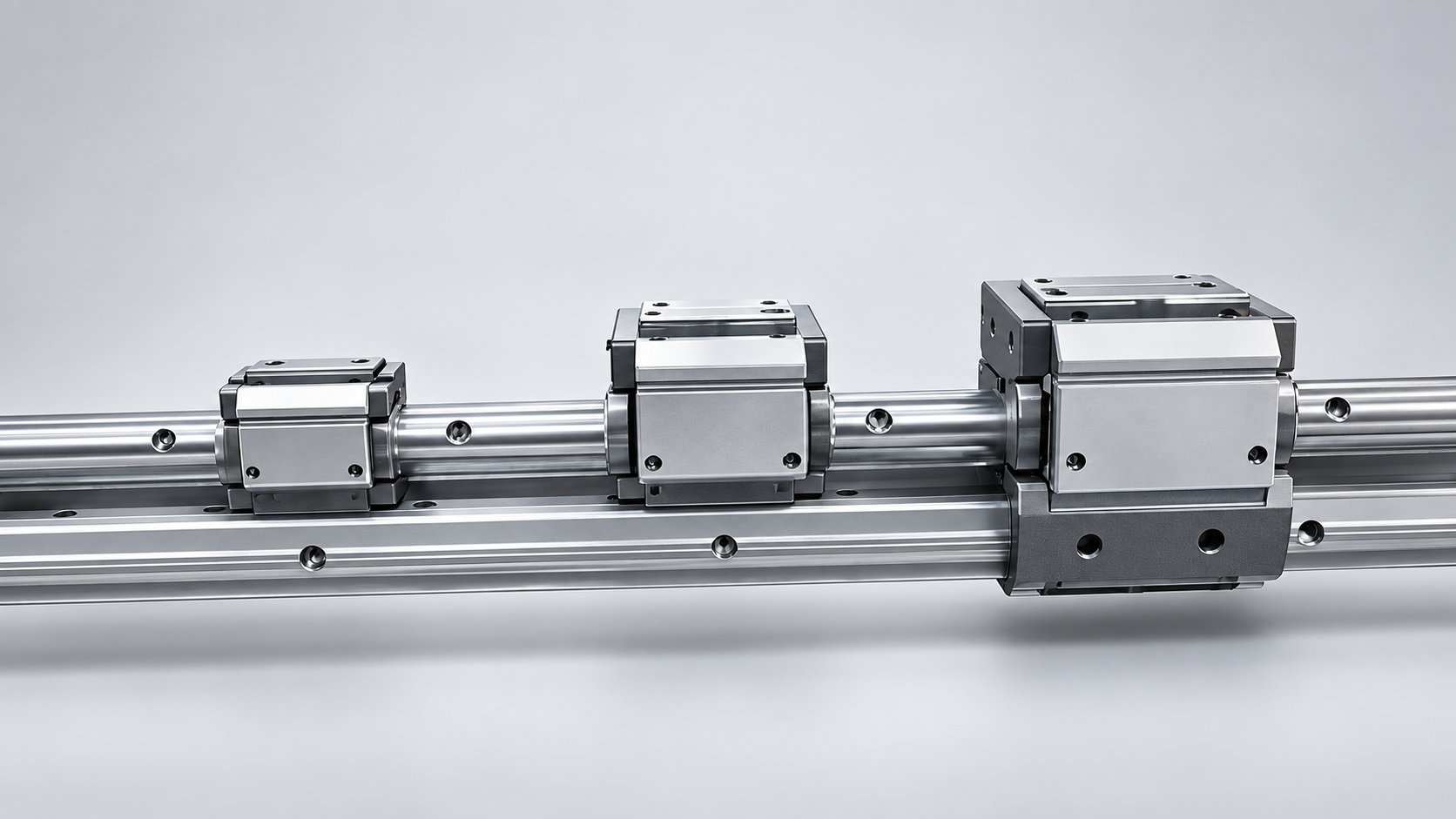
Linear guide rails are used in CNC machines, automation, packaging, medical and lab equipment, and 3D printing. This article explains typical applications, where linear guides fit versus other guide types, and where they are not the right choice, based on our experience as a linear guideway manufacturer.
Linear Motion Applications
If you are specifying a linear guide rail for a machine, the first question is usually not "which brand" but "is this the right guide type at all." This article answers that from the perspective of a manufacturer that has been producing linear motion bearings and guideways for automation buyers for over a decade. We will cover the main application categories where linear guide rails are used, where they fit compared with other guide types, and where they are not the right choice.
Key Takeaways
- Linear guide rails are used wherever a machine needs low-friction, high-accuracy linear motion under load: CNC machines, automation, packaging, medical and lab equipment, and 3D printing.
- They are not automatically the best choice for every axis. Very long travel, extreme contamination, or very low cost targets often point to a different guide type.
- The selection decision is driven by load direction, stroke length, speed and acceleration, environment, and required accuracy and rigidity.
- Confirming fit before requesting a quote saves time for both the buyer and the supplier.
What Linear Guide Rails Do in a Machine
A linear guide rail is a precision track that constrains motion to a straight line while carrying load. A carriage (also called a block or slider) runs along the rail on rolling elements, so the moving part of the machine travels with low friction and repeatable positioning. In practice, the rail system does three jobs at once: it supports the load, it guides the direction of travel, and it helps maintain geometric accuracy over the life of the machine.
That combination is why linear guide rails appear in machines where the moving axis must be both accurate and durable, not just able to slide.
Where Linear Guide Rails Are Used: Main Application Categories
CNC Machines and Machining Centers
CNC routers, milling machines, lathes, and machining centers use linear guide rails on the X, Y, and Z axes. The rail carries the cutting load and keeps the tool path repeatable. In these machines, the guide system must handle varying load directions during cutting, resist chips and coolant, and maintain accuracy as the machine runs through many cycles. Buyers evaluating guides for CNC equipment typically look at rigidity, preload options, and sealing, because a guide that is accurate when new but loses preload quickly will show up as poor surface finish later.
Industrial Automation and Pick-and-Place Systems
Automation is the broadest category. Gantry robots, Cartesian robots, linear actuators, and pick-and-place heads all rely on linear guide rails to move tooling or product with controlled speed and position. Here the guide often works with a belt, ball screw, or rack-and-pinion drive. The rail's job is to keep the payload on a straight path while the drive provides the force. Automation buyers usually care about smooth motion at low speed, quiet running, and consistent friction, because those affect servo tuning and cycle reliability.
Packaging and Material Handling Equipment
Packaging machines, labeling systems, cartoners, and palletizing units use linear guide rails for forming, sealing, cutting, and transfer motions. These machines often run continuously, so guide life and maintenance intervals matter as much as initial accuracy. In dusty or washdown environments, the sealing and lubrication arrangement of the guide becomes a primary selection point rather than an afterthought.
Medical, Laboratory, and Analytical Equipment
Medical devices, laboratory automation, sample handling systems, and analytical instruments use linear guide rails where smooth, quiet, and precise motion is required. In these applications, low friction and low vibration often matter more than raw load capacity. Buyers in this segment frequently ask about cleanroom compatibility, lubrication options, and whether the guide can run with minimal particulation. We recommend confirming these requirements with the supplier early, because they can change the bearing and seal configuration.
3D Printing and Additive Manufacturing
FDM and other motion-based 3D printers use linear guide rails on the X and Y axes to reduce play and improve surface quality. Compared with wheel-on-extrusion systems, a profile rail guide generally offers better stiffness and repeatability, but it also requires a flat mounting surface and reasonable protection from dust. For printer builders, the trade-off is usually between motion quality and cost, and the guide choice is one of the main levers.
Other Common Uses
- Semiconductor and electronics assembly equipment
- Inspection and vision systems
- Woodworking and panel processing machines
- Laser cutting and engraving systems
- Testing and measurement rigs
How Linear Guide Rails Compare with Other Guide Types
Linear guide rails are one option among several linear motion technologies. The table below summarizes where each type typically fits, so you can judge whether a guide rail is the right direction for your machine.
| Guide Type | Typical Fit | Where It Falls Short |
|---|---|---|
| Profile linear guide rail | High accuracy, high rigidity, moderate to long stroke, machine tools and automation | Needs a flat, rigid mounting surface; sensitive to contamination without proper sealing |
| Round shaft and linear bearing | Simpler axes, lighter loads, lower cost, easier alignment | Lower stiffness and load capacity than profile rails; less suitable for high-precision cutting |
| Dovetail or box way | Heavy cutting loads, vibration damping, machine tool slides | Higher friction, stick-slip at low speed, more maintenance |
| Cam follower or wheel on track | Light duty, long travel, cost-sensitive motion | Lower accuracy and stiffness; wear and debris accumulation over time |
When Linear Guide Rails Are Not the Right Choice
Being honest about boundaries helps buyers avoid a costly mismatch. In our experience, linear guide rails are often the wrong choice in these situations:
- Very long travel with limited mounting rigidity. If the machine base cannot provide a flat, stiff surface over the full stroke, a profile rail may not hold accuracy, and a different guide concept may be more forgiving.
- Extremely contaminated or abrasive environments without protection. Heavy dust, grit, or metal chips can damage rolling elements. If sealing and shielding cannot be added, another guide type may last longer.
- Very low cost targets with low accuracy needs. For simple, light-duty motion, a round shaft or wheel system can meet the requirement at lower cost.
- Axes that need very high vibration damping. In some heavy cutting applications, a box way or dovetail slide may damp vibration better than a rolling guide.
- Applications where the axis is not truly linear. If the motion path is curved or requires rotation, a linear guide rail is not the right component.
These are general selection boundaries, not rules. The right answer depends on the specific load, stroke, speed, environment, and accuracy target of your machine. If you are unsure, describe the axis to the supplier and ask for a fit check before requesting a quote.
Selection Principles for Buyers
When evaluating whether a linear guide rail fits your application, work through these questions in order:
- Load direction and magnitude. Is the load mainly downward, sideward, or a moment? This determines the carriage and rail configuration.
- Stroke and mounting. How long is the travel, and can the machine structure provide a flat, rigid mounting surface along the full length?
- Speed and acceleration. High dynamics affect lubrication, sealing, and preload choices.
- Environment. Dust, chips, coolant, washdown, or cleanroom conditions change the required sealing and material options.
- Accuracy and rigidity. What positioning accuracy and repeatability does the process need, and how much deflection is acceptable under load?
- Maintenance and life. How often can the machine be serviced, and what lubrication method is practical?
If you can answer these, you have enough to have a productive conversation with a linear guideway manufacturer and to compare offers on the same basis.
Frequently Asked Questions
Are linear guide rails only for CNC machines?
No. CNC machines are a major application, but linear guide rails are also used in automation, packaging, medical and lab equipment, 3D printing, and many other machines that need accurate linear motion under load.
Can I use a linear guide rail in a dusty environment?
It is possible with the right sealing and shielding, but it depends on the dust type and concentration. In abrasive or heavy contamination, protection becomes a primary design requirement. Confirm the environment with your supplier so the guide configuration matches it.
What is the difference between a linear guide rail and a linear shaft?
A linear guide rail is a profile track with a carriage that runs on rolling elements, offering high stiffness and accuracy. A linear shaft with a round bearing is simpler and often lower cost, but generally has lower load capacity and stiffness. The right choice depends on the axis requirements.
How do I know if a linear guide rail is the right choice for my machine?
Start with load, stroke, speed, environment, and accuracy. If the axis needs high accuracy and rigidity over moderate to long travel with a rigid mounting surface, a profile rail is usually a good fit. If the axis is very long, heavily contaminated, or cost-driven with low accuracy needs, consider alternatives.
Next Step
If you are evaluating linear guide rails for a machine project, the most useful next step is to describe the axis: load, stroke, speed, environment, and accuracy target. That lets a manufacturer confirm fit and recommend a configuration before you request a quote. If you already have a drawing or a machine specification, share it with your supplier and ask for a fit check.