
A rated life on a ball screw datasheet is a statistical expectation, not a warranty. This article explains what the figure covers, why real installations fall short, which conditions shorten service life, and how to catch wear early before it becomes a positioning problem.
Technical Explanation
A datasheet rating for a ball screw is a statistical expectation. It is not a warranty, not a promise for your machine, and not a number that survives a contaminated environment unchanged. The confusion matters commercially: two quotes can carry different rated-life figures for otherwise similar screws, and a buyer has no way to judge whether the difference reflects bearing capacity, testing convention, or optimistic rounding.
This article does not walk through the life calculation. It answers a different question: once a rated life is on paper, what does it actually cover, what silently shortens it in service, and how do you detect life loss before it becomes a positioning failure?
- Rated life is defined under clean, correctly mounted, lubricated, steady-load conditions.
- Real installations rarely match all four conditions at once.
- Contamination, misalignment, over-preload, and lubrication starvation are the common shorteners.
- Wear shows up as backlash growth, rough travel, and noise before it shows up as scrap.
- Replacement versus preload recovery is a measurable decision, not a guess.
- What a rated life figure actually is
- What the rating does not cover
- Why real installations fall short
- What shortens service life in practice
- How wear presents itself
- A practical log and check routine
- Replacement or preload recovery
- FAQ
What a rated life figure actually is
When a manufacturer states a life rating, it is describing a statistical expectation under a defined set of conditions. The conventional definition is that under clean operation, correct mounting, proper lubrication, and the rated load, roughly 90% of identical screws are expected to reach the stated figure. The remaining portion of the population is expected to fail earlier, and some to last considerably longer. The number is a distribution property, not a floor.
That single sentence explains most of the gap between what buyers expect and what they experience. A rating applied to a population cannot describe your specific axis. Two nominally identical screws from the same production run, installed on the same machine, can produce noticeably different service intervals once contamination and mounting quality diverge.
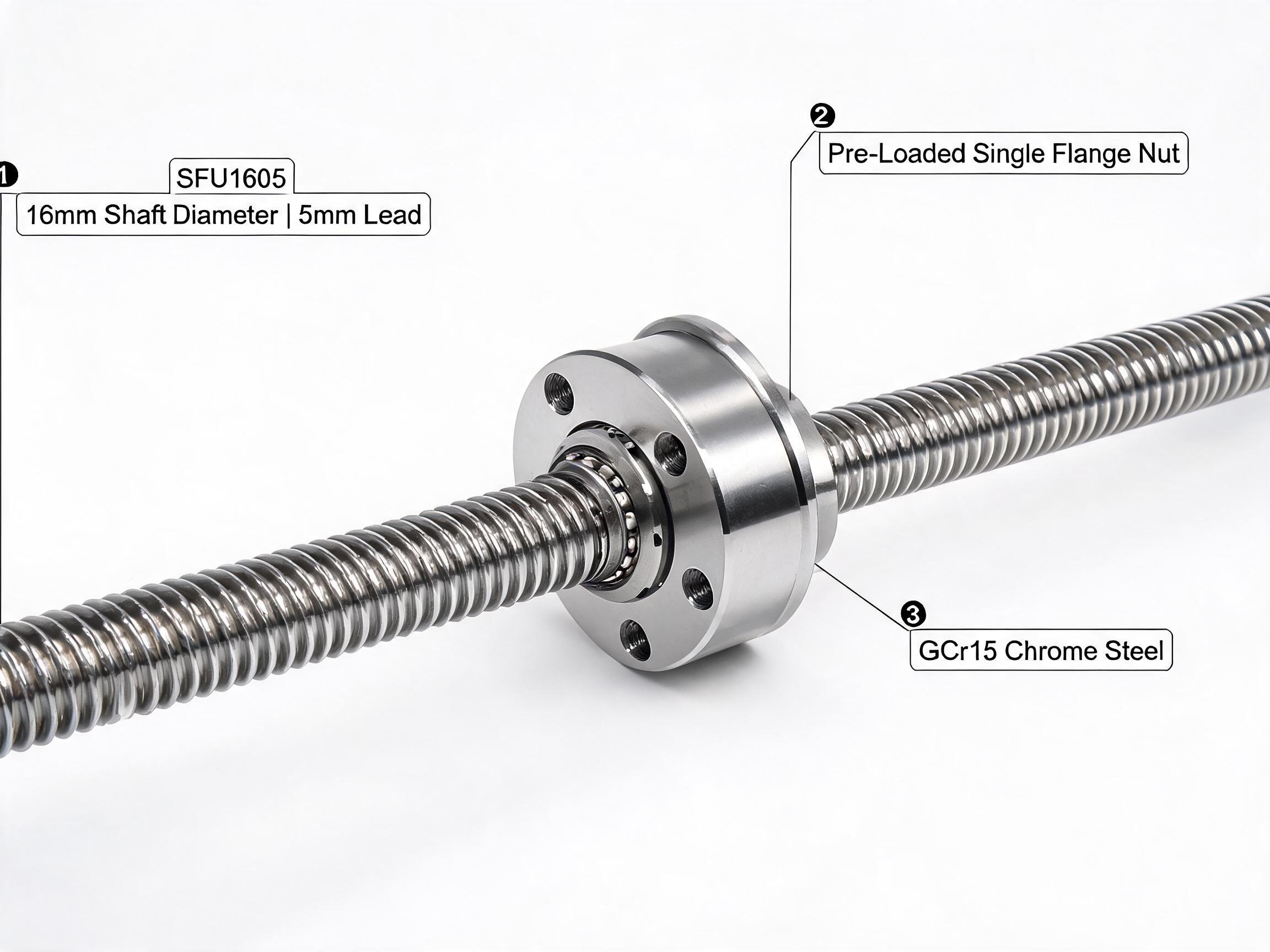
Take a concrete example from a rolled screw. The SFU1605 is a 16 mm rolled screw with C7 (ISO 3408) accuracy, ±0.05 mm/300 mm lead accuracy, a dynamic load rating of 6.8 kN for the single nut, GCr15 chrome steel construction, and induction-hardened shaft at HRC 58–62, supplied in lengths of 300–1500 mm. All of those figures describe the screw as manufactured. None of them describe the screw as installed.
For heavier axes, the same logic applies at a larger scale. The SFU3205 uses a 32 mm shaft with a dynamic load rating of 22.5 kN and a static rating of 34.8 kN. Its shaft is HRC 58–62 with roughly a 2.0 mm induction-hardened case depth, available in lengths of 500–4000 mm, and it accepts BK32/BF32 support blocks. The heavier rating does not make it immune to the same real-world shorteners.
What the rating does not cover
A buyer comparing quotes should read the rating as covering one thing: relative load capacity under reference conditions. It does not cover:
- Your actual environment, including chips, coolant mist, dust, and washdown.
- Mounting accuracy of your bearing housings and rail parallelism.
- Preload set on installation and how it changes over time.
- Lubrication interval, type, and whether it was actually performed.
- Load profile, including shock, reversal, and interrupted cuts.
- Lead accuracy over service life rather than at delivery.
None of these are hidden in fine print because manufacturers are evasive. They are design inputs that only the machine builder and operator control. The rating tells you how the screw performs when those inputs are correct.
Why real installations fall short
Reference conditions are narrow. A practical machine rarely satisfies all of them at once. Three gaps account for most of the difference.
First, the reference assumes clean lubrication reaching the raceways. In machining centers, that assumption competes with coolant, fine chips, and casting dust. Second, it assumes the nut travels parallel to the screw axis within the preload's tolerance for angular error. Housing bores, shimmed spacers, and rail alignment determine whether that is true. Third, it assumes steady load. Many axes see reverse loads, rapid reversals, and shock on entry and exit of a cut.
When more than one gap is present, the shortfalls compound rather than add. That is why an axis that looks fine on a datasheet comparison can produce heavy backlash within a fraction of the rated interval.
What shortens service life in practice
The listed causes below are ordered roughly by how often they appear in service investigations, not by severity. Several can be present simultaneously.
Contamination
Chips, coolant, and abrasive fines enter the nut through wiper seals that were never intended to stop them. Once inside, they act as a lapping compound and accelerate raceway wear. Coolant ingress also dilutes or washes out the lubricant film. This is the single most common shortener on machine tools.
Misalignment and edge loading
If the nut is not parallel with the screw axis within the preload's tolerance, the balls load unevenly and concentrate stress on one side of the raceway. The same happens when bearing housings are bored off-axis or when the screw is supported at only one end on a long axis. Edge loading produces fatigue at loads well below the dynamic rating.
Over-preload
Preload removes backlash, but it also raises running friction and contact stress. A screw set to a preload class heavier than the application needs runs hotter, consumes more torque, and wears faster. Adding preload to compensate for a positioning problem typically shortens life rather than restoring accuracy.
Lubrication starvation
Grease channels and starved oil films cause metal-to-metal contact in the ball path. Symptoms include higher current draw, temperature rise, and a dry or varnished appearance at the nut inlet. Intervals that work for a lightly loaded axis are not automatically adequate for one running near its rated load.
Interrupted or shock loading
High-frequency interruption, tool entry, and rapid reversal introduce transient loads above the steady-state figure. Repeated shock loads damage raceways even when the average load looks modest on a duty chart.
Wrong lead or duty mismatch
A screw selected for a lower duty cycle and then run continuously, or one chosen for positioning accuracy and then driven at high speed, will not behave as the rating suggests. The rating is a capacity figure; it is not a statement that the screw suits your duty profile.
How wear presents itself
Wear does not announce itself as a single event. It shows up as a trend across several observable symptoms.
| Symptom | What it usually indicates |
|---|---|
| Growing backlash between reversals | Raceway wear, preload loss, or both |
| Rough or uneven travel | Contamination in the ball path or raceway damage |
| Audible noise or clicking under load | Ball path distress, misalignment, or lubrication loss |
| Rising motor current or temperature | Over-preload or lubrication starvation |
| Position error increasing over time | Combined wear and preload loss |
Reading the table left to right matters. Backlash growth alone is not proof of contamination, and noise alone is not proof of misalignment. Use the combination and the timing to narrow the cause before deciding on corrective action.
A practical log and check routine
Catching life loss early is mostly a record-keeping discipline. The goal is not to inspect everything constantly, but to have a baseline against which change becomes visible.
- Record at commissioning: backlash measured at the nut, free-travel torque or drive current at a reference feed rate, and the preload class as set.
- Log the environment: coolant type, chip management, and wiper condition at each service.
- Track lubrication: lubricant type, quantity, and interval actually delivered to the nut, not just scheduled.
- Check alignment after any crash or re-mount: parallelism of the screw to the guide and support conditions at both ends.
- Measure backlash on a fixed interval: the same measurement at the same point under the same conditions.
- Note noise and current at a fixed operating point: a rising trend is more informative than any single reading.
- Inspect wipers and seals when the nut is accessible: replace before they fail, not after.
A single backlash reading taken after a problem appears cannot tell you when wear started. A baseline reading taken at commissioning can. The check routine is only as good as the record it produces.
Replacement or preload recovery
When measured backlash exceeds the tolerance your application allows, the question is whether to recover preload or replace the screw. That decision depends on what is actually worn.
Preload recovery makes sense when the screw raceway and balls are still in good condition, the backlash is mostly lost preload, and the nut design permits adjustment. It is a short-term correction in most cases and should be followed by re-measurement at the next interval.
Replacement is the realistic option when raceway damage or contamination has removed material, when noise and rough travel accompany the backlash, or when backlash returns quickly after adjustment. Continuing to run a damaged screw raises the risk of consequential damage to the nut, support bearings, and motor coupling.
The choice between rolled and ground screws belongs in the original selection, not in the replacement decision. Relevant product information is available on the SFU series rolled ball screw assembly page and the SFU3205 heavy-duty rolled ball screw for CNC machining centers page.
FAQ
- Does a rated life figure mean the screw will last that long on my machine?
- No. It is a statistical expectation under reference conditions. Real service life depends on contamination, mounting, preload, lubrication, and load profile in your installation.
- Can I compare quotes by comparing rated life figures alone?
- Only as a rough capacity comparison. Two screws with similar ratings can behave very differently once installed, so mounting accuracy, sealing, and lubrication provisions matter as much as the number.
- What is the earliest measurable sign of life loss?
- Backlash growth measured against an initial commissioning baseline. It typically appears before noticeable noise or position error.
- Does higher preload extend life by improving rigidity?
- No. Higher preload raises friction and contact stress and usually shortens life unless the application genuinely requires the additional rigidity.
- When is preload recovery enough instead of replacement?
- When the raceway and balls are still in good condition and the measured backlash comes mainly from lost preload. If backlash returns quickly after adjustment, replacement is the practical choice.
A rated life figure is a starting point for comparing capacity, not a substitute for controlling the conditions that determine actual ball screw service life. The buyers who get the most from a rating are the ones who log the conditions that erode it.