
A procurement-oriented breakdown of the specification choices that move the cost of a single-axis linear actuator or slide unit, plus a quotation checklist that lets you compare offers on equal terms.
A single-axis linear slide unit is rarely a catalogue drop-in. The price you are quoted depends on a short list of specification choices that a supplier can name, measure and verify, and a quotation that does not separate those choices is hard to compare against another supplier's offer. This article walks through the variables that move the price of a single-axis linear actuator or slide unit, and closes with a checklist you can send to any vendor so that all quotes answer the same questions.
What matters most
- Stroke length sets the rail, shaft and machining content. Custom lengths above the standard range carry their own minimum order quantity.
- Shaft diameter and carriage count change the dynamic and static load figures, and therefore the bearing block cost.
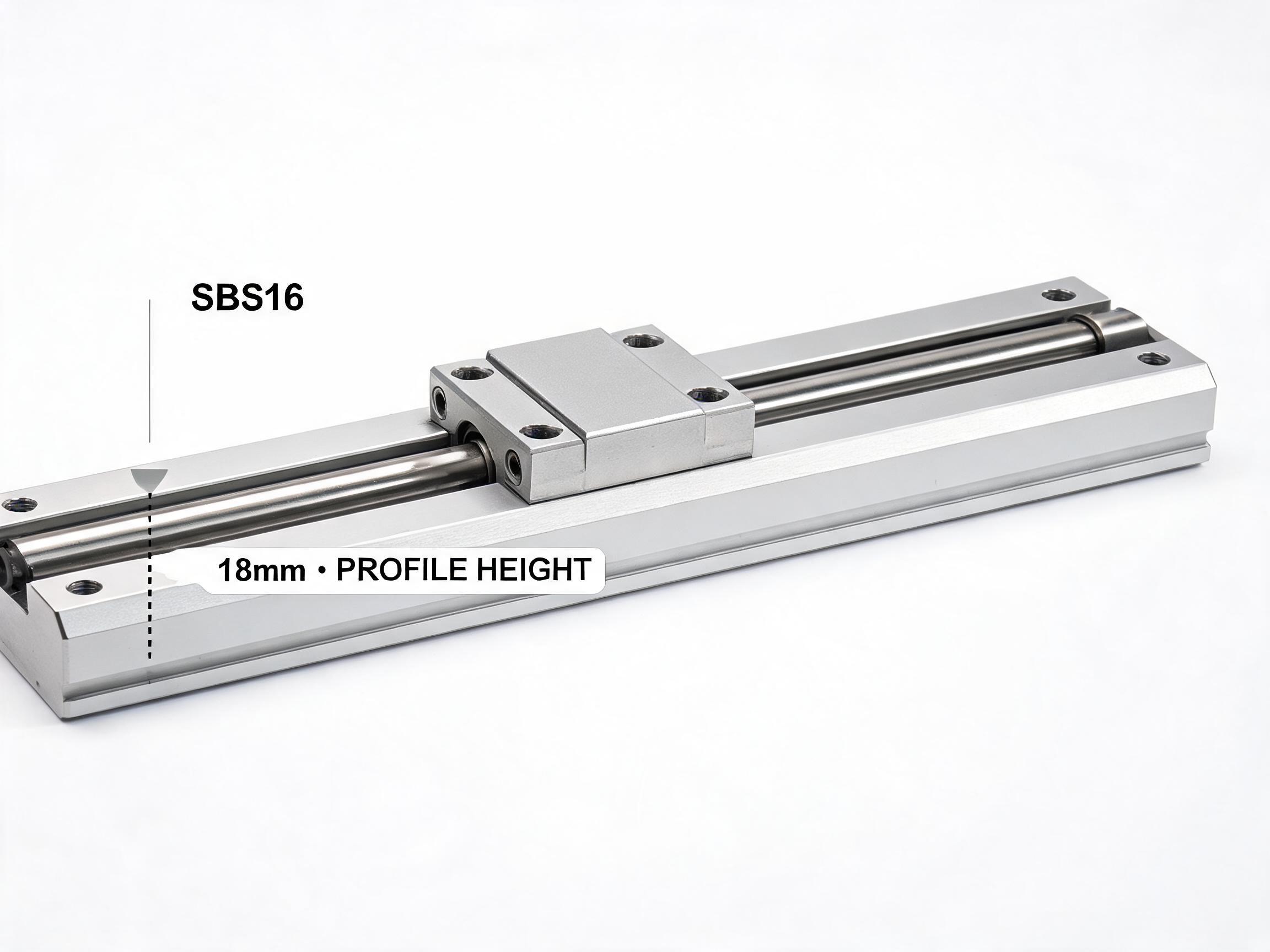
- Profile height affects how the axis integrates into your machine, but not the load rating of a given size.
- Precision grade is a specification on the drawing; where a supplier cannot state it, the quote cannot be compared.
- Order quantity and the way lengths are grouped determine unit price more than any single dimensional choice.
In this article
Stroke and overall length drive the bill of materials
A slide unit is priced along its length. The support rail, the hardened shaft, the number of mounting holes, the machining and the packaging all scale with the length you ask for. Standard lengths keep a supplier on existing tooling and fixturing; anything outside that range becomes a one-off setup.
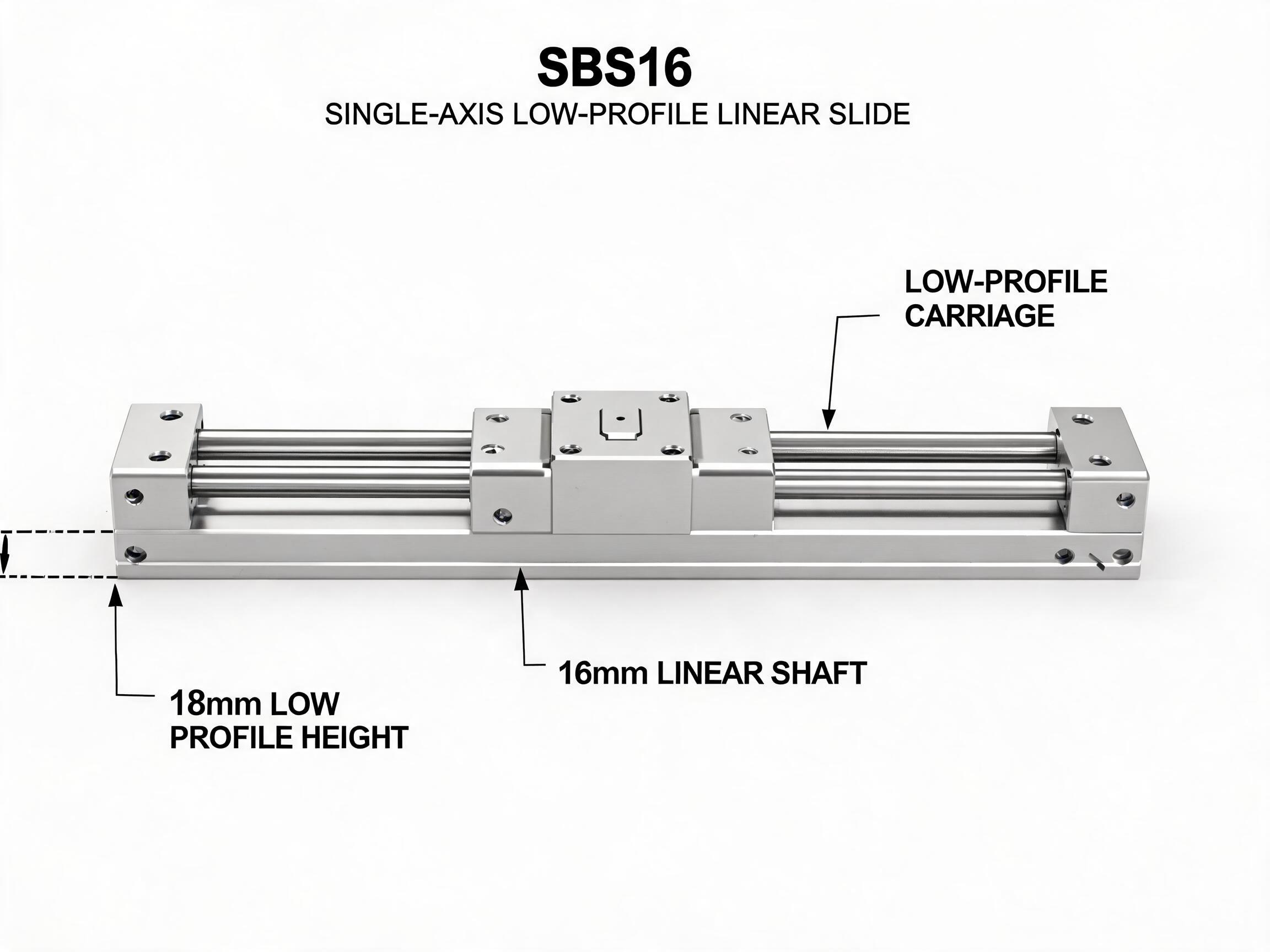
On the SBS16 Single-Axis Linear Motion Slide Unit with Low-Profile Carriage, standard lengths are 150 mm, 200 mm, 300 mm and 500 mm, with custom lengths available up to 1000 mm. Two commercial consequences follow. First, if your stroke fits a standard length, do not pay for a custom one. Second, if it does not, expect a separate minimum order quantity for the custom length rather than the same MOQ as the catalogue sizes.
Mounting hole spacing is the detail that often decides whether a length is usable at all. On the SBS series the holes run every 25 mm along the support rail, which means the effective usable length and the overall length are not the same number. When you specify, state stroke first and confirm how the supplier measures overall length.
Shaft diameter and material
Shaft diameter is the single largest lever on load capacity. A larger shaft carries a higher rated load for the same rail length, and it costs more because both the shaft and the bearing block grow. The SBS series covers sizes 12, 16 and 20, so a buyer can move up or down within one product family rather than switching platforms.
Material and heat treatment are part of the quoted specification, not a factory detail. On the SBS16, the 16 mm shaft is GCr15 chrome steel, induction hardened to HRC 58-62, running in an anodized aluminium 6063-T5 support rail. If a competing quote does not name the shaft steel, the hardness range and the rail alloy, you have no way to know whether you are comparing the same class of product. Put those three items on the checklist.
Carriage count and configuration
One carriage and two carriages on the same rail behave differently and price differently. The bearing block is the most machined component in the assembly, so adding a second block adds cost and adds load capacity at the same time. For many single-axis applications the real question is whether one block can carry the moment load your tooling creates, or whether you need a longer carriage or a second block to keep deflection acceptable.
This is also where you should state mounting needs precisely. On the SBS16, the carriage mounting bolts are 4x M4 on the top face. If your carriage plate is drilled for a different pattern, the adapter becomes part of the project and part of the cost.
For applications where the moment load or duty cycle exceeds what a single-axis slide unit should carry, it is worth confirming whether a profile rail system is a better platform than forcing a larger actuator. The HGR series heavy-duty linear guideway rail is the parallel option to compare against before you commit to a slide unit size.
Profile height and mounting interface
Low-profile designs exist because machine builders run out of vertical space, not because they cost less. A lower total system height usually means a different rail cross-section, and that change is reflected in tooling and therefore in price.
The SBS16 has a total system height of 18 mm. That figure is the number to check against the clearance under your moving plate, and it is also the number that tells you whether the low-profile carriage is genuinely required or whether a standard-height unit would fit. Changing profile height does not change the dynamic and static load ratings of the size, so do not buy height for load.
Mounting interface matters for the same reason. The SBS16 carriage bolts to a 4x M4 pattern on the top face, and the support rail is drilled on a 25 mm hole pitch, so the frame you bolt it to has to match that pitch. Where the existing frame drilling already lines up, integration cost drops because no adapter plate is needed. Where it does not, the adapter plate is a real line item, and it is worth settling that question against the dimensional drawing before the order is placed.
Precision grade and pre-assembly
Precision grade is where quotes differ most and where buyers most often compare unlike products. Grade is a specification: it should appear on the drawing and on the quotation, with the measuring conditions and the datum it applies to. If a supplier quotes a lower figure without stating a grade, you are not comparing offers, you are comparing two sentences.
Assembly condition is the other half of this. The SBS16 arrives pre-assembled and aligned so the axis is functional after bolting to a flat surface. That removes alignment labour from your build, but it also depends on the surface you bolt it to. A quote that includes pre-assembly and one that ships loose components are not the same quote, even when the headline number looks similar.
Custom lengths and order quantity
Order quantity is a commercial variable, not a dimensional one, and it has more effect on unit price than any single millimetre of stroke. Standard MOQ for the SBS series is 50 sets, where a set is one rail plus one carriage. Custom lengths above 500 mm carry an MOQ of 30 sets. Sample sets of a small quantity are available to qualified buyers, which is the normal route for validating fit before committing to production volume.
Three practical points for negotiation:
- Group your lengths. If you use three strokes that are close together, ask what happens to price and lead time if you consolidate to two.
- Keep custom lengths above 500 mm separate from standard lengths in your enquiry, because they are quoted on different minimums.
- State annual volume and first-order volume separately. Suppliers price the second differently from the first because of setup and material purchasing.
A worked reference: what the SBS16 fixes and what stays open
The table below separates the SBS16 specifications that are already fixed from the choices that remain yours. Use the left column to check whether this platform suits your application at all; use the right column to build the enquiry.
| Fixed specification (SBS16) | Buyer-side choice that affects price |
|---|---|
| Total system height 18 mm | Whether low-profile height is required by the machine envelope |
| 16 mm shaft, GCr15 chrome steel, induction hardened HRC 58-62 | Whether size 12, 16 or 20 is the correct load class |
| Anodized aluminium 6063-T5 support rail | Environment and mounting surface condition |
| Single low-profile bearing block | One or two carriages on the rail |
| Dynamic load 5.2 kN, static load 8.0 kN | Actual load and moment case in your application |
| Standard lengths 150, 200, 300, 500 mm; custom to 1000 mm | Stroke and overall length required |
| Mounting holes every 25 mm | Frame drilling pattern and adapter plate need |
| Carriage bolts 4x M4 on the top face | Carriage plate bolt pattern |
| Pre-assembled and aligned as delivered | Flatness of the surface the unit is bolted to |
| MOQ 50 sets; custom above 500 mm MOQ 30 sets | Order quantity and length grouping |
The load figures here are the ones to plan against, and they belong to size 16. They are not transferable to other sizes in the series, and they do not by themselves describe moment capacity or life at your duty cycle. Ask the supplier to confirm the load case you intend to run.
The linear slide unit quotation checklist
Send the same list to every supplier. A quote that answers all of it can be compared line by line; a quote that answers half of it will look cheaper for reasons that have nothing to do with the product.
| Item to specify or confirm | Why it changes the price |
|---|---|
| Required stroke and overall length, measured the same way | Determines rail and shaft material content and machining |
| Standard length or custom length | Custom length carries its own MOQ and setup |
| Shaft diameter and series size (for example 12, 16, 20) | Largest single lever on load rating and bearing block cost |
| Shaft steel and hardness range | Verifies you are comparing the same material class |
| Rail alloy and surface treatment | Part of the quoted specification, not an option |
| Number of carriages and block type | Each block is machined and adds both cost and capacity |
| Total system height and available clearance | Low-profile cross-sections use different tooling |
| Dynamic and static load rating for the quoted size | Confirms the size class against your load case |
| Mounting hole pitch along the rail | Determines usable length and frame drilling |
| Carriage bolt pattern | Adapter plates are a separate cost if the pattern differs |
| Keeping frame drilling and adapter plate need on the same drawing | Removes or adds an adapter plate |
| Precision grade, with datum and measuring conditions | Only comparable when stated the same way by both suppliers |
| Delivery condition: pre-assembled and aligned, or loose | Alignment labour moves to your build |
| Order quantity, with first order and annual volume stated separately | Drives setup amortisation and material purchasing |
| MOQ for standard and for custom lengths | Custom lengths are usually quoted on a different minimum |
| Availability of a small sample set before volume | Validates fit and function before a production commitment |
Two habits make this checklist work. First, ask each supplier to quote against the same stroke definition and the same load case; if the definitions differ, correct them before comparing numbers. Second, ask what is excluded. A quotation that omits the carriage, the adapter, the alignment or the custom-length minimum is not a lower price, it is a shorter scope.
FAQ
Where can I buy a single-axis linear slide unit?
Slide units in this class are sold directly by linear motion manufacturers and through industrial motion distributors. Buying from the manufacturer makes specification questions easier to route and keeps the shaft material, hardness and load rating documented against the part number. When you enquire, send the checklist items above so the reply comes back as a comparable specification rather than a general brochure.
Why is the price different between two quotes for what looks like the same slide unit?
Usually because one or more of the following differs: stroke definition and overall length, shaft diameter and steel, hardness range, number of carriages, profile height, precision grade, whether the unit ships pre-assembled and aligned, order quantity, or the MOQ applied to custom lengths. Any one of these can change the number without changing what the offer looks like at a glance.
Does a low-profile carriage cost more?
A low-profile design uses a different rail cross-section, so it is a distinct manufactured item rather than a trim option. Whether it costs more than a standard-height unit of the same size depends on the supplier's tooling for each. Choose profile height from the clearance in your machine, not from price.
Can I order one unit to test before committing to a volume order?
Sample sets of a small quantity are available to qualified buyers on the SBS series. Volume pricing for standard lengths starts at an MOQ of 50 sets (one rail plus one carriage), and custom lengths above 500 mm are quoted at an MOQ of 30 sets.
Is an actuator with a larger shaft always the safer choice?
Only if your load case needs it. A larger shaft raises the load rating but also raises cost and takes more space. Sizing should start from the actual load and moment case, then move up within the series (12, 16, 20) if the calculated case requires it. Confirm the load case with the supplier rather than defaulting to the largest size.
Next step
Build your enquiry around stroke, shaft diameter, carriage count, profile height, precision grade, length grouping and order quantity, and send the same list to every supplier. You will receive fewer quotes that look alike and more quotes you can actually compare. Specification details for the SBS series are listed on the SBS16 product page, including standard lengths, load ratings and mounting dimensions.