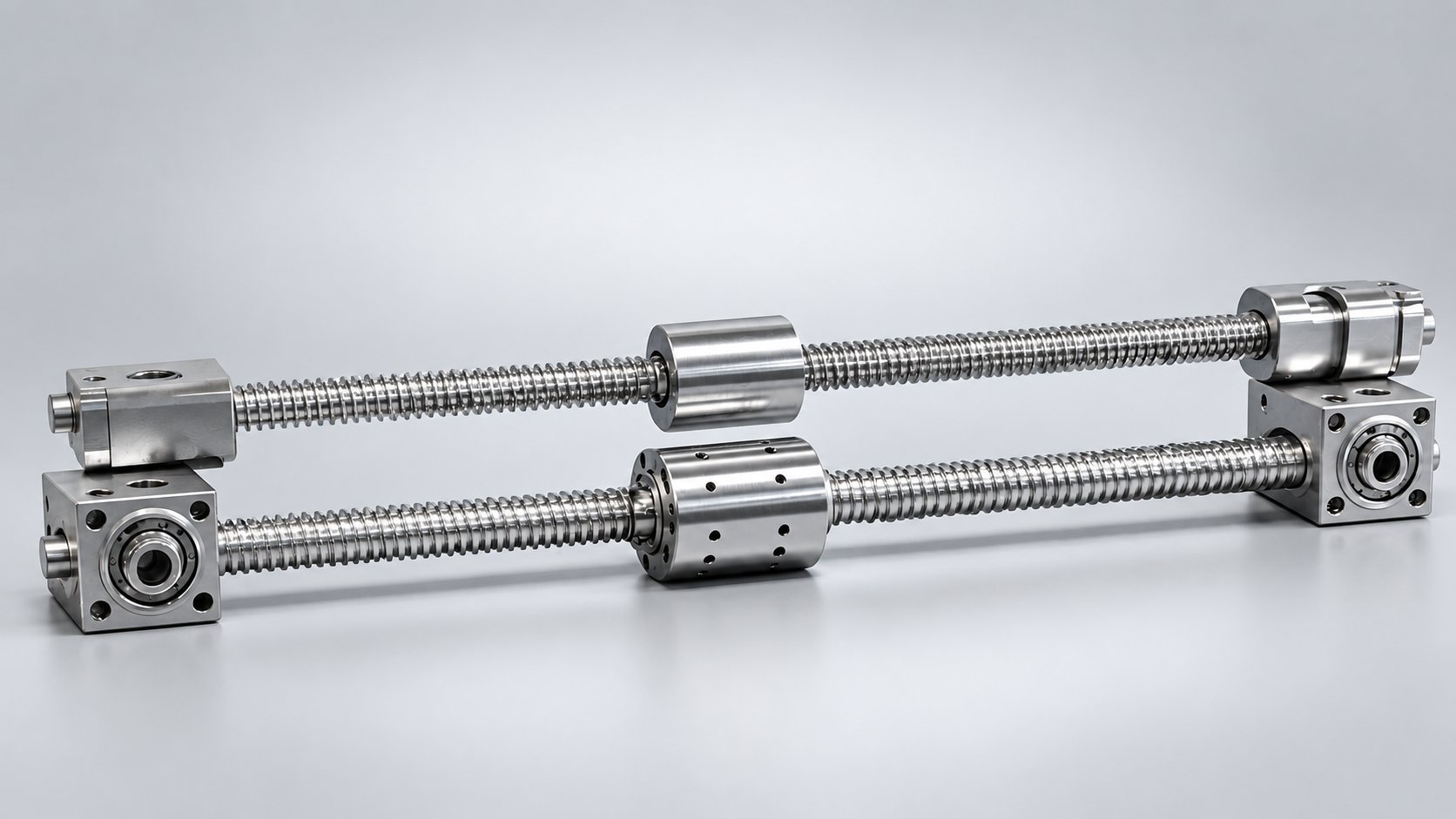
A ball screw assembly is more than a shaft and a nut. This guide walks through the screw shaft, ball nut, recirculation system, wipers and seals, and end supports, and explains which parts must be specified together so your RFQ gets a correct, buildable quote.
A ball screw assembly is not a single part you can order by one number. It is a matched set of components that only works when the screw shaft, ball nut, recirculation system, sealing, and end supports are specified as a system. Buyers who treat it as one line item on an RFQ often receive a quote that cannot be built, or a delivered set that fits poorly on the machine. This guide explains what each component does and which parts must be quoted together.
Key takeaways
- A ball screw assembly has five functional groups: screw shaft, ball nut, recirculation system, wipers and seals, and end supports.
- Nut and shaft are matched by internal geometry, not just by nominal size. They should be quoted as a pair.
- Recirculation type, seal grade, and bearing arrangement are separate choices that affect fit and service life.
- A complete RFQ lists mounting dimensions, load and speed direction, environment, and lubrication intent — not only diameter and lead.
What a ball screw assembly actually contains
In a ball screw, load travels between the screw shaft and the nut through recirculating balls rather than through sliding contact. That is the core difference from a lead screw or ACME screw, and it is why the components must be matched more tightly. The assembly is usually described as five groups:
- Screw shaft — the threaded shaft that carries the rolling groove along its length, with machined ends for bearings and coupling.
- Ball nut — the nut body that houses the ball track and returns the balls to the start of the circuit.
- Recirculation system — the internal or external return path (end cap, deflector, or tube) that keeps the ball circuit closed.
- Wipers and seals — the end seals that keep contaminants out of the ball track and retain lubricant.
- End supports — the bearing blocks and housings that locate the shaft and take axial and radial load.
Each group is a separate purchasing decision, but only some of them can be changed independently after the fact. The rest must be fixed at the quotation stage.
The screw shaft: more than a diameter and a lead
Buyers usually start with diameter and lead, and those are necessary. They are not sufficient. The shaft drawing also defines:
- Overall length and the position of the threaded section relative to the machined ends.
- End journal dimensions for the support bearings, including shoulder positions and thread for locknuts.
- Coupling or drive-end geometry, keyway or clamping surface.
- Straightness and surface condition requirements, which affect how the nut travels along the length.
Two shafts with the same nominal diameter and lead can be non-interchangeable if the end machining differs. When the shaft is quoted without a matching nut, the supplier cannot verify the internal fit, and the buyer carries the risk of a returned or scrapped part.
The ball nut: matched to the shaft, not sold separately
The ball nut is where most mismatch problems appear. The nut's internal groove, ball size, and circuit length are designed against a specific shaft. A nut from one supplier generally will not run correctly on a shaft from another, even when the catalog numbers look equivalent.
When specifying the nut, confirm:
- Nut type and shape — cylindrical, flanged, or block style — and how it mounts to the carriage.
- Flange hole pattern and pilot dimensions, which determine whether the nut bolts to the existing bracket.
- Preload class and how it is achieved, since this affects stiffness and drag torque.
- Whether the nut is supplied with the shaft as a matched set, and whether the set is serialized.
From a manufacturing standpoint, preload and ball selection are set during assembly. If the buyer later asks to change preload, the nut may need to be rebuilt rather than adjusted in place. That is a quotation-stage decision, not a field adjustment.
Recirculation: internal, external, and why it changes the envelope
The recirculation system returns balls from the end of the load zone to the beginning. Three common arrangements behave differently in practice:
| Type | How it returns balls | What it means for the buyer |
|---|---|---|
| End cap | Return channel built into caps at each end of the nut | Compact nut profile; caps add to nut length and must clear the mounting bracket |
| Internal deflector | Deflector lifts balls over the groove inside the nut body | Short nut, but the deflector is sensitive to contamination |
| External tube | Tube on the outside of the nut carries balls back | Simple to inspect, but the tube adds radial height and can interfere with guarding |
The recirculation type is not a free upgrade later. It changes the nut's outside dimensions, which changes whether the nut fits the machine envelope and whether the wiper can be fitted. Specify it at the RFQ stage, or confirm with the supplier which type is standard for the nut you are quoting.
Wipers and seals: the parts buyers forget until the first failure
Wipers and seals sit at the ends of the nut and are the assembly's first line of defense against chips, dust, and coolant. They also retain grease or oil in the ball track. Because they are wear items, they are often the first components to be replaced — which means the buyer needs to know they are replaceable and available.
Questions worth settling before ordering:
- What is the operating environment — machining chips, fine dust, washdown, or cleanroom?
- Is a standard wiper sufficient, or is a reinforced or double seal needed?
- Are seals supplied pre-installed, and can replacement seals be ordered separately?
A seal that is too aggressive adds drag and heat; one that is too light lets contamination into the ball circuit. The right choice depends on the environment, not on the catalog default. Confirm with the supplier which seal grade is standard and which is optional.
End supports: the interface between the screw and the machine
End supports locate the shaft and carry the axial load the screw generates. They are usually quoted as a pair — a fixed side and a supported side — and their bearing arrangement determines how the shaft is constrained.
- Fixed side takes axial load in both directions and typically uses an angular contact or paired bearing arrangement.
- Supported side allows the shaft to accommodate thermal growth and typically uses a radial bearing.
- Housing dimensions — bolt pattern, height, and bore — must match the machine bed and the shaft end journals.
End supports are frequently ordered separately from the screw and nut, which is fine as long as the shaft end machining is specified to match the chosen bearings. If the shaft ends are machined for one bearing series and the buyer supplies another, the assembly will not go together. This is one of the most common causes of a stalled installation.
Which parts must be specified together
The practical rule is simple: anything that shares a fit or a load path should be quoted together. That means:
- Shaft and nut — always as a matched set.
- Nut and recirculation type — because the return system changes the nut envelope.
- Nut and seals — because seal retention is part of the nut end geometry.
- Shaft ends and end supports — because the journal machining must match the bearing bore and locknut thread.
Parts that can be quoted separately, provided the interfaces are fixed: lubrication fittings, mounting brackets that are not part of the nut, and spare seals.
What mismatches cause in practice
Mismatches rarely announce themselves as a single obvious failure. More often they show up as:
- A nut that binds or runs rough because it was paired with a shaft from a different production batch or supplier.
- Premature contamination failure because the seal grade did not match the environment.
- An installation that cannot be assembled because the shaft end journals do not match the supplied bearings.
- Reduced stiffness or unexpected backlash because preload was chosen without matching the application's load direction.
Each of these is avoidable at the quotation stage. None of them is reliably fixable by adjusting the machine after delivery.
How to write a complete ball screw assembly RFQ
A complete RFQ lets the supplier quote a buildable set instead of guessing. Include:
- Machine or axis description and what the screw moves.
- Shaft diameter, lead, and overall length, plus a drawing if available.
- Nut type, mounting flange pattern, and required preload class.
- Recirculation preference, or a request for the supplier's standard.
- Operating environment and required seal grade.
- End support type and the shaft end machining that goes with it.
- Lubrication intent — grease or oil — and whether fittings are required.
- Quantity, and whether spare seals or a spare nut are needed.
If some of these are unknown, say so and ask the supplier to confirm the standard configuration. That is faster than quoting an incomplete set and discovering the gap at assembly.
Frequently asked questions
Can I buy a ball nut separately from the screw shaft?
In most cases the nut and shaft are matched by internal geometry and should be ordered as a set. If you need a replacement nut, provide the original screw's identification or drawing so the supplier can match it. Confirm with your supplier whether a standalone nut can be supplied for your specific screw.
Does the recirculation type affect the nut's outside dimensions?
Yes. End cap, internal deflector, and external tube designs differ in nut length and radial height, which affects whether the nut fits the machine envelope and whether seals can be fitted. Specify the type, or confirm the standard, before ordering.
Why do end supports need to be quoted with the shaft?
The shaft end journals are machined to match the support bearings and locknut. If the bearings and shaft ends are specified separately and do not match, the assembly cannot be installed without re-machining. Quoting them together keeps the interface consistent.
What information is most often missing from an RFQ?
Environment and seal grade, end support type, and the shaft end machining. These are the items that most often cause a quote to come back with assumptions the buyer did not intend.
Next step
If you are preparing an RFQ for a ball screw assembly, start from the interface list above and mark anything you cannot answer. Send that list to your supplier and ask which items are standard and which are options. A short exchange at the quotation stage is far cheaper than a returned set or a stalled installation.
This article describes general ball screw assembly principles. Specific dimensions, preload classes, seal grades, and bearing arrangements vary by application and must be confirmed with your supplier against the actual machine drawing.