
A lead screw is a plain-thread screw paired with a sliding nut, not a precision ball screw. This guide explains the trapezoidal thread geometry, how the mechanism travels, why self-locking and quietness make it the right choice for many vertical and low-speed axes, and where sliding friction makes a ball screw the better call.
A lead screw looks simple because it is: a threaded shaft and a nut that slides along it. That simplicity is exactly why it still wins a large share of linear axes in automation equipment. This guide covers what a lead screw is, how a trapezoidal thread drive actually moves a load, and the point in a design review where a ball screw becomes the better answer.
Key takeaways
- A lead screw is a sliding (plain) screw drive: a trapezoidal thread shaft rotating inside a nut with matching internal threads.
- Motion comes from thread engagement — one full turn advances the nut by one lead, regardless of thread starts.
- Its advantages are self-locking tendency, quiet running, and low cost; its limits are friction, wear, and heat at speed.
- Lead screws fit low-speed, intermittent, vertical-hold and cost-sensitive axes; ball screws fit continuous, high-duty, high-accuracy axes.
What a lead screw is
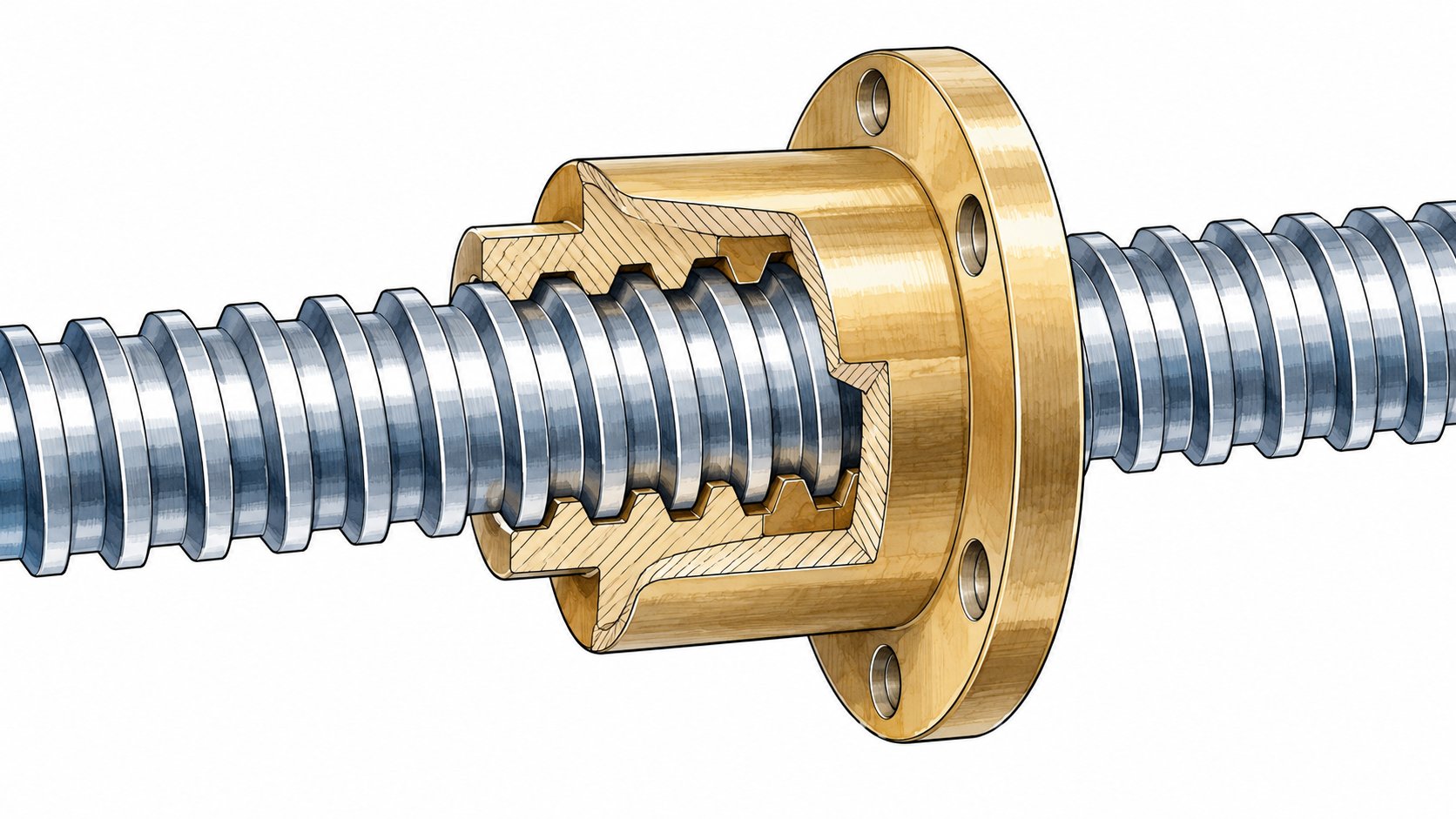
A lead screw is a rotary-to-linear mechanism made of two parts: a screw shaft with a helical thread, and a nut with a matching internal thread. The nut does not roll along the shaft on balls or rollers — it threads onto it and slides. Every rotation of the shaft drags the nut axially along the thread, converting turning motion into straight-line travel.
The same mechanism is sometimes called a power screw, a translation screw, or a trapezoidal screw drive. All three describe the same idea: a sliding contact between two threaded surfaces. A lead screw is used for positioning, lifting, pressing, clamping, and slow feeding — anywhere a load has to move in a straight line at modest speed.
One naming point trips people up early. A lead screw is not a ball screw with a cheaper nut. A ball screw inserts recirculating balls between the shaft and nut so the two never touch, which changes friction, accuracy, and cost entirely. A lead screw keeps metal or polymer threads in direct sliding contact, which changes the same three things in the opposite direction. The two are different families of screw drive, not grades of the same product.
How a lead screw works
The working principle is thread geometry. When the shaft turns one full revolution, the nut advances by exactly one lead. If the thread is single-start, lead and pitch are the same number. If the thread is multi-start, the nut skips past intermediate thread ridges and advances by the combined lead — faster travel per turn, but with a coarser position resolution per revolution.
A typical linear axis built around a lead screw has four parts:
- Screw shaft — the threaded rod, supported at one or both ends in bearings so it can rotate without whipping.
- Nut — the travelling element that threads onto the shaft and carries the load, often flanged for bolting to a carriage.
- Drive — a motor coupled to the shaft, turning it at a controlled number of revolutions.
- Guide — a rail or bearing set that stops the nut from rotating with the shaft, so the rotation becomes straight-line travel.
Two numbers define the travel behavior before any product is chosen. Lead sets how far the nut moves per revolution; the number of thread starts sets whether one turn is a fine or a coarse step. A fine lead gives finer movement per motor step and better mechanical advantage when back-driving a load. A coarse lead gives faster travel at the same motor speed but a larger minimum step. A designer picks the lead from the required travel speed and positioning resolution, not the other way around.
The trapezoidal thread, explained
Most industrial lead screws use a trapezoidal thread profile, often called an Acme thread. Its flanks are angled rather than square, which gives the thread a wider root and a stronger cross-section than a square thread of the same size.
- Angled flanks transmit load over a larger contact area, so pressure per unit area drops and the thread wears more evenly.
- A wide root leaves more material in the shaft, so a given diameter carries load with less risk of thread shear.
- The profile is easy to machine and inspect, which is part of why trapezoidal screws are economical to make in volume.
- The angled flank also contributes to self-locking when the lead angle is small enough relative to friction between the materials.
Nuts come in several materials, and the choice changes service behavior more than most buyers expect:
| Nut material | Typical fit | Practical note |
|---|---|---|
| Bronze or brass | Higher-load, industrial axes | Good load capacity and heat tolerance, needs lubrication |
| Polymer / acetal | Light-load, quiet, dry-running axes | Low noise and no oil film required, but lower load and temperature limits |
| Steel | Heavy pressing or lifting | High strength, higher friction, careful lubrication needed |
The nut material and the shaft surface finish together decide friction, wear rate, and whether the axis can run without lubrication. A polymer nut can run dry and quiet, but it will not carry the load a bronze nut handles at the same size.
Where a lead screw wins
A lead screw is the better default in several recurring design situations.
Vertical axes that must hold position
With a small lead angle and matching friction, a lead screw tends to resist back-driving — the load does not push the nut down the thread on its own. The axis simply stays put when the motor is unpowered. A ball screw has very low friction by design, so a vertical ball screw axis usually needs a brake or counterbalance to hold its position. This self-locking tendency is one of the strongest reasons lead screws are common on lift, adjust, and hold axes.
Quiet, low-speed motion
There are no balls to recirculate and no return path to rattle, so lead screw axes tend to run quietly at low speed. For lab equipment, medical positioning, office-adjacent machinery, and operator-station adjusters, that quietness is a feature, not an afterthought.
Cost-sensitive, intermittent motion
The parts are simpler, the thread is easy to produce, and the nut has no ball return mechanism. That makes lead screw axes economical when the duty is intermittent — set, hold, adjust, feed slowly — rather than continuous. Where the axis moves for a few seconds and then stops, the cost case is typically clear.
Contamination tolerance
Sliding threads are less sensitive to chips, dust, and non-recirculating debris than a ball nut with a return channel. With appropriate sealing and wiping, a lead screw can survive environments where a ball screw would need extra protection.
Where friction and wear bite
The plain-sliding contact that makes a lead screw simple also sets its limits. Sliding friction converts more input torque into heat than rolling contact. Run the nut fast enough and the thread interface heats up; keep going and it wears faster, and in extreme cases the nut material can soften or scuff.
- Speed limit. Continuous high-speed travel is the weak point. Hold the sliding interface within a temperature range the nut material tolerates and the wear rate stays reasonable.
- Wear over time. Sliding contact removes material slowly, so backlash grows and positioning accuracy drifts. A worn nut can often be re-tensioned or replaced.
- Positioning accuracy. A lead screw can hold a position accurately when the nut is adjusted and the axis is slow, but it does not match a preloaded ball screw for fine, repeatable bidirectional motion.
- Efficiency. Sliding threads need more input torque for the same thrust than a rolling screw. That shows up in motor sizing and, on high-duty axes, in energy use.
None of these make a lead screw a poor product. They define the envelope: low speed, intermittent duty, moderate accuracy, hold-and-adjust motion.
Lead screw or ball screw: a decision rule
The two families answer different questions. Use the table below as a starting filter, then confirm the specific numbers with the supplier for the axis you are designing.
| Requirement | Lead screw | Ball screw |
|---|---|---|
| Axis orientation / holding | Self-locking tendency; often holds without a brake | Low friction; usually needs a brake or counterbalance |
| Duty cycle | Intermittent, set-and-hold | Continuous, high-cycle production motion |
| Speed | Low to moderate | High |
| Positioning accuracy | Moderate, resolvable with proper nut adjustment | High and repeatable, especially preloaded |
| Noise | Quiet at low speed | More running noise from ball recirculation |
| Input torque / efficiency | Higher torque needed, sliding contact | Lower torque, rolling contact |
| Contamination tolerance | More forgiving of debris | Needs seals and clean lubrication |
| Cost of a simple axis | Lower | Higher |
The decision rule: if the axis is slow, intermittent, and needs to hold or adjust with modest accuracy at low cost, a lead screw usually wins. If it runs continuously, needs fine repeatable positioning, or must move fast all day, a ball screw is the better answer.
What to put on a specification sheet
When requesting a lead screw for an axis, these items let the supplier propose a workable screw and nut rather than a generic one:
- Required travel length and stroke.
- Lead and number of thread starts (or the travel per revolution you need).
- Screw diameter and thread standard.
- Load and direction — thrust, lift, side load.
- Speed and duty cycle — how often it moves and how long each move is.
- Nut material and lubrication environment (dry, oiled, contaminated).
- End-support method and coupling details.
- Mounting interface for the nut and the guide rail.
Lead, diameter, and duty cycle usually determine the rest. Where a value is not yet fixed, state the requirement it must meet rather than leaving it blank — that gives the supplier room to match the screw to the axis instead of quoting a catalog item.
FAQ
Is a lead screw the same as a threaded rod?
A lead screw is a threaded shaft made to a defined geometry for power transmission, paired with a matching nut. A general-purpose threaded rod uses a fastening thread profile. The two diverge in thread shape, fit, and how precisely the nut travels, so a hardware-store threaded rod is not a substitute for a lead screw in a positioning axis.
What does a lead screw do that a ball screw cannot?
It tends to self-lock, runs quietly at low speed, tolerates debris more readily, and costs less for simple axes. Those properties come from the sliding thread contact, which is exactly what a ball screw replaces with rolling elements.
Can a lead screw run without lubrication?
With a polymer nut, yes, dry running is possible within that material's speed and load limits. Metal nuts generally need lubrication to control friction and wear. The allowable combination depends on the nut material and the load, so confirm it for the specific assembly.
How do I reduce wear on a lead screw axis?
Keep running speed and duty within the screw and nut's rating, maintain lubrication where required, wipe the shaft before the nut passes over it, and check backlash periodically so a worn nut can be adjusted or replaced before it affects positioning.
Can a lead screw hold a load without a brake?
Often yes, when the lead angle is small enough relative to thread friction. Whether a specific lead screw self-locks depends on its lead, diameter, and nut material, so treat self-locking as a property to confirm for the chosen combination rather than a fixed characteristic of every lead screw.
If you are specifying a screw drive for an axis and want to compare a trapezoidal lead screw against a ball screw option, describe your stroke, load, speed, and duty cycle and we can discuss the fit.