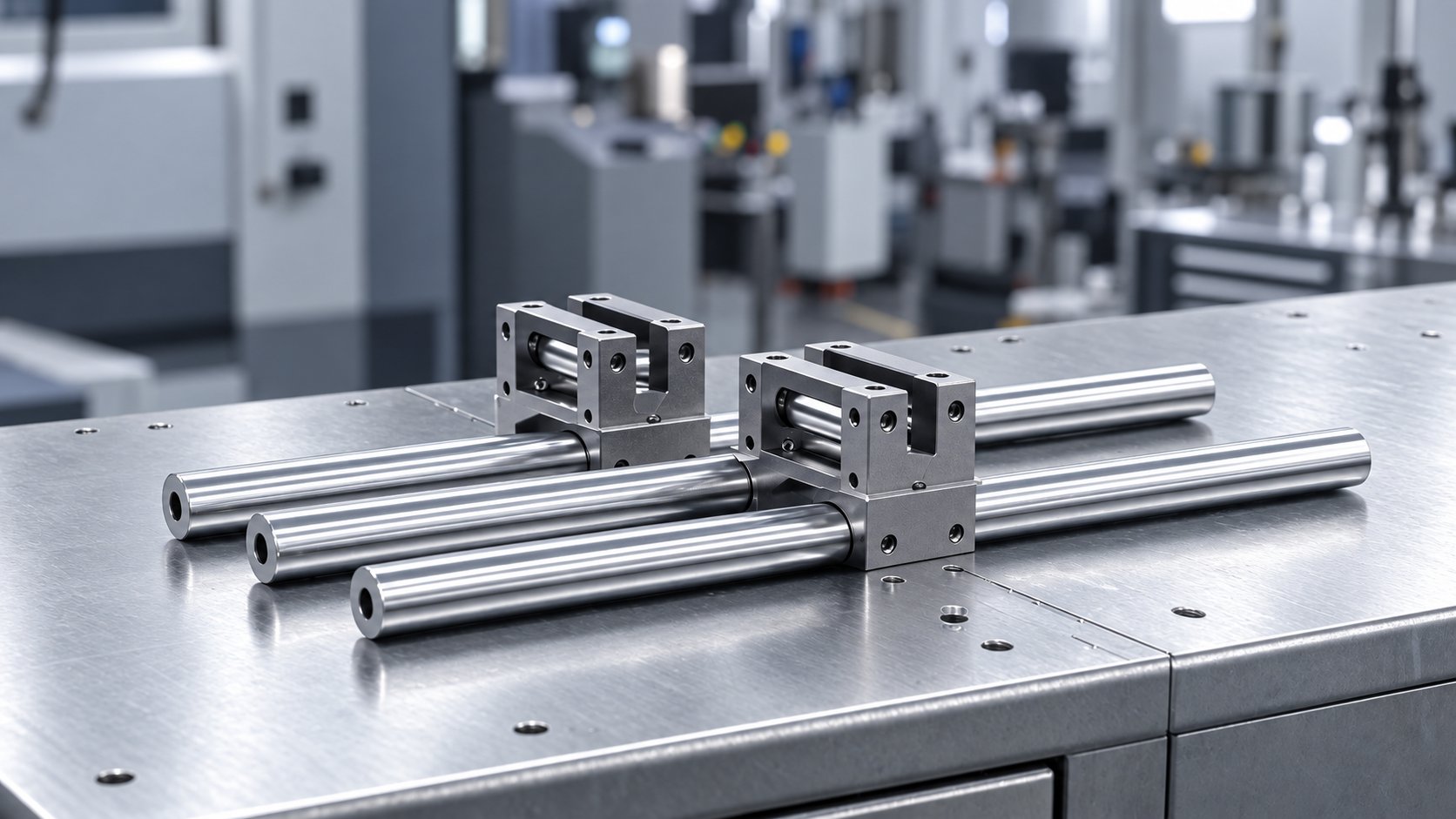
A linear shaft is a hardened, ground round rail that works with linear ball bearings. This guide defines the shaft, explains how the shaft-and-bearing pair works, and gives an honest comparison with profile rail systems so you can choose the right guiding system before you request a quote.
Buyers searching for a linear shaft are usually trying to answer one question: is this a round rail that runs with a bearing, or is it the same thing as a linear rail? They are not the same, and mixing them up leads to wrong quotes and wrong designs. This article defines the linear shaft, explains how it pairs with linear bearings, and gives a straight comparison of shaft-and-bearing versus profile rail systems.
In this article
What a linear shaft actually is
A linear shaft, also called a linear motion shaft or round rail, is a cylindrical steel bar used as the running track in a linear motion system. It is not a structural profile and it is not a rail with a machined groove. Its defining features are the ones that make it work as a bearing raceway:
- Round cross-section. The shaft is a cylinder, so a bearing can travel along it and, in many designs, rotate around it.
- Hardened surface. The outer layer is heat treated so the rolling elements of the bearing run on a surface hard enough to resist indentation and wear. Hardness is a selection parameter, not a marketing claim, and it should be stated by the supplier for the specific shaft.
- Ground and polished finish. The running surface is ground to a fine finish and controlled roundness, because the bearing balls contact it directly. Surface roughness and roundness affect running smoothness and bearing life.
- Straightness. A shaft that is not straight will cause binding, noise, and uneven wear. Straightness tolerance is normally specified per unit length.
- End machining. Shafts are commonly supplied with tapped ends, threaded ends, or machined steps so they can be mounted to a frame or supported at both ends.
In short, the linear shaft is the track. It does not move the load by itself and it does not contain the rolling elements. The bearing does that. This is the key point that separates a shaft from a linear rail.
How a shaft and linear bearing work together
A linear ball bearing is a sleeve that slides over the shaft. Inside the sleeve, balls circulate in a cage or return channel. As the bearing moves, the balls roll along the hardened shaft surface, and the load is carried through the balls from the housing to the shaft. The result is low-friction linear motion with the shaft acting as the raceway.
Because the bearing wraps around the shaft, the pair can carry loads in different directions depending on how the shaft is oriented and how many bearings are used. A single bearing on a single shaft allows rotation as well as linear travel. Two shafts used in parallel, with the bearings fixed to a common carriage, prevent rotation and guide the carriage in one direction. This is the classic round-rail configuration.
The practical consequence for buyers is that the shaft and the bearing are a matched pair. You cannot select one without the other, and the fit between them decides how the system feels and how long it lasts.
Matching shaft to bearing: the principles
Matching is not about picking a part number from a catalog and hoping it fits. It is about four relationships. The exact values depend on the bearing series and the application, so treat the following as the principles to confirm with your supplier rather than fixed numbers.
Shaft hardness and the running surface
The bearing balls are hard. If the shaft surface is softer than the balls, the balls will dent the raceway and the system will develop play and noise. The shaft must therefore be hardened to a level appropriate for the bearing series. A shaft that is only case hardened to a shallow depth can wear through that layer in a heavily loaded or long-travel application. Ask what hardness and what hardening depth are specified, and whether they are stated for the actual shaft you are quoting, not for the product family in general.
Surface finish and roundness
Bearing life and running smoothness depend on the finish of the running surface. A ground and polished surface gives the balls a consistent track. A rough or out-of-round shaft increases friction, generates heat, and shortens bearing life. Surface finish and roundness are measurable characteristics; a supplier who cannot state them for the shaft is a risk.
Diameter and fit
The bearing bore and the shaft diameter must match within the bearing's tolerance. Too loose and the bearing rocks on the shaft; too tight and it binds or cannot be installed without damage. Shaft diameter tolerance, roundness, and straightness all contribute to the actual fit. When a customer reports a bearing that "fits but runs rough," the cause is often shaft straightness or roundness rather than the nominal diameter.
Load direction and number of bearings
A linear ball bearing carries load in the direction it is loaded, and its capacity depends on how the load is distributed across the ball rows. Using a single bearing in a moment-loading situation puts the load on a small contact area. Spacing two bearings on the same shaft, or using two shafts in parallel, changes the load path. Matching therefore includes deciding how many bearings carry the load and how far apart they are.
Shaft support and deflection
A round shaft is a beam. Under load it deflects, and the amount of deflection depends on the span between supports, the shaft diameter, and the load. This is the single most common reason a shaft-and-bearing system underperforms: the shaft was selected for diameter but not for span.
There are two general approaches:
- End-supported shaft. The shaft is fixed at both ends to a frame. Deflection is lowest, but the span is fixed by the machine structure.
- Continuously supported shaft. The shaft is mounted along its length on a support rail or support blocks. This reduces deflection and allows longer travel, at the cost of additional mounting hardware and alignment work.
For long travel or heavy loads, continuous support is usually the practical choice. For short travel and light loads, end support may be enough. The decision should be made with the deflection limit the application can tolerate, not by habit.
Linear shaft versus linear rail: an honest comparison
This is where most buyer confusion sits. A linear shaft is a round bar with a separate bearing that wraps around it. A profile rail, often called a linear guide rail, is a machined profile with a groove or raceway, and its carriage is a matched block that rides inside that profile. They solve the same problem, but with different mechanics and different trade-offs.
| Consideration | Round shaft with linear bearing | Profile rail with carriage block |
|---|---|---|
| Load capacity in a given envelope | Lower for the same footprint; load capacity depends on shaft diameter and number of bearings | Higher, because the profile and carriage are designed together as a compact unit |
| Moment and torsional stiffness | Lower on a single shaft; requires two shafts or widely spaced bearings to resist moment | Higher; a single rail and block can carry moment loads |
| Alignment and installation | Forgiving in some ways, but two parallel shafts must be aligned; round shafts can be adjusted in their supports | Requires a flat, straight mounting surface; alignment errors show up as binding |
| Travel length | Can be long with continuous support; without support, deflection limits span | Can be long; rail joints and mounting flatness become the limiting factors |
| Contamination and environment | Round shafts are easier to wipe and shield in some dirty environments; bearings can be specified with seals | Carriage seals protect the raceway, but the profile can trap debris if not sealed |
| Cost and availability | Generally lower cost for simple, light-duty axes; shafts and bearings are widely available | Higher cost per axis, but often fewer parts and less assembly labor |
| Rotational freedom | Possible with a single shaft and bearing, which can be an advantage or a problem | Not available; the carriage is constrained |
Neither column is "better." The right choice depends on the axis, the load, the stiffness required, and the environment.
Selection boundaries: when to choose which
From a manufacturer's experience, the decision usually falls into a few recognizable situations.
Choose a shaft-and-bearing system when:
- The axis is light to moderate duty, and the load can be carried by one or two shafts.
- You need rotational freedom at the guide, or you want to build a simple, adjustable axis.
- The environment is dirty or washdown-prone, and a round shaft is easier to clean or shield.
- Travel is long but the load is light, and continuous shaft support can be used.
- Budget and lead time favor standard round rail components.
Choose a profile rail system when:
- The load is heavy, or the axis must resist moment and torsional loads.
- Stiffness and positioning accuracy are the primary requirements.
- The machine structure can provide a flat, straight mounting surface.
- You want a compact, pre-matched rail-and-carriage unit with defined load ratings.
- The axis is part of a precision positioning system where deflection is not acceptable.
A common mistake is to specify a round shaft for a heavy, moment-loaded axis because the shaft is cheaper, then add supports and larger bearings until the assembly is more expensive and harder to align than a profile rail would have been. The reverse mistake is to specify a profile rail for a simple, light, adjustable axis where a round shaft would have been faster to build. The boundary is set by load, stiffness, and environment, not by habit.
Before you request a quote
Have these answers ready. They determine whether a shaft-and-bearing system is suitable at all, and they let a supplier quote the correct shaft and bearing rather than a generic one.
- Axis orientation (horizontal, vertical, inclined) and travel length.
- Load and where it acts relative to the bearings.
- Required stiffness or maximum acceptable deflection.
- Environment: dust, chips, moisture, washdown, temperature.
- Whether rotation at the guide is wanted or must be prevented.
- Mounting method: end support or continuous support.
FAQ
Is a linear shaft the same as a linear rail?
No. A linear shaft is a round, hardened, ground bar. A linear rail is a profile with a machined raceway and a matched carriage block. They use different bearings and have different load and stiffness behavior.
Can any linear bearing run on any linear shaft?
No. The bearing is designed for a shaft diameter, hardness, and surface condition. A bearing that fits the nominal diameter can still run poorly if the shaft is too soft, out of round, or not straight. Confirm the shaft specifications against the bearing series.
Why does my shaft-and-bearing axis feel rough or bind?
Common causes are shaft straightness, roundness, surface finish, alignment of two parallel shafts, or insufficient shaft support causing deflection under load. Check the shaft first, then the alignment, then the bearing fit.
Do I need one shaft or two?
One shaft allows rotation and carries limited moment. Two parallel shafts, with the bearings fixed to a common carriage, prevent rotation and guide the carriage. The choice depends on whether rotation is acceptable and how much moment the axis must resist.
When is a profile rail the better choice?
When the load is heavy, moment or torsional stiffness is required, the structure can provide a flat mounting surface, and the axis needs compact, pre-matched components. For light, adjustable, or dirty-environment axes, a round shaft with linear bearings is often the simpler choice.
The practical takeaway
A linear shaft is a hardened, ground round rail. It becomes a guiding system only when it is matched with the right linear bearing, supported so it does not deflect beyond the application's limit, and aligned so the bearing runs freely. The shaft-versus-rail decision is not about which product is more advanced. It is about load, stiffness, environment, and how the axis is built. Get those four clear before you ask for a quote, and the correct guiding system usually becomes obvious.