An electric linear actuator converts motor rotation into straight-line push or pull motion. This guide explains how it works, compares the main construction families — screw-driven, belt-driven and rodless — and gives a qualitative selection frame covering force, stroke, duty cycle, precision and environment, so automation buyers can shortlist the right type before requesting quotations.
An electric linear actuator turns the rotation of a motor into straight-line push or pull motion. That single conversion is what lets a machine lift, press, position, clamp, tilt or feed something along a defined stroke without any compressed air line or hydraulic power pack. Buyers searching for “what is electric actuator” usually need to do two things: understand how the mechanism works, and shortlist the construction type that matches their load, stroke and environment. This article covers both, from the manufacturer side.
- An electric linear actuator is a motor plus a mechanism that converts rotation into linear force and position.
- The three common construction families are screw-driven, belt-driven and rodless — each suits different stroke, speed and load profiles.
- Selection is driven by force, stroke, duty cycle, precision, mounting and environment — not by a single headline number.
- Confirm the application conditions with your supplier before freezing a model.
How an Electric Linear Actuator Works
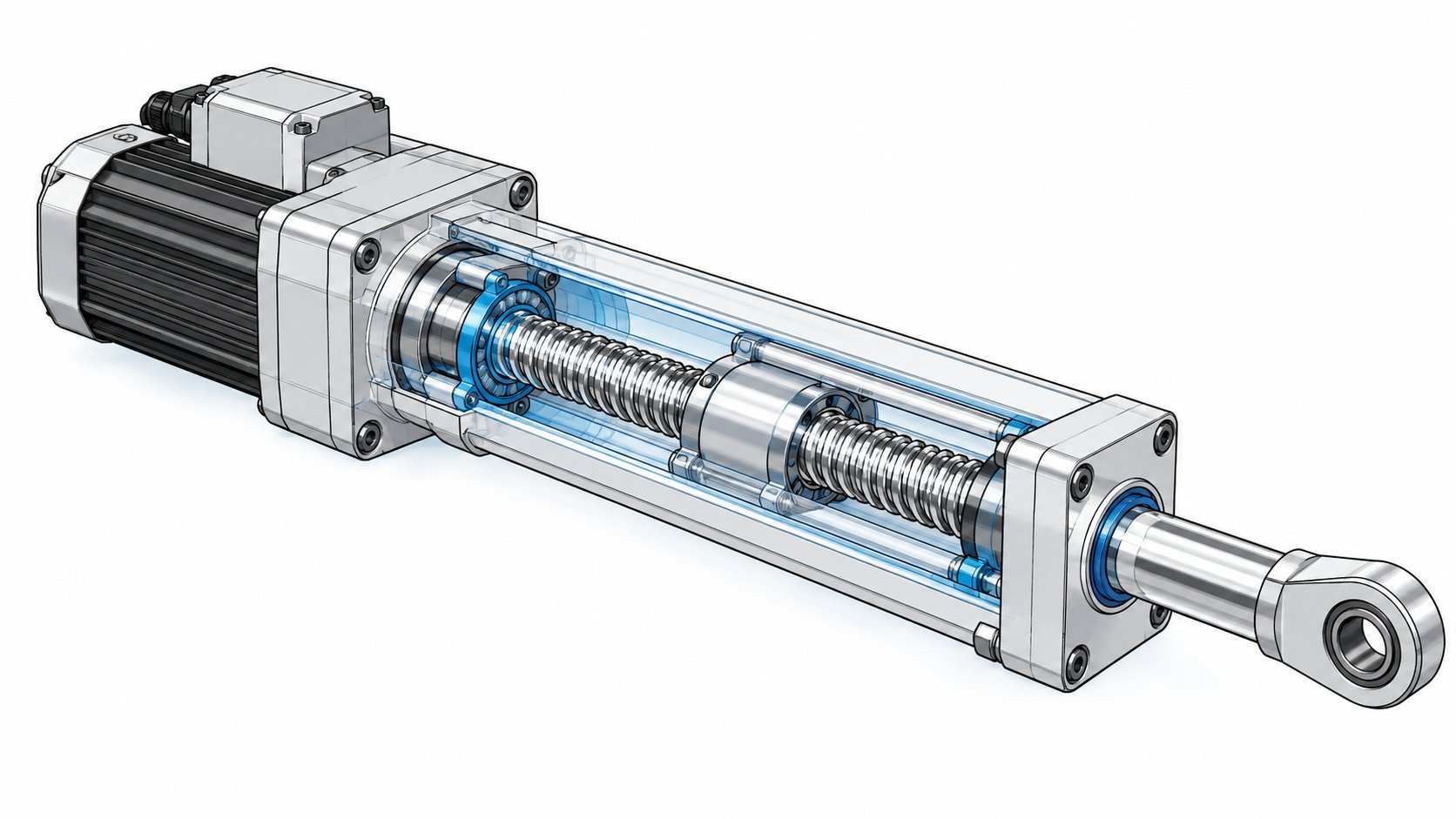
Inside a standard unit you will find four functional stages:
- A motor — usually a DC motor, stepper or servo, selected for the torque and controllability the application needs.
- A reduction stage — gears or a gearbox that trade motor speed for usable output torque.
- A conversion mechanism — a screw (or in some designs a belt) that converts rotary input into linear travel.
- An output element — a rod, carriage or slider that carries the load, plus bearings and guides that keep motion straight.
When the motor turns, the screw rotates and the nut — or the screw itself, depending on the design — travels along the thread, pushing or pulling the output. Reversing the motor reverses the direction. Because the motor is electrically controlled, the actuator can start, stop and hold position from a controller, which is the main reason electric actuation is chosen over pneumatic or hydraulic alternatives in automation equipment: wiring is simpler, motion is programmable, and there is no compressed air or oil to manage.
Electric vs Pneumatic and Hydraulic Actuation
The practical differences matter more than the theory when you are specifying for a machine build:
| Factor | Electric | Pneumatic | Hydraulic |
|---|---|---|---|
| Motion control | Programmable position, speed and force profile | Typically two-position; harder to hold mid-stroke | High force, limited fine positioning |
| Installation | Electrical wiring only | Requires compressor and air lines | Requires power pack, hoses and oil |
| Cleanliness | No air or oil media | Air exhaust and moisture | Leak risk; fluid handling |
| Force density | Moderate to high, depends on screw and motor | Moderate, limited by air pressure | Highest |
Electric actuation is usually the preferred route when the machine needs repeatable positioning, multiple stop points or a clean, quiet enclosure. Pneumatics still win where very fast, simple extend/retract cycles are enough. Hydraulics remain the choice for extremely high force in harsh conditions. The right answer depends on what the actuator must do, not on a default preference.
The Main Types of Electric Linear Actuator
Construction families differ mainly in how rotation is converted to linear motion, and that choice drives stroke, speed and load behaviour.
Screw-driven actuators (ball screw and lead screw)
A rotating screw drives a nut along its thread. Ball screws use recirculating balls between screw and nut; lead screws use direct sliding contact. Screw-driven units are generally the first choice for moderate-to-high force and controlled positioning, and they are common where the actuator must hold position under load or resist back-driving. Lead screws are often used in lighter, cost-sensitive designs; ball screws where efficiency and smooth travel matter more. These designs tend to suit shorter-to-medium strokes and applications where precision positioning is the priority.
Belt-driven actuators
A toothed belt runs between two pulleys, and a carriage attached to the belt travels along a rail. Belt drives favor longer strokes and faster travel, because the belt does not have the critical-speed limits of a long rotating screw. They are widely used for pick-and-place gantries, transfer axes and other tasks where speed and stroke length matter more than resisting heavy push-back force. The trade-off is typically lower thrust capacity and less stiffness than a well-matched screw drive.
Rodless actuators
Rodless designs carry the load on a carriage that rides along the actuator body rather than on a protruding rod. That means the actuator occupies roughly its own stroke length instead of extending as it travels, which is valuable where space is tight. Rodless units can be built around either a screw or a belt, so “rodless” describes the packaging, not the conversion mechanism. They are common in vertical lifts, sliding doors and compact multi-axis setups.
What Each Type Suits
- Screw-driven: pressing, clamping, lifting, positioning; short-to-medium stroke; controlled positioning and holding force.
- Belt-driven: long-stroke transfer, gantry and pick-and-place axes; higher speed with moderate load.
- Rodless: space-constrained mounting, multi-axis gantries, vertical applications where the body must not extend.
Selection Basics: What to Define First
A shortlist is only meaningful once the application is described. These are the factors that decide the type, in the order buyers usually work through them:
Force
Start with the load the actuator must move, the direction of travel and whether any leverage or friction is involved. Force requirements drive the choice between screw and belt, and the motor and gear ratio. A unit rated for a given force should be checked against your actual duty — continuous push, intermittent thrust and holding conditions are not the same.
Stroke length
Stroke sets the mechanical format. Long strokes favour belt drives and rodless designs; short, stiff strokes favour screw drives. Also define retracted and extended dimensions so mounting and clearance can be checked early.
Duty cycle and duty rating
An actuator that runs continuously generates more heat and wears faster than one that moves occasionally. Tell your supplier the real cycle pattern — how often it moves, how long it rests and how much of the time it is under load. This is a qualitative input that changes motor, screw and lubrication choices, and it should never be guessed from a datasheet alone.
Precision and repeatability
How precisely must the carriage or rod return to a position? Positioning requirements lean toward screw drives and closed-loop feedback; less demanding tasks can use simpler arrangements. Define what the process can tolerate, not an arbitrary target.
Mounting and orientation
Horizontal, vertical, cantilevered or side-loaded installations all change the load on the screw, belt and guides. Vertical axes need consideration of back-driving and holding; side loads may call for external guide rails rather than loading the actuator linearly.
Environment
Dust, moisture, washdown, temperature, vibration and available space all affect construction and protection. If the machine operates in a harsh setting, raise it during the quotation stage so the supplier can propose suitable protection and materials.
- Load and direction of motion (including any side load)
- Required stroke and overall mounting space
- Motion profile: how often, how fast, how long
- Positioning accuracy the process actually needs
- Environment and protection requirements
- Control interface and available power
Common Mistakes When Shortlisting
- Choosing by force rating alone. Force, stroke and duty interact; a unit that meets one may not meet the others.
- Ignoring side loads. Loads perpendicular to the axis can damage guides and shorten life if not accounted for.
- Assuming actuators are interchangeable. Screw, belt and rodless designs behave differently, so substituting one for another usually changes the whole motion concept.
- Leaving out environment. Protection and material choices are decided at selection, not after installation.
FAQ
What is the difference between an electric actuator and an electric linear actuator?
An electric actuator is the broad term for any electrically driven device that produces motion, which may include rotary output. An electric linear actuator is the subset that produces straight-line motion.
Do I need a ball screw or a lead screw?
It depends on efficiency, load and positioning needs. Ball screws generally offer smoother, more efficient travel under load; lead screws are common in lighter-duty designs. Your supplier can match the choice to the application once force, stroke and duty are defined.
Can an electric linear actuator replace a pneumatic cylinder?
Often yes, especially where programmable positioning or a cleaner installation is wanted. The decision should be based on the required force, speed, cycle rate and control, not on the actuator name alone.
Can actuators be customised?
Many suppliers offer variations in stroke, mounting and control interface. Confirm the specific options available for your project with the supplier before designing them into a machine.
Next Step
If you are sourcing linear motion components for automation equipment, start with the application conditions above and send them to a manufacturer that builds them. Xiamen Dongfeng Bearing has supplied linear motion components to automation equipment makers since 2014, and can review your force, stroke and duty requirements to recommend a suitable type. Share your motion profile and environment, and we will tell you what to confirm next.
Working on an actuator selection?
Describe your load, stroke, cycle and environment. Our team will review the application and advise on a suitable construction type.