
Standard hardened alloy rail plus seals and wipers handles most dust and debris problems, so the real question is narrower: when does the rail material itself have to change? This article sets out the environments that justify a stainless steel linear rail — washdown, water-miscible coolant, food processing and packaging, and humid coastal or condensing sites — the environments where standard rail with proper sealing is enough, and what stainless changes in cost, available sizes, and compliance documentation.
Most buyers specify seals and wipers when they expect dust, chips, or debris, and that is usually the right first move. But seals protect the bearing from particles — they do not change what the rail is made of. If the environment attacks the rail steel itself, no wiper will stop it. That is the point where the stainless question becomes a real cost decision rather than a specification upgrade.
Short version
- Standard hardened alloy rail + wipers covers dry, dusty, and chip-heavy machining.
- A stainless steel linear rail is justified when water, coolant, cleaning agents, or salt-laden air reach the rail surface repeatedly.
- Food processing and packaging equipment often need stainless for material compliance, not only for corrosion.
- Stainless changes your cost structure and, in some cases, the sizes and compliance documentation available to you.
What stainless actually changes
Rails in the standard MGN range are made from hardened alloy steel with an anti-corrosion surface treatment. That treatment works well in clean, dry, indoor service. It performs less well when it is repeatedly wetted, wiped with cleaning chemicals, or exposed to airborne chlorides.
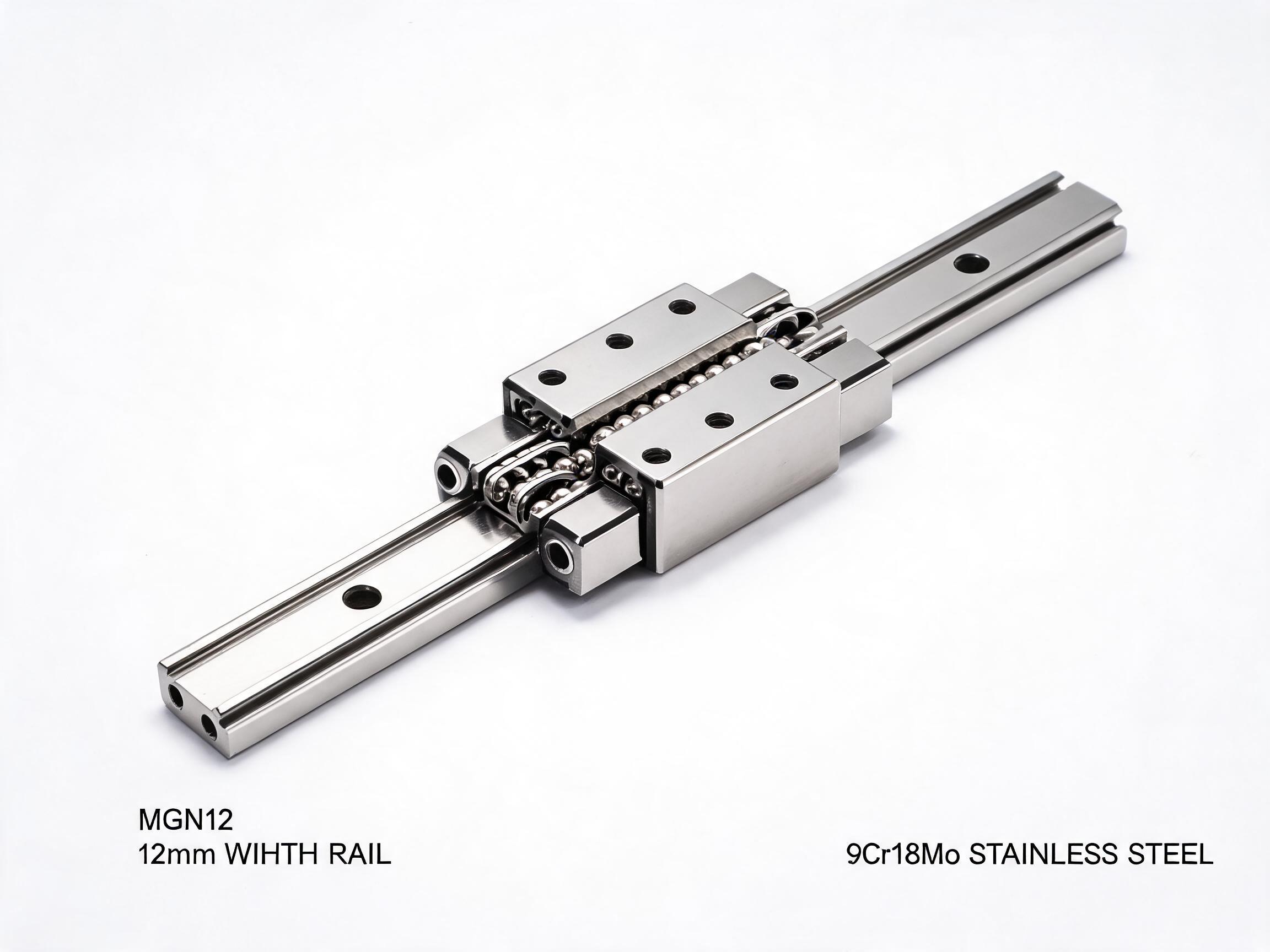
In a stainless steel linear rail, the rail material itself is corrosion resistant. The MGN Series stainless steel miniature linear guide uses a 9Cr18Mo stainless steel rail. Because the resistance comes from the material rather than a coating, there is no plated layer to wear through at the point where the rolling elements contact the raceway — the area where a coating failure would cause the most trouble.
That is the technical core of the argument. Everything else in this article is about working out whether your application needs it.
Environments that justify a stainless steel linear rail
Washdown and frequent cleaning
If the axis is hosed down, steam cleaned, or wiped with alkaline or acidic detergents on a daily or shift-by-shift schedule, the rail surface is wet more often than it is dry. Water sits in the raceway area, cleaning agents strip or slowly attack the surface treatment, and the first visible sign is usually corrosion pitting or staining on the rail rather than a sudden failure. This is the clearest case for stainless.
Coolant exposure on machine tools
Where water-miscible coolant splashes or mists onto a linear axis, the rail sees a continuous film of diluted coolant. Many coolants are mildly alkaline and contain additives that are not friendly to plated surfaces. If a machine runs coolant-heavy operations and the rail is not fully shielded, stainless is worth pricing up front rather than replacing rails later.
Food processing and packaging equipment
Food and beverage lines combine frequent washdown with a second, separate requirement: material compliance. Stainless steel linear bearing variants meet FDA food-grade material requirements for food processing and packaging equipment. If the rail sits in a zone where product contact or incidental contact is possible, or where your customer's own audit expects food-grade materials, the material choice is driven by compliance rather than by corrosion rate.
Humid, coastal, and condensing environments
Humid coastal sites, unheated buildings, and installations that cycle between warm and cold (cold-room exits, outdoor gantries under a roof) produce condensation. Condensation is less aggressive than washdown but more persistent, because it happens every day. If you have seen rust bloom on steel frames, fasteners, or machine beds in the same room, assume the rail will see it too.
Environments where standard rail plus seals is enough
It is equally important to know when you are over-specifying. A stainless upgrade adds material cost to every axis, and in some applications it buys you nothing.
- Dry, climate-controlled assembly and handling. Clean-room and general automation axes that stay dry and are never washed do not need a stainless rail. Seals and wipers handle the particle load.
- Machining without water-based coolant. Dry cutting, minimum-quantity lubrication, and air-blow chip removal keep the rail surface dry. Dust and chips are a wiping problem, not a material problem.
- Occasional splash with drainage. A guard that deflects splashes and lets the rail drain and dry between events is a legitimate alternative to stainless — provided you are prepared to inspect the rail periodically.
- Short-service or prototype equipment. Where the axis will be rebuilt or retired before corrosion becomes visible, the stainless premium is hard to justify.
The existing guidance on Linear Guide Seals and Wipers covers the dust and debris side of this problem. That article and this one answer two different questions: seals protect the bearing, stainless protects the rail.
Side-by-side decision table
| Operating condition | Standard hardened alloy rail + seals | Stainless steel linear rail |
|---|---|---|
| Dry dust, chips, general debris | Appropriate | Not needed for this reason alone |
| Frequent washdown with detergents | High risk of surface attack at the rail | Appropriate |
| Water-miscible coolant splash or mist | Depends on shielding and drainage | Appropriate where exposure is continuous |
| Food processing and packaging zones | Only where material compliance rules allow | Appropriate — meets FDA food-grade material requirements |
| Humid coastal or condensing sites | Acceptable with inspection and some corrosion allowance | Appropriate for long-life assets |
| Climate-controlled, dry automation | Appropriate | Over-specified for most builds |
What stainless changes in cost and options
Buyers often assume the decision is a straight premium on an identical part. In practice, three things shift.
The rail and block cost more. 9Cr18Mo rail material carries a higher material price than standard hardened alloy, and that flows into the rail and the block that runs on it. The premium applies to the whole axis, not just the rail extrusion, so a multi-axis machine multiplies it. Ask for pricing on the complete assembly — rail, block, and any preload or accuracy grade you need — rather than on the rail alone.
Size and configuration choices narrow. Stainless miniature guides are concentrated in the smaller section sizes. In the MGN Series, for example, MGN12 is a 12 mm rail width; stainless variants of miniature profiles like this suit compact actuators, small gantries, and instrument-scale motion. If your design uses a large rail section, confirm which sizes are actually produced in stainless before you commit the drawing.
Compliance documentation becomes part of the package. For food and packaging projects, the useful part of a stainless purchase is not only the material — it is being able to show a buyer or an auditor why the material was chosen. Stainless steel linear bearing variants meet FDA food-grade material requirements, and the range is RoHS and REACH compliant and CE and SGS certified. Material certificates, compliance statements, and OEM/ODM custom material requests should be raised with the supplier at quotation stage, not after the order.
How to make the call
Work through the axis, not the machine:
- Ask how often the rail surface is wet. Daily or per-shift wetting points to stainless. Occasional, draining splashes usually do not.
- Identify what is in the water. Plain condensation is less aggressive than alkaline washdown chemicals or coolant additives.
- Check whether compliance rules apply. In food, beverage, and packaging equipment, material requirements can decide the question on their own.
- Look for existing corrosion evidence nearby. Rust on fasteners, frames, or machine beds in the same room is a reliable indicator of what the rail will face.
- Price the complete axis both ways. Compare the stainless build against a standard build plus a realistic seal arrangement and a replacement or inspection interval you can live with.
If you are still between the two options, the productive next step is to send the operating conditions to the supplier: how often the axis gets wet, with what, the rail section you need, and any food-grade or compliance requirement. That combination is enough to say whether stainless is justified for your design.
FAQ
Can I use a standard rail in a washdown area if I fit better seals?
Seals and wipers keep particles out of the bearing. They do not stop water and cleaning chemicals from reaching the rail surface, and they do not replace a surface treatment. In repeated washdown, the rail is the part at risk, so seals alone do not solve it.
Is stainless rail only for food equipment?
No. Food processing and packaging is the case where compliance drives the decision, but washdown, coolant exposure, and humid coastal environments justify stainless on corrosion grounds alone.
Which stainless miniature sizes are available?
It depends on the series and profile. The MGN Series stainless steel miniature linear guide uses a 9Cr18Mo stainless steel rail, and MGN12 is a 12 mm rail width. Confirm the sizes you need against the supplier's current stainless range before finalizing drawings.