
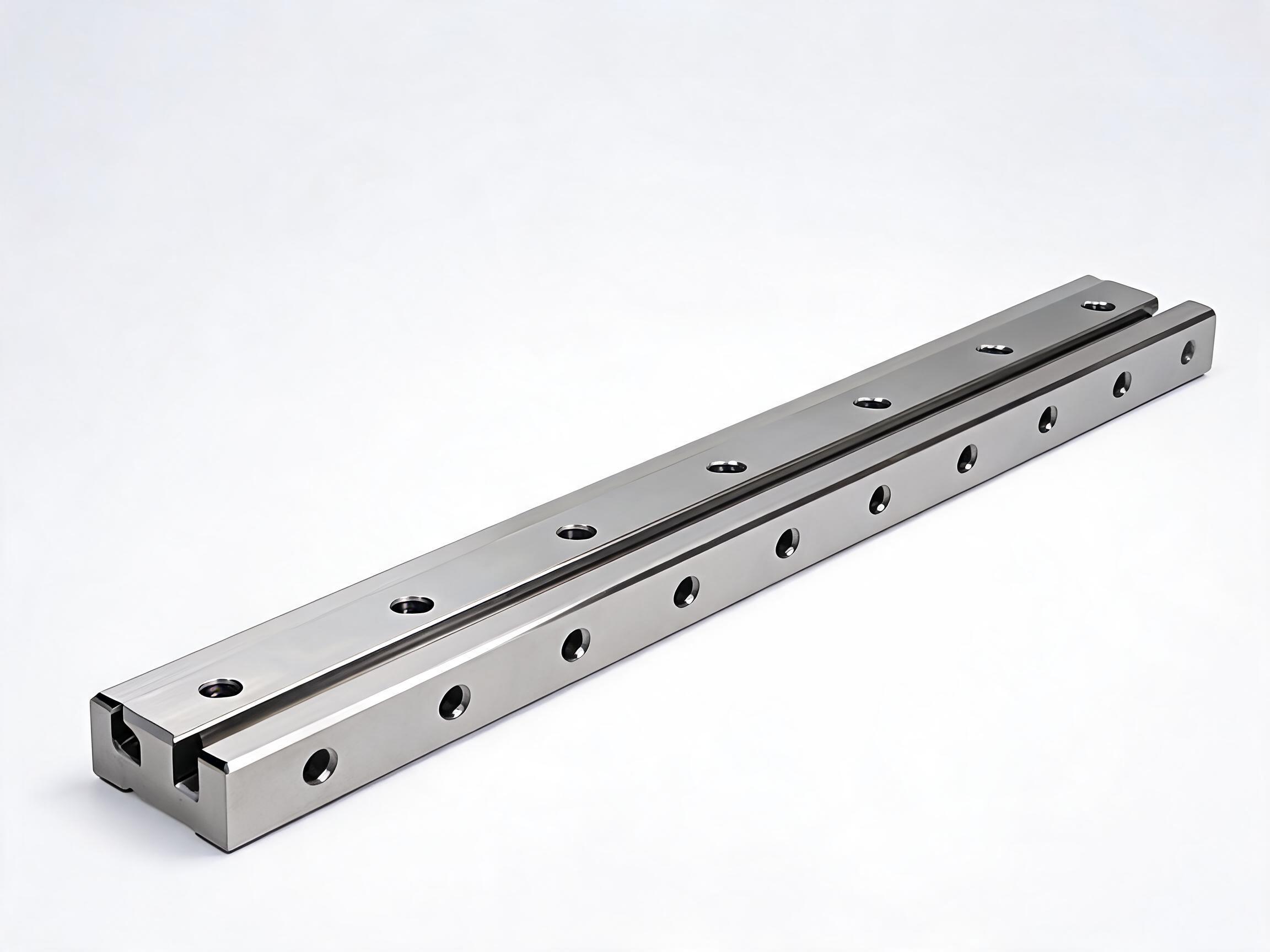
A buyer's decision framework for specifying stainless steel linear bearings by operating environment. Compares 9Cr18Mo martensitic stainless and GCr15 chrome steel on hardness, load ratings and cost, and explains when the corrosion trade-off justifies the lower raceway hardness.
Material Selection Guide
Standard chrome steel linear bearings handle most industrial motion jobs. The question is not whether stainless is stronger — it isn't — but whether the corrosion risk in your application is high enough to justify trading some raceway hardness for corrosion resistance. This article sets out a framework for that decision by environment, using the material properties and load ratings of two common bearing families.
Key takeaways

- Stainless bearings use 9Cr18Mo martensitic stainless (raceway hardness HRC 54–58); standard LM series bearings use GCr15 chrome steel (HRC 60–64 series specification; third-party SGS reports on the covered chrome steel products have read 58–62 HRC — treat the shipment test report as the acceptance reference).
- Lower hardness means lower dynamic and static load ratings — stainless is not a like-for-like load substitute.
- Choose stainless when washdown, humidity, chemical fumes or outdoor exposure would corrode a chrome steel raceway before the bearing reaches its load life.
- Choose chrome steel when the environment is dry and controlled and the highest load capacity per unit size matters.
In this article
Why the material decision matters
Corrosion in a linear bearing rarely announces itself. It starts as surface discoloration in the ball grooves, then progresses to pitting that raises friction and produces rough travel. By the time an operator notices jerky motion, the raceway is already damaged. In food processing, washdown areas, coastal installations and outdoor equipment, this failure mode can arrive long before the bearing reaches its rated load cycles.
Stainless steel addresses that failure mode, but it is not a free upgrade. It changes the material, the raceway hardness, and consequently the load capacity. Buyers who specify stainless without accounting for the load difference can end up with a corrosion-resistant bearing that fails under load. The sections below set out what changes so you can decide whether the trade is acceptable.
Stainless vs chrome steel: what actually changes
The two common constructions differ in steel grade and hardness. The figures below come from the published specifications for each product family. Note that third-party SGS material reports on the chrome steel range have shown 58–62 HRC on the products they covered, while the LM series raceway is specified at 60–64 HRC; the applicable band for your part is the one stated in its datasheet and shipment test report.
| Property | 9Cr18Mo stainless | GCr15 chrome steel |
|---|---|---|
| Material type | Martensitic stainless steel | High-carbon chromium bearing steel |
| Raceway hardness | HRC 54–58 | HRC 60–64 (LM series specification) |
| Corrosion resistance | Resists rust in humid, washdown and mildly chemical environments | Requires dry, controlled environment or protective lubrication |
| Typical product example | MGN Series stainless steel miniature linear guide | LM Series linear ball bearing bush |
The hardness gap of roughly 2–6 HRC points translates into a measurable difference in load rating. For example, the MGN12C stainless steel miniature linear guide carries a dynamic load of 3.7 kN and a static load of 5.4 kN. A published load rating for a chrome-steel equivalent of this model is not available in the current range data, so compare candidate models directly from their datasheets rather than assuming a fixed percentage difference.
Decision framework by environment
Use the environment as the first filter. The table below summarizes where each material typically fits.
| Environment | Corrosion risk | Recommended material | Notes |
|---|---|---|---|
| Washdown / food processing | High — frequent water and cleaning agents | Stainless (9Cr18Mo) | Confirm chemical compatibility with cleaning agents and required IP rating with supplier. |
| Humid coastal or marine | High — salt-laden air | Stainless (9Cr18Mo) | Salt-spray performance depends on grade and passivation; request test data for the specific application. |
| Chemical / fume exposure | Medium to high — depends on chemical | Stainless or coated chrome steel | Check chemical resistance chart; some acids still attack 9Cr18Mo. Confirm with supplier. |
| Outdoor / exposed | Medium — rain and humidity | Stainless if regular wetting; chrome steel if shielded | Consider drainage and lubrication retention. |
| Clean, dry, controlled | Low | Chrome steel (GCr15) | Maximum load capacity per size; typically lower unit cost — confirm by quotation. |
Washdown and food processing
Frequent cleaning with water and detergents is the classic case for stainless. Chrome steel raceways will corrode unless thoroughly dried and relubricated after each wash. Stainless resists this, but verify that the cage material and lubricant also suit the washdown regime. The MGN stainless guide uses a double-row Gothic-arch ball groove, which maintains contact geometry while the 9Cr18Mo surfaces resist rust. For food areas, confirm compliance with relevant food-safety standards with the supplier — the material itself is not a certification.
Humid coastal or marine environments
Salt-laden air accelerates corrosion on unprotected steel. Stainless steel offers better resistance, but salt spray can still attack 9Cr18Mo over time. For coastal installations, specify stainless and plan for periodic inspection. Request salt-spray test data for the exact grade and finish from the supplier; this article does not quote salt-spray hours because they vary by test condition.
Chemical and fume exposure
Chemical environments are more nuanced. 9Cr18Mo resists many mild chemicals but is not immune to strong acids or chlorides. If the bearing will be exposed to specific chemicals, obtain a chemical compatibility chart from the supplier and consider additional protection such as bellows or covers. In some cases, a chrome steel bearing with a protective coating may be more economical.
Outdoor and exposed equipment
Outdoor use ranges from occasional rain to continuous exposure. Stainless is the safer choice when wetting is regular, but if the bearing is shielded from direct water, chrome steel with proper lubrication can suffice. Consider the consequences of failure: if maintenance access is difficult, stainless reduces the risk of a corrosion-induced seizure.
When the hardness trade-off is worth it
Stainless steel linear bearings trade hardness for corrosion resistance. The question is whether your application will see corrosion before it sees load-related fatigue. If the answer is yes, stainless is worth it. If the environment is dry and the bearing will operate under high load, chrome steel remains the better choice.
Consider a simplified example. Suppose an application requires a dynamic load of 3 kN and operates in a washdown area. The MGN12C stainless guide, rated at 3.7 kN dynamic, has sufficient capacity margin once you account for the lower hardness. In a dry, controlled environment with the same load, a chrome steel equivalent would typically offer higher capacity and lower cost. The decision hinges on whether corrosion would reduce the stainless bearing's life below the chrome steel alternative. In washdown, it usually would.
Important: Stainless steel is not a substitute for proper lubrication or maintenance. Even stainless bearings can fail if lubricant is washed away and the bearing runs dry. Always follow the lubrication schedule recommended for the application.
Specifying checklist
When you are ready to specify, use this checklist to gather the information your supplier needs:
- Environment: Describe humidity, washdown frequency, chemicals present, and outdoor exposure.
- Load: Provide dynamic and static load requirements, including shock loads.
- Speed and duty cycle: Continuous or intermittent operation affects lubrication and corrosion risk.
- Mounting and space: Stainless bearings may have different dimensions; confirm interchangeability.
- Certifications and documentation: Request SGS material reports and compliance certificates if needed.
- Lubrication: Specify lubricant type and re-lubrication interval; stainless may require different lubricants.
Xiamen Dongfeng Bearing manufactures both stainless and chrome steel linear motion products. The MGN Series stainless steel miniature linear guide uses 9Cr18Mo martensitic stainless with HRC 54–58 raceway hardness. For standard environments, the LM Series linear ball bearing bush in GCr15 chrome steel offers HRC 60–64 hardness with bores from 6 to 60 mm. Both are available with OEM/ODM customization, and the company is ISO 9001 certified. Stainless construction is also offered for the LM Series on request.
To discuss your application, contact our technical team with your operating conditions and load requirements. We can help you determine whether stainless steel is the right choice, and provide SGS material reports and load ratings for the specific models you are considering.