
Compare buying HGR linear guide rails direct from a manufacturer versus through a distributor, including precision grade, preload, length and splice options, and what to confirm before ordering to avoid fit and lead-time issues.
Linear Motion Sourcing
Buyers searching for where to buy linear rails usually have a specific job in hand: replace a worn guideway on an existing machine, or source rails for a new build with defined travel, load, and mounting geometry. The channel decision — manufacturer direct or distributor — affects what rail lengths you can get, whether end machining and per-SKU minimums are possible, how fast stock arrives, and how much you pay per meter. This article compares the two channels against real HGR rail options and lists the specifications to confirm before any purchase order is issued.
Key Takeaways
- Manufacturer direct suits custom lengths, end machining, and per-SKU MOQ; standard in-stock HGR sizes ship in 7–10 business days.
- Distributors carry fast stock in standard sizes but usually add a margin and may not offer machining.
- Match precision grade (H/P5 or N/P7) and preload to the carriage you already run — grade affects fit and performance, not just price.
- Rails longer than 4000 mm are supplied as spliced sections with the same straightness grade at the joints.
What manufacturer direct gives you
Ordering from the rail manufacturer means the product is cut, drilled, and finished to your drawing rather than picked from a shelf. That matters most when the rail is not a catalog standard length or needs a specific hole pattern.
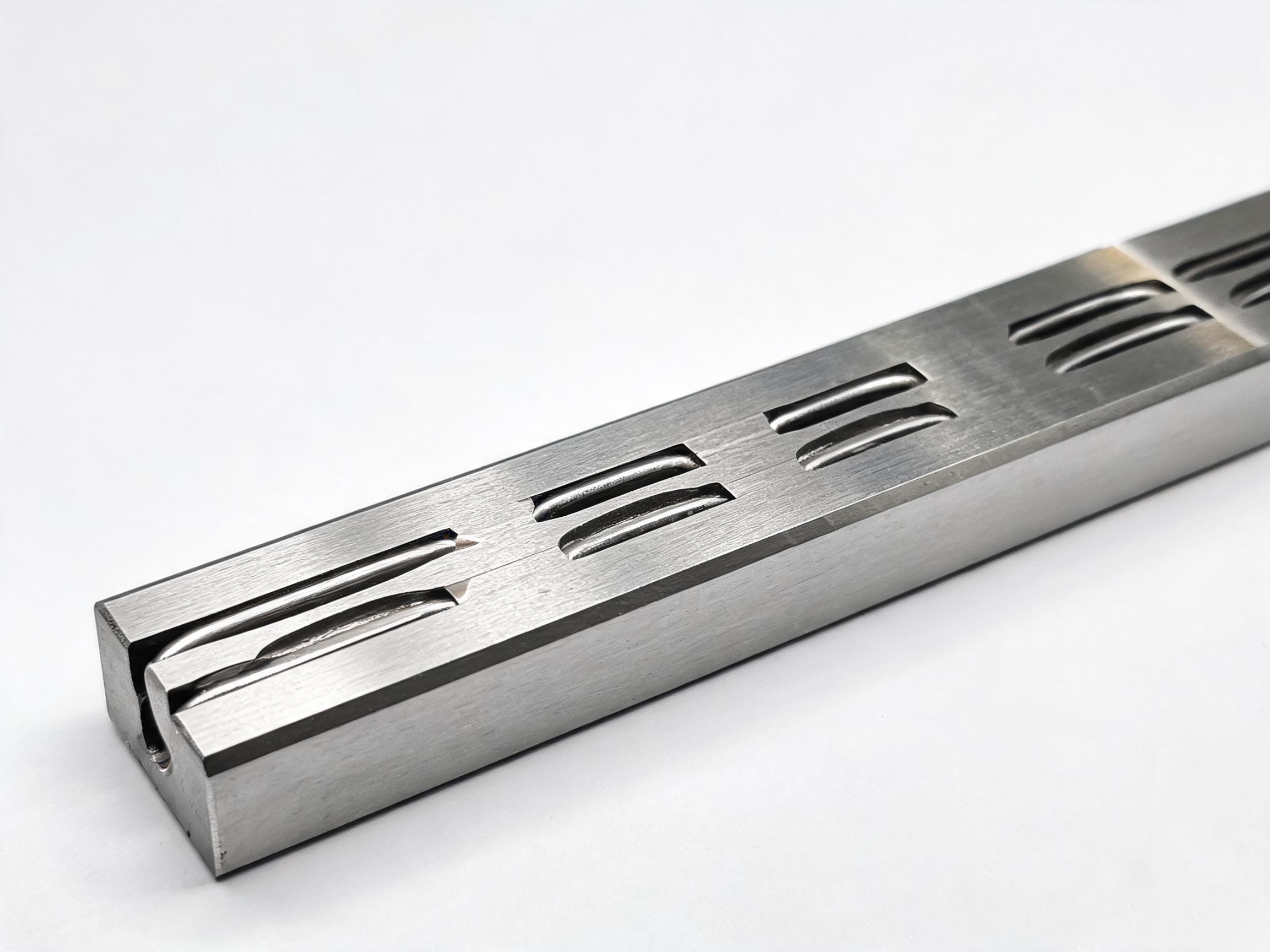
HGR rails come in sizes 15, 20, 25, 30, 35, and 45. Two grades are produced: ground H (P5) and rolled N (P7). The steel is 55# high-carbon steel, induction hardened to a surface hardness of 58–62 HRC. Rails are supplied at standard lengths up to 4000 mm; anything longer is supplied as spliced sections, and the straightness grade is maintained across the joints.
Standard in-stock sizes — HGR20, HGR25, and HGR30 — ship in 7–10 business days. Custom lengths and end machining follow the manufacturer’s cutting and drilling schedule.
The trade-offs are real, and they are the reason this channel is not automatically the right one:
- Custom lengths: available, but priced and scheduled as non-standard cuts.
- End machining: holes can be drilled to your drawing; this is normally not offered by resellers.
- MOQ: applied per SKU, so mixing sizes and lengths in one order may not reduce the minimum on each line item.
- Lead time: longer than same-day shelf stock; 7–10 business days applies to the in-stock sizes, not to every configuration.
For a replacement rail that matches an existing frame, confirm the interchangeability details below before assuming a direct order is the shortest path.
What distributors and marketplaces give you
A distributor’s advantage is inventory. Standard sizes, standard grades, ready to ship. If a machine is down and the replacement is a catalog rail, buying through a distributor often beats waiting on a production slot.
The costs are predictable too:
- Unit price: usually higher than direct, because the distributor carries the stock and the margin.
- Standard sizes only: cut lengths and non-standard hole patterns are rarely available.
- No end machining: what is in the box is what you install.
- Grade mix: you may be offered what is on the shelf rather than the grade your carriage is matched to.
Marketplace listings add a further check: the rail may be described as HGR-compatible, but the actual profile, pitch, and material are not always verifiable from the listing. For OEM builds where several rails must run in parallel, that uncertainty is worth resolving before the order, not after.
Distributors are a good fit when the requirement is a standard length in a standard grade, and speed matters more than unit cost or customization. They are a poor fit when the rail must match an existing hole pattern, needs a specific hardness and grade, or exceeds 4000 mm.
Direct vs distributor at a glance
| Consideration | Manufacturer direct | Distributor / marketplace |
|---|---|---|
| Custom rail lengths | Yes, cut to order | Standard only |
| End machining (drilled ends) | Available to drawing | Normally not available |
| MOQ | Applied per SKU | Often lower or per pack |
| Lead time, standard in-stock sizes | 7–10 business days (HGR20/25/30) | Stock dependent, potentially faster |
| Unit price | Lower at volume | Higher, carries margin |
| Length over 4000 mm | Spliced sections, same straightness grade at joints | Rarely offered |
| Grade and preload choice | Selected at order | Limited to stock |
The table is a starting point, not a rule. A distributor with the exact HGR25 in N (P7) on the shelf can be the fastest correct answer; a manufacturer direct order is the only route when the rail needs machining or a non-standard length.
What to confirm before you order
Most linear rail purchasing problems trace back to a specification that was assumed rather than verified. These are the points to settle with the supplier before the PO is signed:
Size and profile
HGR15, 20, 25, 30, 35, and 45 are distinct profiles. The number is a size designation — measure the existing rail’s cross-section and mounting hole pitch if you are replacing rather than specifying a new build. Bolt-hole pitch and cross-section match the standard Taiwanese HGR profile, so a correctly sized rail drops into an existing frame without adapter plates.
Precision grade: H (P5) vs N (P7)
Ground H (P5) rails and rolled N (P7) rails are not interchangeable in terms of running accuracy. Ordering the wrong grade can mean either paying for precision the machine does not use, or losing the accuracy the carriage was matched to. Confirm the grade first, then the price.
Preload grade
The carriage preload must match the rail grade and the load case. This is a carriage-side specification, but it constrains which rail grade and size you should buy. If you are replacing a rail on an existing carriage, keep the preload of the existing pair.
Length and splice needs
Standard lengths run up to 4000 mm. Longer travel requires spliced sections — the joints hold the same straightness grade as the rest of the rail, but the joint positions still need to be planned relative to carriage travel and support points. Decide splice locations before the order, not during installation.
Interchangeability with existing carriages
HGR rails match the standard Taiwanese HGR profile in bolt-hole pitch and cross-section. If you are replacing one rail on a machine that already runs HGR carriages, the profile match is what lets the new rail accept the existing carriage. Verify the full carriage model before ordering — a rail that fits the frame is not useful if it does not match the carriage block.
- Rail size: HGR15 / 20 / 25 / 30 / 35 / 45
- Grade: H (P5) ground or N (P7) rolled
- Preload: matched to the carriage and load case
- Length: standard up to 4000 mm, or spliced
- Machining: hole pattern and end details, if required
- Existing carriage model for interchange verification
Export packaging
Long rails are vulnerable to bending and edge damage in transit. Confirm how the supplier packs the specific length you order — especially for rails approaching the 4000 mm limit or supplied as spliced sections.
Load capacity check
For sizing, the HGR20 rail is rated at 16.7 kN dynamic and 26.7 kN static. These are the rail figures — the carriage block carries its own load rating, and the machine’s actual load case should be checked against both.
Interchangeability and replacement sourcing
Two products belong to the same decision:
- The HGR series heavy-duty linear guideway rail — the guideway itself, available in the sizes and grades above.
- The HGH series flange-type linear guideway carriage block — the flange carriage that runs on the HGR profile.
For replacement sourcing, the practical order of operations is: identify the rail size and grade, verify the carriage model, then choose the channel. A distributor may have the rail but not the carriage; a direct order can supply both matched, though the lead time applies.
Where a machine uses multiple rails in parallel, sourcing all of them from one channel reduces the risk of mixing grades or profiles across a single axis.
FAQ
Is manufacturer direct always cheaper?
Unit price is usually lower, but MOQ is applied per SKU and custom lengths and end machining are non-standard items. For a single standard rail, a distributor may land lower once minimums and schedules are considered.
Can I get a rail longer than 4000 mm?
Yes, as spliced sections. The straightness grade is maintained at the joints, and splice positions should be planned around carriage travel and support points.
Will an HGR rail fit my existing carriage?
HGR bolt-hole pitch and cross-section match the standard Taiwanese HGR profile, so the rail accepts matching carriages from that profile family. Confirm the exact carriage model before ordering, particularly if you are replacing only one rail.
What is the difference between H (P5) and N (P7)?
H is a ground grade at P5; N is a rolled grade at P7. They differ in running accuracy and are specified for different applications. Match the grade to the carriage and the machine’s accuracy requirement.
How fast can standard rails ship?
In-stock sizes HGR20, HGR25, and HGR30 ship in 7–10 business days. Other sizes, custom lengths, and machined rails follow a production schedule quoted at order.
Next step
Before requesting a quote, assemble the six items above: rail size, grade, preload, length and splice plan, carriage model, and machining drawing if applicable. A complete specification lets either channel quote accurately and shortens the back-and-forth on a replacement or OEM rail order.