
A side-by-side comparison of box guideways and linear guide rails under identical evaluation conditions—rigidity and damping in interrupted cuts, travel speed and positioning, lubrication and maintenance, rebuild cost and lead time—ending with a by-machine-class recommendation for builders and buyers.
Box guideways and linear guide rails are both called guideways, but they behave differently on the floor. This comparison holds the same conditions on both sides—heavy interrupted cutting, travel and positioning, lubrication practice, rebuild economics—so you can match the guideway to the machine class rather than to a spec sheet slogan.
The short answer: heavy roughing mills and lathes that live in interrupted cuts favor box guideways for their sliding contact damping. Fast travel, predictable positioning and rebuild economics favor linear rails. Many mid-size CNC machines now mix both, and that is often the right call.
The guideway types you will actually be choosing between
The word "guideways" covers several families, and buyers comparing box guideways with linear rails are usually picking between the two dominant ones on modern machine tools. A brief map first, then the decision itself.
- Hydrostatic guideways: a pressurized oil film separates the sliding surfaces, used on high-precision or high-load machines where the oil system is part of the machine design.
- Dovetail and V-flat sliding ways: cast-iron surfaces in direct sliding contact, with or without a friction-reducing liner.
- Box guideways (hard ways): a closed, cast-iron sliding contact geometry that surrounds the slide or saddle on multiple faces. They are scraped and fitted by hand and rebuilt in the same tradition.
- Linear guide rails (profile rails): a hardened steel rail with a recirculating bearing block running on it, mounted and preloaded as a bolt-on assembly.
For the rest of this article, "box guideways" means the cast-iron sliding type and "linear rails" means the profile rail-and-block assembly. Both are judged under the same four conditions below.
Condition 1: Rigidity and damping under heavy interrupted cuts
Interrupted cutting—milling over a keyway, turning a shaft with a gap, roughing a casting with hard and soft spots—injects a periodic shock into the tool and the slide. What matters there is not only stiffness but damping: how quickly the structure absorbs vibration before it reaches the cutting edge.
Box guideways
Cast-iron sliding contact brings the damping that is the main reason heavy roughing machines still use it. The sliding interface and the large, continuous contact area spread load across the whole saddle rather than through a few bearing blocks. The trade-off is friction and wear: the surfaces are in direct contact, so they depend on a maintained oil film, and they are scraped by hand to fit and to restore accuracy.
Linear rails
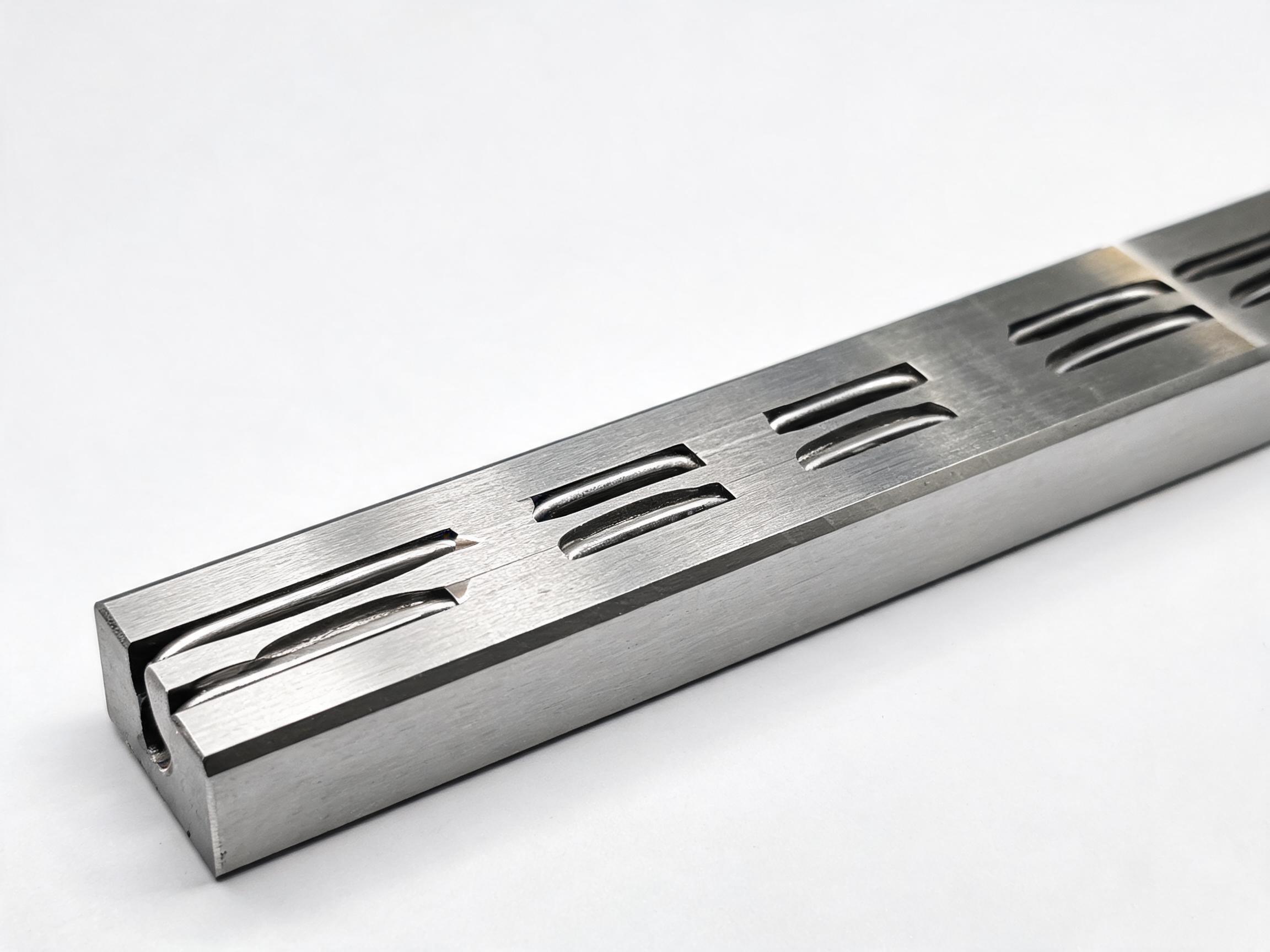
Profile rails carry load through rolling elements. A heavy-duty rail design such as the HGR series—55# high-carbon steel body, raceways induction-hardened to 58-62 HRC, four-row ball contact geometry—is built to take high load in a compact envelope. Sizes run HGR15 to HGR45, with standard length up to 4000 mm and splice joints beyond that. For an idea of capacity, HGR20 is rated 16.7 kN dynamic and 26.7 kN static; the larger HGR45 heavy-duty large linear guideway rail paired with an HGW45CA block is rated 62.8 kN dynamic and 112 kN static. Rolling contact damps less than sliding contact, which is why machine builders mounting rails on heavy roughing spindles pay close attention to frame mass and bolted joint stiffness.
What to compare
- Ask what cuts the machine will actually take, not its maximum spindle rating. A machine that only occasionally interrupts a cut sits differently from one that roughs castings all day.
- On a rail machine, the mounting surface flatness and the block preload carry the vibration story, so they belong in the acceptance check.
- On a box machine, the scraping fit between slide and saddle determines the same thing, so it belongs in the acceptance check just as much.
Condition 2: Travel speed and positioning behavior
This is where the two families diverge most clearly, and where the buyer's process decides.
Linear rails suit fast traverse and rapid positioning. The bearing block runs with low friction and a defined preload, so acceleration and reversal are consistent from one axis to the next, and the rail assembly is easy to mount and preload. For a machine that spends much of its cycle moving between features—drilling patterns, routing, pick-and-place automation—that consistency is the working advantage.
Box guideways are limited by sliding friction and by the oil film that must stay between the surfaces. Travel speed is lower, and stick-slip at low feed is a known characteristic of sliding contact. A heavy roughing machine usually accepts that because its time is spent in the cut, not between cuts.
Buyers comparing machines should put the two speed profiles against their own cycle, not against a catalog maximum. A general-purpose mill that moves as much as it cuts may be better served by rails even when its heaviest cut is moderate.
Condition 3: Maintenance and lubrication practice
Both systems are maintenance items, but the maintenance is different in kind.
| Aspect | Box guideways | Linear rails |
|---|---|---|
| Lubrication | Oil film must be maintained across the full sliding contact; loss of film shows up as wear and accuracy drift. | Blocks carry their own grease or oil supply. Many rails include a continuous oil groove for relubrication, as on the HGR series heavy-duty linear guideway rail. |
| Wear mode | Direct sliding wear; fitted surfaces gradually lose accuracy and are restored by scraping. | Rolling contact in the block; a worn block is replaced rather than refitted. |
| Contamination | Wipers and covers keep chips off the sliding faces; swarf on a way is a real risk. | Blocks rely on seals and wipers; a rail with a damaged seal ingests chips quickly. |
| Skill required | Scraping and fitting are a trade skill; not every shop keeps it in-house. | Rails mount and preload with ordinary mechanical fitting, so maintenance is a bolt-on operation. |
There is nothing hidden in either column. The relevant question is which maintenance routine your shop will actually keep up. A box-way machine with a neglected oil system fails differently from a rail machine with neglected seals, but both fail.
Condition 4: Rebuild, replacement and lead time
This is where purchase price and lifetime cost part company.
- Box guideways: a rebuild is a scraping job. The machine is stripped, the ways are refitted and scraped back to geometry, and the machine goes back together. That takes skilled labor and time, and the machine is out of service while it happens.
- Linear rails: the rail and block are components. A worn block is replaced, and a damaged rail is swapped for a new length. For sizes up to 4000 mm the rail ships as one piece; longer runs use splice joints. The machine is back in service faster and the work does not depend on a scraping hand.
Rail grades also matter to a rebuild: the HGR series is offered in ground H (P5) and rolled N (P7) grades, so a replacement can match the accuracy class of the original machine rather than upgrade or downgrade it by accident.
What this means for the buyer
- If your service life plan runs to a rebuild, price the rebuild method, not just the machine. A box-way rebuild without a scraping capability in your region is a different risk than a block swap.
- If lead time on spares controls uptime, keep replacement rails and blocks in your own parts stock.
By-machine-class recommendation
Putting the four conditions together gives a practical rule for each machine class.
- Heavy roughing mills and lathes: box guideways. The sliding contact damping and the large contact area suit interrupted heavy cuts, and these machines typically spend cycle time in the cut rather than moving between features.
- General-purpose CNC machining centers and lathes: linear rails. Fast traverse, consistent preload and bolt-on replacement serve a machine that does both roughing and finishing and needs uptime more than maximum damping.
- Routers and high-speed machining: linear rails. Travel speed and acceleration dominate the cycle, and the HGR15 to HGR45 range covers the common sizes.
- Automation axes and pick-and-place: linear rails. Low friction, repeatable preload and quick component replacement match an axis that runs continuously and must be serviced in minutes.
More than one answer is normal. Many modern mid-size CNC machines mix both approaches: box guideways on the heaviest axis or the ram, linear rails on the cross and table axes where speed matters. If you are specifying a machine, treat each axis separately. If you are buying one, ask which guideway type sits on which axis—a machine described only as "linear guided" or "box way" may be telling you half the story.
Questions worth putting to a supplier
- Which guideway type is fitted to each axis, and why that split?
- For a rail machine, what are the rail grade and block preload, and what is the mounting surface check at acceptance?
- For a box machine, who scrapes the ways, and what is the fit specification?
- For either, what is the spare-part lead time for rail, block, wiper or way, and what should the buyer keep in stock?
The comparison does not produce a winner in the abstract. It produces a rule: decide by cut severity, travel speed, maintenance capability and rebuild plan, then let the machine class settle it. Where a rail is the answer, heavy-duty profile rail such as the HGR series gives the load capacity to make the choice practical.